YRT395 Rotary Table Bearing for Precision Rotary Assemblies
The LYDL
YRT395 rotary table bearing is a
395 × 525 × 65 mm axial/radial roller bearing. Its two axial roller rows support axial loading in both directions, while the radial roller row provides radial guidance. Together, the arrangement supports combined loads and tilting moments.
Within the
YRT rotary table bearing range, YRT395 adds 70 mm of bore and 5 mm of height compared with YRT325. Its fixing-hole count increases to 46 inner and 45 outer holes, while the nominal hole diameter remains Ø9.3 mm.
 YRT series construction reference. YRT395 nominal dimensions: 395 × 525 × 65 mm.
Dimensions and Mounting Specifications
The table follows LYDL’s published YRT395 series data. Dimension symbols refer to that table; the approved order drawing defines tolerances, fits and detailed interfaces.
| Parameter | LYDL YRT395 |
|---|
| Bore × OD × height, d × D × H | 395 × 525 × 65 mm |
| Mounting heights, H1 / H2 | 42.5 / 22.5 mm |
| Outer-ring width, C | 20 mm |
| Inner-ring outside diameter, d1 | 486 mm |
| Inner-ring fixing-hole pitch circle, dn | 415 mm |
| Outer-ring fixing-hole pitch circle, dm | 505 mm |
| Inner-ring fixing holes | 46 × Ø9.3 mm |
| Inner-ring counterbore diameter / depth, ds / Ts | Ø15 / 8.2 mm |
| Outer-ring fixing holes | 45 × Ø9.3 mm |
| Listed precision options | P5 / P4 / P2 |
| Listed bearing-steel options | GCr15 / GCr15SiMn / 100Cr6 |
| Lubrication | Grease; specification agreed for the application |
The steel grades are separately specified options, not automatic equivalents. LYDL-specific load ratings, permissible speed, stiffness, mass, preload and numerical runout limits are required for final selection; the public dimensional table does not establish these performance values.
INA/Schaeffler YRTC395-XL Reference Data
The following values belong to
INA/Schaeffler YRTC395-XL, as published in
TPI 120, and are provided for comparison. They are not LYDL YRT395 supply guarantees.
| Reference parameter | YRTC395-XL — TPI 120 |
|---|
| Basic dynamic axial load rating, Ca | 265 kN |
| Basic static axial load rating, C0a | 2,190 kN |
| Basic dynamic radial load rating, Cr | 200 kN |
| Basic static radial load rating, C0r | 640 kN |
| Continuous-operation limiting speed, nG | 200 rpm |
| Frictional torque guide value, MR | 19 N·m at 5 rpm |
| Mass | 32.5 kg |
| Standard fitted-bearing axial / radial runout | 6 / 6 µm with ideal adjacent construction |
The catalog speed is based on defined lubrication, mounting and thermal test conditions without external application load. It is not a universal operating limit. Static ratings require combined-load and safety-factor assessment; they do not directly specify an allowable workpiece weight.
Profile: LYDL lists d1 = 486 mm; TPI 120 gives YRTC395-XL D1 max. = 487.7 mm. Compare the section drawings and mating recess before treating the bearings as interchangeable.
Source differences: Schaeffler’s online YRTC395-XL data list 32.51 kg and a +120°C maximum, whereas TPI 120 lists 32.5 kg and a −30°C to +100°C operating range. LYDL’s series page gives −20°C to +120°C. The supplied configuration’s grease and construction determine its agreed operating range.
Need a drawing or selection data? Request a YRT395 drawing and technical review. Start with the model, quantity and application; add loads, offsets, speed, duty cycle and mounting details when engineering assessment is needed.
Application Areas
YRT395 is a candidate where a 395 mm bore and 525 mm outside diameter suit the assembly:
- CNC rotary tables: fixture and workpiece support under combined machining loads.
- Swivel axes: positioning assemblies with changing load directions.
- Indexing fixtures: repeated angular movement with defined settling requirements.
- Measuring stages: rotary inspection with specified axial and radial running accuracy.
Evaluate cutting, acceleration and stationary holding as separate load cases. For an offset fixture, include the distance from the applied force to the bearing reference point when assessing the tilting moment.
 Application illustrations for YRT bearing selection; suitability depends on the complete machine load cycle.
Comparing Nearby YRT Sizes
These dimensions establish the available space. They do not rank load capacity or stiffness without configuration-specific performance data.
YRTS395, YRTM and ZKLDF395 Options
| Option | Function | Relevance to this size |
|---|
| LYDL YRT395 | Axial/radial roller support | Standard 395 × 525 × 65 mm envelope |
| LYDL YRTS395 | Roller-bearing design for higher-speed duties | Listed at 395 × 525 × 65 mm |
| YRTM family | Bearing system with angular measurement | A 395 mm configuration needs a specific drawing |
| INA/Schaeffler ZKLDF395 | Double-direction angular contact ball bearing | Catalog dimensions: 395 × 525 × 65 mm |
LYDL’s detailed table includes YRTS395, although its typical-model list omits this size. Its listed fixing dimensions match LYDL YRT395. YRTM395 is not identified in the published lists; this does not establish that a suitable configuration is unavailable.
For speed comparison,
TPI 120 lists Schaeffler YRTS395 at 650 rpm and ZKLDF395 at 1,600 rpm, under the catalog’s limiting-speed conditions. These figures belong to those brand products, not LYDL versions.
Matching boundary dimensions creates a substitution candidate. Review mounting interfaces, ring profiles, stiffness, preload, lubrication, sealing and operating loads before conversion. Angular measurement also requires a compatible encoder interface and a defined system accuracy.
Accuracy, Mounting and Delivery
Specify numerical acceptance limits alongside P5, P4 or P2. Bearing runout does not establish complete-axis positioning accuracy in arcseconds. In the Schaeffler reference system,
XL denotes X-life,
VSP identifies the preload arrangement for an axially supported L-section ring, and
PRL50 denotes restricted runout tolerances; these are not automatic LYDL grade equivalents.
Identify fixing holes, retaining screws, extraction threads and lubrication passages separately. TPI 120 lists M12 extraction threads for YRTC395-XL; this is not its mounting-screw specification. Use the supplied drawing and assembly instructions for fastener selection and tightening.
Agree inspection of dimensions, hole geometry, runout and rotational resistance, including measurement conditions and report scope. For wooden-case packing, lay the bearing flat with rust-preventive wrapping, cushioning and suitable blocking. Tape secures the wrapping; it does not replace structural restraint inside the case. Final packing follows the agreed shipment configuration.
 Inspection and packing illustrations, including cushioned flat packing; these are not YRT395 batch inspection or shipment records.
YRT395 FAQ
Why does 415 mm appear on both YRT325 and YRT395 drawings?
In LYDL’s table, 415 mm is YRT325’s inner-ring outside diameter, d1, but YRT395’s inner fixing-hole pitch circle, dn. They describe different features. When adapting CAD geometry, transfer each dimension by its symbol and section location, not by matching the numerical value.
Can I retain a 20 mm mounting stack because the outer-ring width is 20 mm?
The 20 mm value describes outer-ring width C, not the complete mounting stack. YRT395 has a 65 mm total height and H1/H2 dimensions of 42.5/22.5 mm. Establish the mating shoulders and axial clearances from the section drawing rather than using C alone.
Is 19 N·m the breakaway torque for LYDL YRT395?
No. It is the Schaeffler YRTC395-XL running-friction guide value measured at 5 rpm. It does not establish LYDL starting torque. For drive selection, obtain the supplied bearing’s torque requirements and include acceleration, seals, transmission losses and any external resisting moment.
Can an adjacent table clamp affect the bearing?
Yes, if its force path deforms the bearing seats or changes ring support. Review the clamp interface with the bearing mounting section. Where clamping can influence alignment, compare runout and rotational resistance in the relevant clamped and released conditions.
What if the design needs angular feedback at the 395 mm bore size?
Specify the required system accuracy, controller interface and available sensor space. The solution may involve a separately mounted encoder or an engineered bearing system with integrated measurement. A YRTM designation alone does not confirm a 395 mm assembly or its installation envelope.
Request a YRT395 Quotation
Request YRT395 pricing and configuration options. Send the model, quantity and intended application to begin. If available, include a drawing and delivery destination; detailed load and accuracy requirements can follow during technical selection.
Engineering Standards and References
Manufacturer data are comparative references. The approved LYDL specification defines the supplied bearing. The standards below provide calculation or tolerance frameworks, not evidence of product certification.
- INA/Schaeffler: TPI 120 — Precision Bearings for Combined Loads, including YRTC395-XL, YRTS395 and ZKLDF395 tables and operating conditions; YRTC395-XL online product data.
- ISO 281:2007 — dynamic load ratings and rating life.
- ISO 76:2006 — static load ratings.
- ISO 492:2023 — radial-bearing geometrical specifications and tolerance values; agree its application to the specified bearing features.


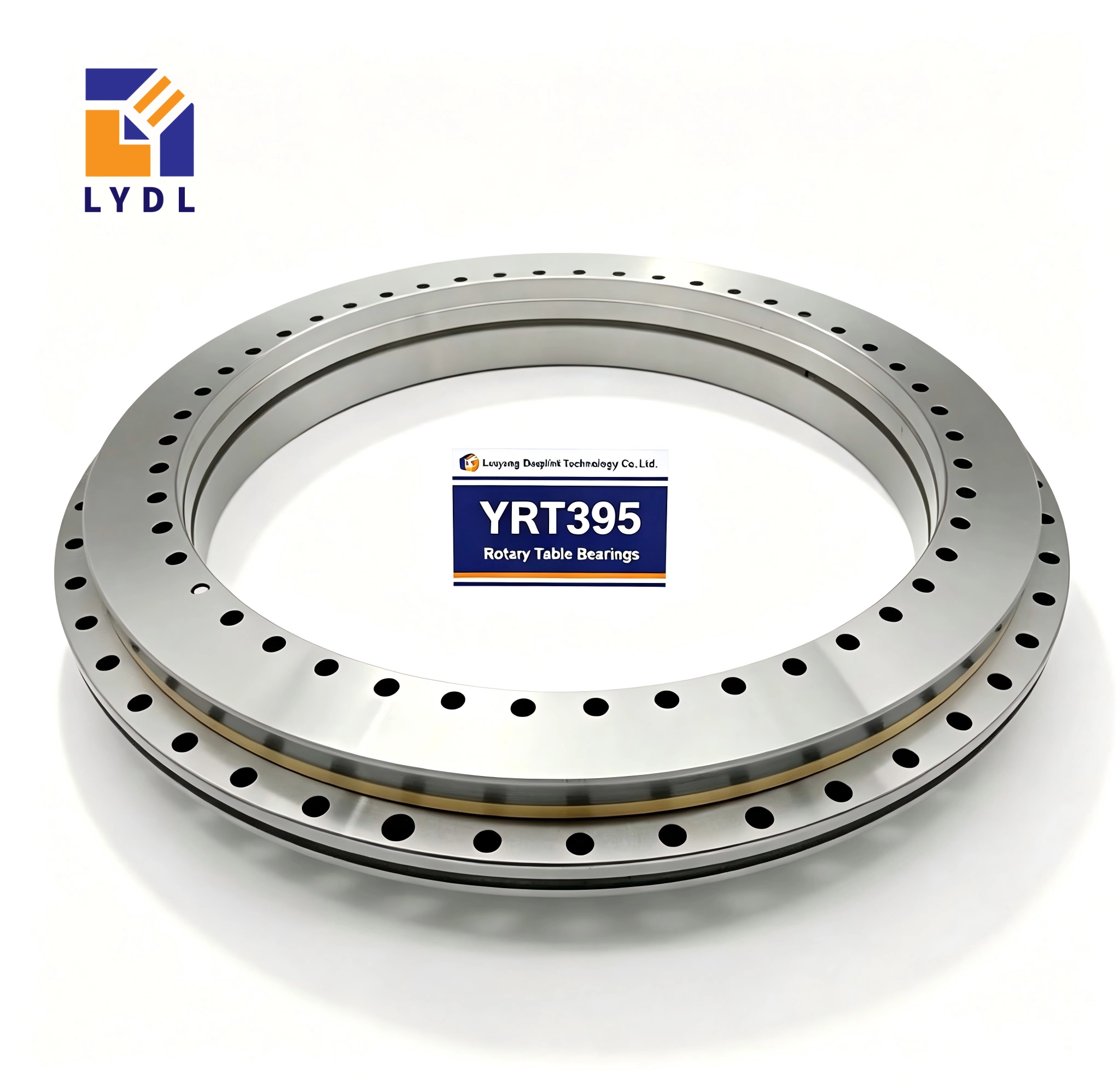


 YRT series construction reference. YRT395 nominal dimensions: 395 × 525 × 65 mm.
 Application illustrations for YRT bearing selection; suitability depends on the complete machine load cycle.
 Inspection and packing illustrations, including cushioned flat packing; these are not YRT395 batch inspection or shipment records.