Specify RB10016 preload from the required loaded displacement, rotational resistance and installed conditions. Do not choose the highest preload simply because the axis needs precision. A useful purchase specification identifies the bearing configuration, the load case, the surrounding fits and support, and the method used to verify the completed bearing position.
For an OEM buyer, the important question is not whether preload is desirable in general. It is whether the proposed configuration provides the required behaviour in the actual machine without consuming excessive drive margin or creating an unsuitable operating condition.
What RB10016 tells you before preload is considered
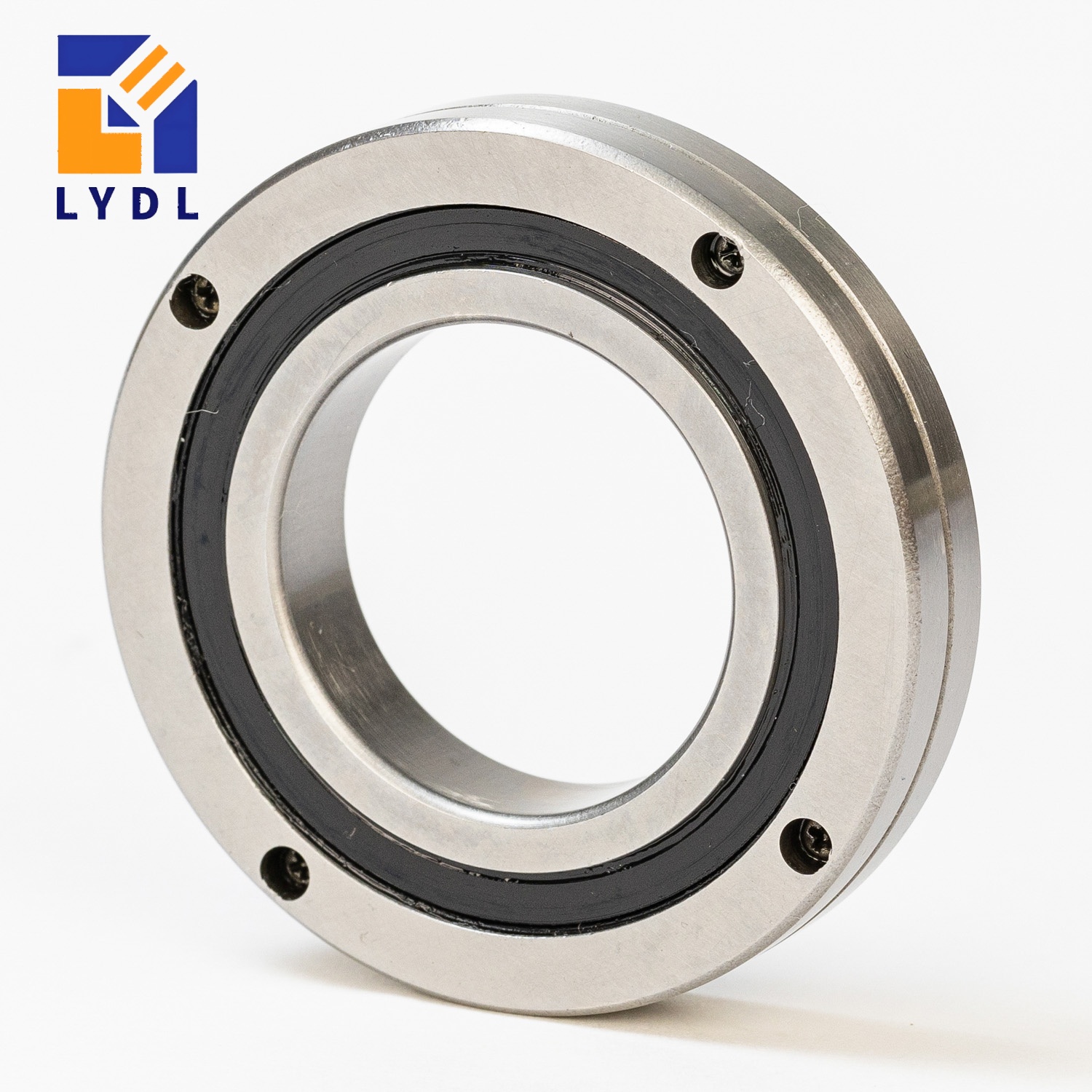
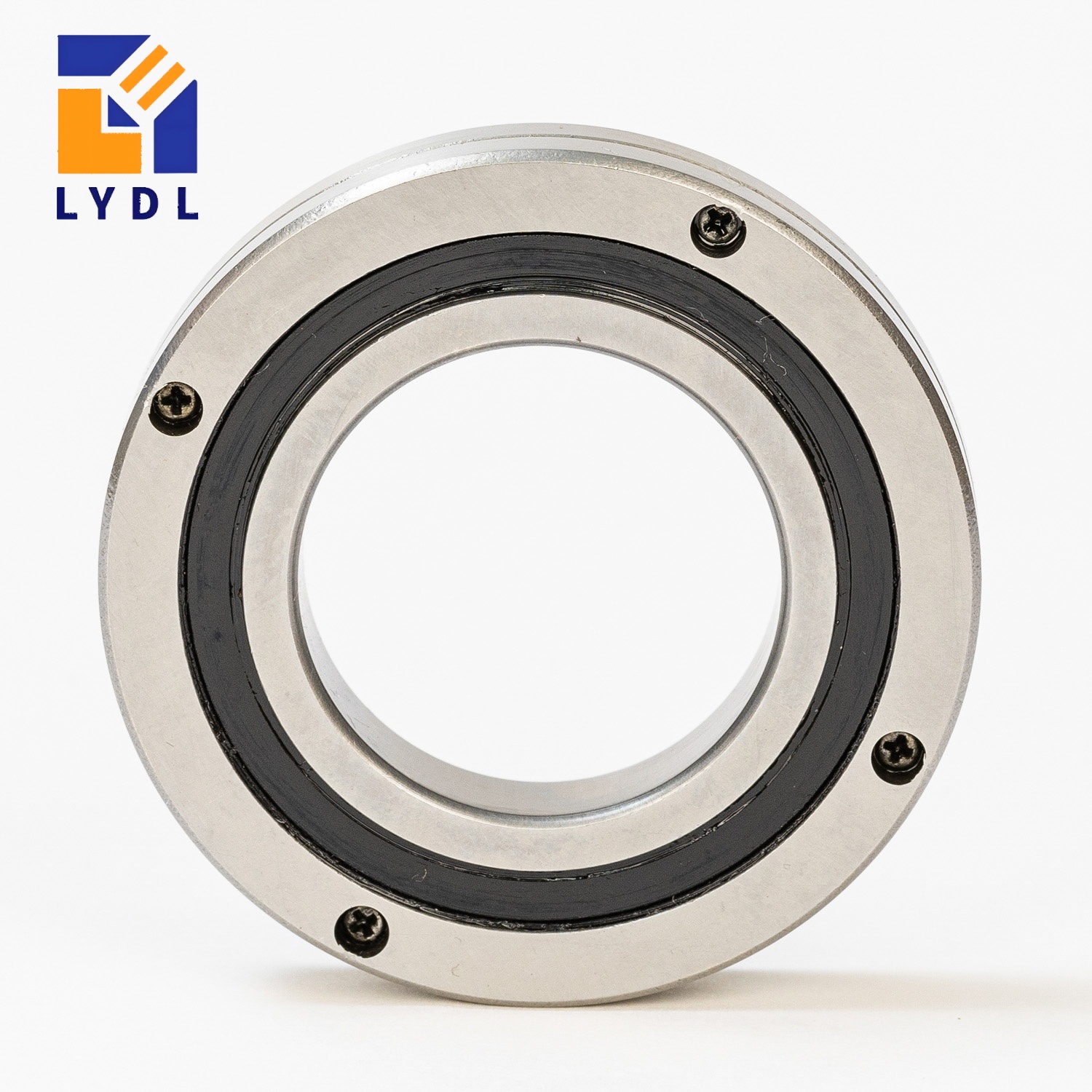
The LYDL RB10016 entry lists a 100 mm bore, 140 mm outside diameter and 16 mm width. These are boundary dimensions for layout work. They do not define the required preload, operating torque or permitted tool movement.
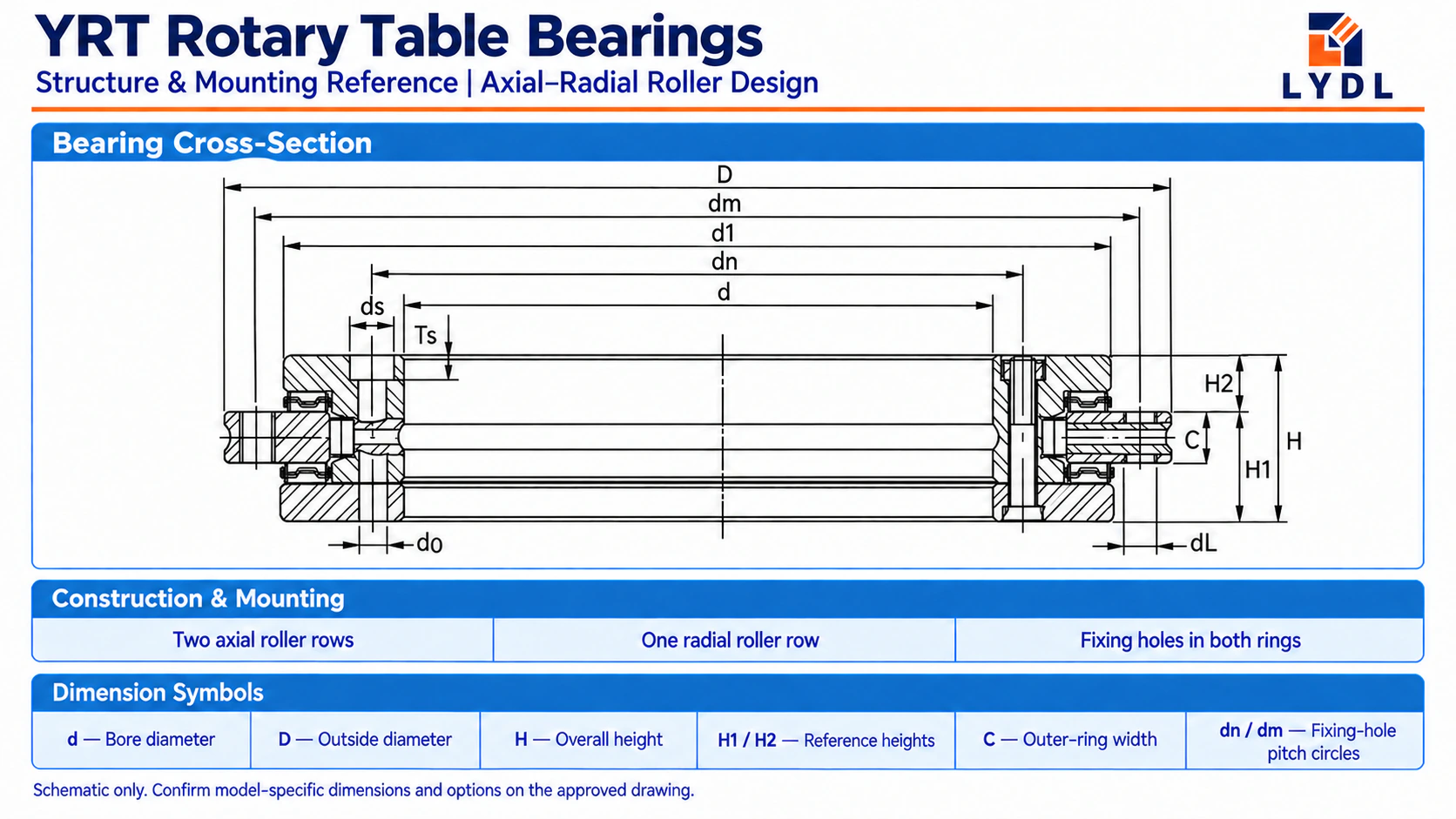
The RB reference construction has a split outer ring and an integral inner ring. Its installation therefore includes the arrangement that locates, supports and retains those rings. Confirm the exact drawing and rotating-ring accuracy requirement for the LYDL supply. Technical reference: THK RB construction
If the surrounding arrangement is still undecided, first review the RB versus RU mounting guide. This article addresses the next purchasing decision: how to define the required installed behaviour once an RB10016 arrangement is being evaluated.
Separate preload from the requirements it is meant to support
Preload is an internal bearing condition. Stiffness, running accuracy, positioning and starting resistance are different properties or system requirements. A preload label should not be used as shorthand for all of them.
| Requirement | State it independently | Why the distinction matters |
|---|---|---|
| Loaded displacement | Permitted movement or tilt at a defined functional point | Support plates, shafts and fixings also deform |
| Starting resistance | Limit and method after a stated dwell | Seals, lubricant, temperature and the fixture affect the result |
| Running resistance | Speed, direction, load and temperature conditions | A low-speed inspection does not define every operating condition |
| Running accuracy | Measured surface, reference and mounted state | Accuracy classification is not a stiffness or torque specification |
| Operating duty | Motion, loads, duration and environment | The bearing is selected for the cycle rather than a single label |
Start with the requirement that limits the design. A small servo axis may be governed by available starting torque. A workholding axis may instead be governed by tool movement under load. Where both matter, the proposal must satisfy both; solving one by leaving the other unspecified creates an incomplete order.
Use a conditional preload review
The following route supports a discussion with the supplier. It does not assign a preload value to every RB10016 application.
If loaded movement is the main concern: define the load direction, application point and allowable displacement. Ask what stiffness information applies to the proposed bearing and support condition. Establish whether the value describes the bearing alone or the complete bearing position.
If drive torque is the main concern: define starting and running resistance separately. Include the motion profile and any accessories that share the drive. Ask for a proposal with applicable resistance information, rather than requesting the lowest available preload without a displacement check.
If both requirements are tight: compare candidate configurations under equivalent conditions. Keep the same load case, mounted state, lubricant, seals and measurement definitions. A comparison using different test conditions cannot isolate the effect of preload.
If the support layout is unresolved: complete that review before treating preload as the remedy. THK's moment-rigidity guidance explains that housing, retaining parts and bolts influence the rigidity of the bearing position. Technical reference: moment rigidity
Include fits and the retaining arrangement
The supplied internal condition and the condition after installation should not be assumed to be identical in every assembly. Fits, retaining components and temperature belong in the application review.
Mark the bearing seats, shoulders, clamping contacts and intended clearances on the section drawing. Identify the material of the shaft and housing and describe the normal operating temperature range. This gives the supplier the information needed to discuss the proposed configuration in its actual surroundings.
THK treats fitting recommendations for RB/RE separately from RU. Its guidance illustrates why a fit should be matched to the reference architecture and conditions rather than copied between series. Use the recommendation approved for the supplied LYDL configuration. Technical reference: crossed roller ring fits
Also identify how the split outer ring will be retained. Uneven support, unsuitable adjacent geometry or an incompletely seated component should be investigated as mounting issues. Increasing the requested preload does not remove the need for an adequate retaining design.
Make the clearance designation unambiguous
A code on a quotation is useful only when its meaning is defined. Ask LYDL to identify the applicable clearance or preload convention and its relationship to the supplied drawing.
Do not transfer a familiar clearance code from another bearing family or supplier without checking its definition. A negative-clearance designation, a preload force and a measured rotational resistance are not interchangeable quantities.
For purchasing, record:
- The complete bearing designation and all agreed suffixes.
- Whether the requirement concerns clearance, preload or a specified installed result.
- The source and revision of the designation convention.
- The reference condition in which the supplied requirement is assessed.
- Which mounted checks remain the machine builder's responsibility.
Avoid adding a numerical preload value merely to make the order look complete. An unsupported value can be less useful than a clearly defined application requirement that still needs supplier confirmation.
Compare two proposals without inventing a performance ranking
Use one requirements sheet for both proposals. The entries below are fields to agree, not RB10016 specifications or measured results.
| Comparison item | Proposal A | Proposal B |
|---|---|---|
| Complete configuration | Drawing and suffixes | Drawing and suffixes |
| Clearance/preload definition | Applicable value or class and reference condition | Equivalent definition |
| Load case | Forces, moments, positions and cycle | Same required case |
| Displacement evidence | Direction, load and included structure | Comparable scope |
| Resistance evidence | Starting/running method and conditions | Comparable method and conditions |
| Installation | Fits, support and retention | Proposed differences identified |
| Acceptance | Agreed measurements and limits | Same functional requirements |
If one proposal has useful resistance data but no relevant displacement information, mark the gap. Do not interpret missing data as evidence that its stiffness is better or worse.
Define acceptance before the sample arrives
A sample review should connect the incoming bearing with the installed axis. Agree which observations are made in a reference fixture and which are made after mounting.
For resistance, define instrument, speed or travel, direction, lubricant, temperature, external load and dwell. For runout, define the reference and measured feature. For loaded displacement, define the force application and the functional measurement point.
The result is a set of checks that answer different questions. Passing a runout check alone does not demonstrate compliance with the displacement or torque requirement.
Keep the sample's identification and assembly revision with the record. When a configuration is changed, retain the earlier result and identify the change; otherwise, a successful prototype can be difficult to reproduce in production.
Common purchasing questions
Is a preloaded RB10016 always better than a clearance version?
The appropriate condition depends on the required displacement, rotation and operating duty. Specify those requirements and evaluate the proposed configuration against them.
Can the mounting screws be used to adjust internal preload?
Do not use mounting-bolt tightening as an improvised internal-preload adjustment. Follow the assembly and joint specification for the supplied bearing, and discuss an unsuitable installed result with the supplier.
Does a higher accuracy grade guarantee smaller loaded deflection?
Running accuracy and loaded deflection are different requirements. Identify the required grade and the displacement limit separately, with their respective verification methods.
Prepare an RB10016 enquiry for LYDL
Send the assembly section, rotating ring, forces and moments with their application points, motion cycle and temperature conditions. State the permitted loaded displacement, available drive margin and the inspection records you require.
Review the LYDL RB series and identify RB10016 explicitly. Contact LYDL with the preload review requirements so the proposed configuration, mounting arrangement and acceptance scope can be discussed as one technical specification.