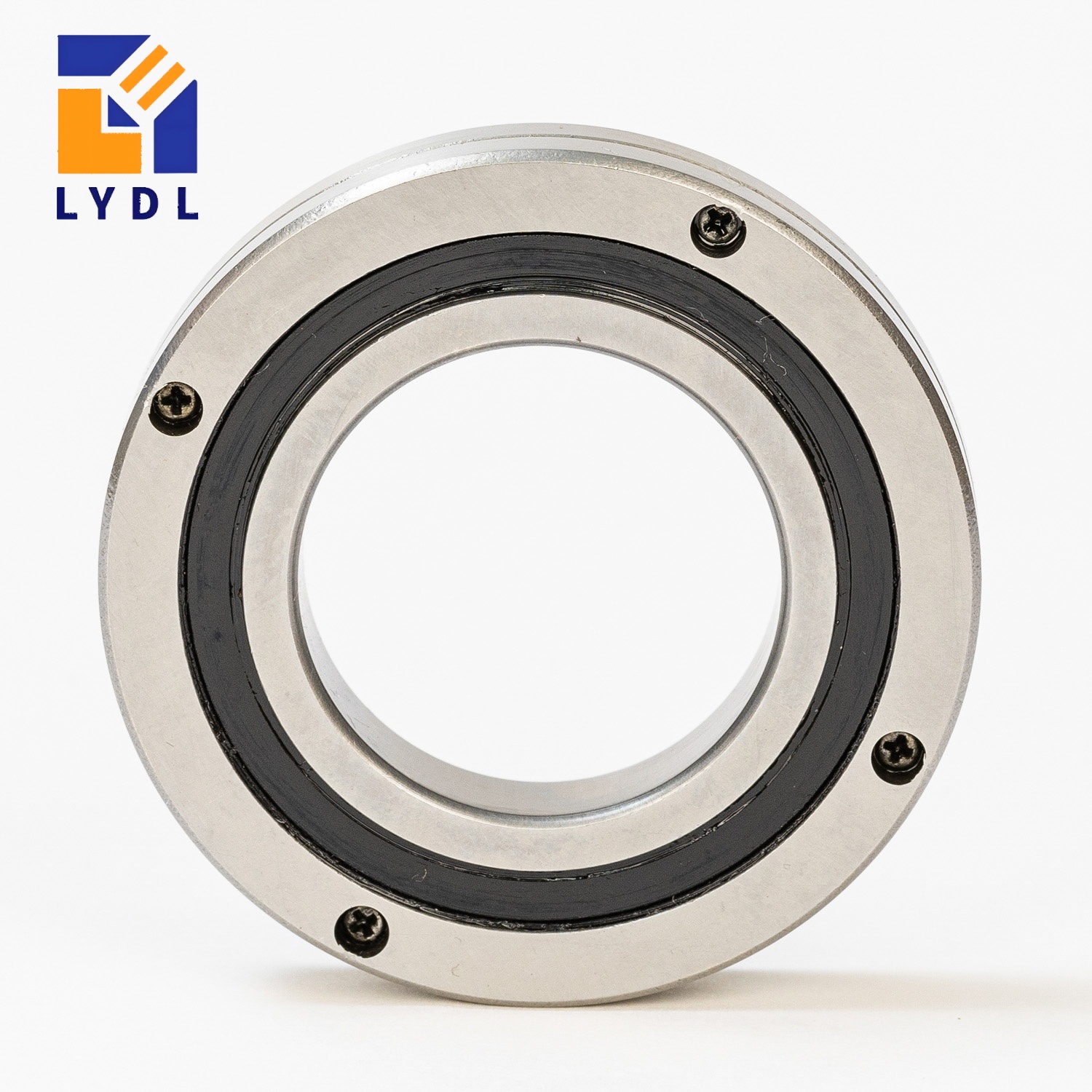
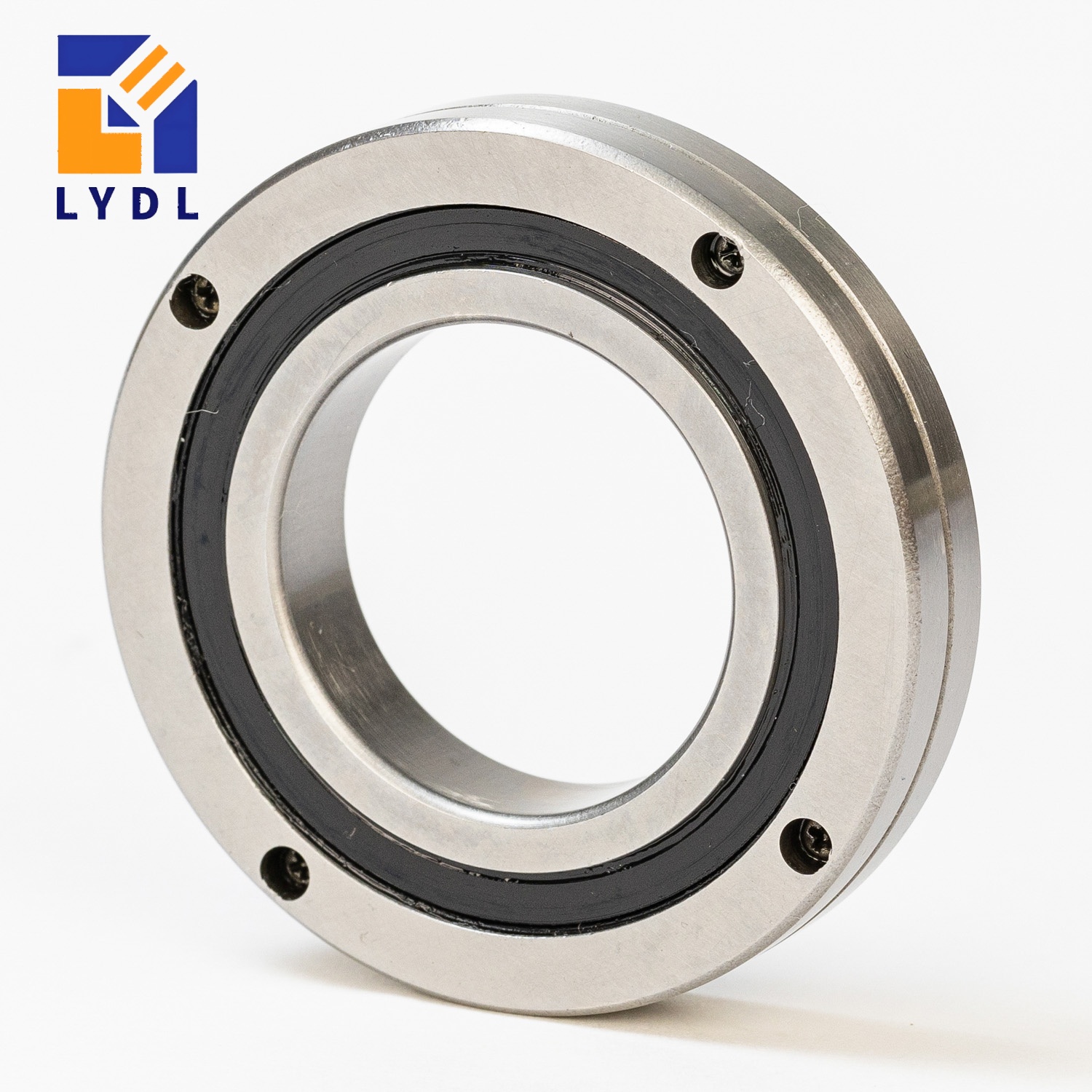
The RB10016 cross roller bearing has a 100 mm bore, 140 mm outside diameter and 16 mm width, providing a large through-bore within a compact 20 mm radial section. Its crossed cylindrical roller arrangement supports radial loads, axial loads in both directions and overturning moments.
Featuring an integrated inner ring and split outer ring, RB10016 is suitable for precision rotary mechanisms requiring high rigidity, stable rotational accuracy and space-efficient installation. Typical applications include industrial robot joints, rotary actuators, CNC indexing tables, inspection equipment, optical systems and automated positioning mechanisms.
Precision grade, clearance, preload, sealing and lubrication options can be confirmed according to the application and approved mounting drawing.
RB10016 Cross Roller Bearing Overview
The RB10016 cross roller bearing is a compact precision bearing with a 100 mm bore, 140 mm outside diameter and 16 mm width. Its relatively large through-bore and 20 mm radial cross-section make it suitable for rotary mechanisms that require cable routing, shaft access or component integration through the centre of the bearing.
Cylindrical rollers are arranged alternately at 90 degrees between the inner and outer raceways. This crossed arrangement enables one bearing to support radial loads, axial loads in both directions and overturning moment loads.
The RB10016 uses an integrated inner ring and a split outer ring. This configuration is commonly selected for applications requiring accurate inner-ring rotation, high rigidity and compact installation.
Additional bore sizes are available in our RB Series Cross Roller Bearings range.
GCr15, GCr15SiMn or 100Cr6, subject to specification
*The shoulder dimensions are catalogue references. Final shaft, housing and flange dimensions must follow the approved LYDL drawing supplied with the quotation or order.
Basic load ratings are reference values used for bearing selection and life calculations. They are not maximum permissible application loads. Radial, axial and moment loads must be evaluated as a combined operating load with appropriate life and static safety factors.
Structure and Operating Principle
The rollers inside the RB10016 are positioned so that the axes of adjacent rollers cross at right angles. Each roller makes line contact with its raceway, helping limit elastic deformation under load.
This arrangement allows the bearing to carry:
Radial loads
Axial loads in both directions
Overturning moment loads
Combined radial, axial and moment loads
The split outer ring facilitates assembly of the rollers and separators, while the integrated inner ring provides a continuous raceway and stable rotational accuracy.
Outer-ring retaining screws are generally used to prevent separation during handling and installation. They must not be considered structural mounting fasteners unless the approved product drawing specifically states otherwise.
Key Advantages of RB10016
Large 100 mm Through-Bore
The 100 mm bore provides space for drive shafts, electrical cables, pneumatic lines, optical components or other machine elements passing through the rotary axis.
Compact 16 mm Width
RB10016 provides a 100 mm bore while maintaining a width of only 16 mm. This is beneficial for mechanisms with limited axial installation space.
Combined-Load Capability
One bearing can support radial, bidirectional axial and overturning moment loads, potentially simplifying the surrounding bearing arrangement.
High Moment Rigidity
The crossed roller geometry resists tilting deformation and supports applications requiring controlled angular displacement and stable positioning.
Lower Mass Than RB10020
RB10016 weighs approximately 0.83 kg, compared with approximately 1.45 kg for RB10020. It is therefore suitable when reduced mass and a smaller housing envelope are more important than the additional capacity of the wider model.
Configurable Precision
Accuracy, clearance, preload, sealing and lubrication can be specified according to positioning accuracy, running torque, speed and environmental requirements.
Typical RB10016 Applications
RB10016 can be considered for:
Industrial robot joints
Robot base and waist axes
Precision rotary actuators
CNC rotary and indexing tables
Machine-tool positioning mechanisms
Optical inspection systems
Semiconductor handling equipment
Medical and laboratory equipment
Measuring instruments
Automated assembly systems
Direct-drive rotary mechanisms
Compact cable-through rotary axes
Final selection must consider the actual load spectrum, overturning moment, speed, duty cycle, required life, mounting rigidity, operating temperature, lubrication and acceptable running torque.
Choose RB10016 when the application requires a 100 mm through-bore, 16 mm width and lower mass.
Choose RB10020 when the available housing space allows a 150 mm outside diameter and 20 mm width, and the application benefits from its larger bearing section and slightly higher catalogue load ratings.
For related sizes, see the RB8016 Cross Roller Bearing and RB12025 Cross Roller Bearing.
RB10016 Common Configurations and Suffix Guide
Bearing suffixes are manufacturer-specific. THK, IKO, NSK and other manufacturers do not necessarily use identical codes for seals, clearance, preload or accuracy.
The following RB10016 designations should be treated as enquiry examples. The final LYDL order code and numerical specification must be confirmed in the quotation.
Both-side seals with controlled negative clearance or preload
Preload and running torque
RB10016UUC1
Both-side seals with specified C1 clearance
Manufacturer-specific limits
RB10016UUP5
Both-side seals with P5 accuracy
Controlled surfaces and inspection limits
RB10016UUP4
Both-side seals with P4 accuracy
Runout and dimensional requirements
RB10016UUCC0P4
Both-side seals, controlled preload and P4 accuracy
Complete approved specification
RB10016UUCC0P2
Both-side seals, controlled preload and P2 accuracy
Technical review and manufacturing availability
Seal Suffixes
No suffix: Generally indicates an open configuration, but the actual supplied condition must be confirmed.
U: Commonly indicates a seal fitted on one side. The required side must be specified.
UU: Commonly indicates seals fitted on both sides.
Clearance and Preload Suffixes
CC0: Used in the THK designation system for controlled negative clearance or preload.
C0: A specified clearance category. In the THK system, C0 indicates positive clearance and must not automatically be interpreted as zero clearance.
C1: A manufacturer-specific positive-clearance category.
Clearance and preload affect rigidity, starting torque, running torque, temperature rise and rotational behaviour. For precision orders, the numerical clearance or preload range should be included in the technical agreement.
Accuracy Suffixes
P6: Accuracy class 6
P5: Accuracy class 5
P4: Accuracy class 4
P2: Accuracy class 2
PE5, PE4 or PE2: THK-style designations combining rotational and dimensional accuracy requirements
A higher accuracy grade should only be selected when it is supported by appropriate shaft, housing, flange and assembly accuracy.
CRB10016 and NRXT10016 should not be entered automatically as equivalent model numbers because direct standard catalogue counterparts have not been confirmed.
IKO and NSK manufacture crossed roller bearing ranges, but their nearest models may use different outside diameters, widths, internal structures, clearances and load ratings. For example, a bearing with a 100 mm bore is not necessarily interchangeable with RB10016.
When evaluating a replacement, compare:
Complete model number and suffixes
Bore, outside diameter and width
Inner and outer ring structure
Shoulder and chamfer dimensions
Roller or separator arrangement
Dynamic and static load ratings
Clearance or preload
Rotational and dimensional accuracy
Sealing and lubrication
Running torque
Permissible speed
Mounting and clamping method
Brand references are provided only for technical identification and dimensional comparison, not as a claim of universal interchangeability.
Material, Sealing and Lubrication
Depending on the confirmed specification, bearing-steel options can include GCr15, GCr15SiMn or 100Cr6.
Open bearings require appropriate external sealing and lubrication. A sealed configuration offers additional protection against contamination and grease leakage but may increase starting and running torque.
Lubricant selection should consider:
Rotational speed
Radial, axial and moment loads
Duty cycle
Operating temperature
Required running torque
Environmental contamination
Relubrication interval
Compatibility with surrounding components
Greases with unknown base-oil or thickener compatibility should not be mixed.
Inspection and Quality Control
Inspection requirements should be agreed before production. Depending on the order specification, LYDL can discuss an inspection scope including:
Bore and outside-diameter measurement
Bearing width inspection
Dimensional and rotational runout
Radial clearance or preload verification
Starting and running torque
Rotation smoothness
Raceway and surface-condition inspection
Hardness verification
Cleanliness and appearance inspection
Laser marking verification
Final packaging inspection
Material certificates, inspection reports or additional documentation should be requested before order confirmation.
Installation Recommendations
To maintain the accuracy and service life of RB10016:
Clean the bearing, shaft, housing, flange and mounting surfaces.
Remove burrs, contamination and raised edges from all mating surfaces.
Confirm shaft and housing tolerances against the approved drawing.
Apply installation force only to the ring being fitted.
Never transmit mounting force through the rollers.
Do not strike the bearing directly.
Support the split outer ring during handling and installation.
Tighten flange bolts gradually in a diagonal sequence.
Apply uniform clamping force around the complete circumference.
Check running torque and rotational smoothness after mounting.
Protect open bearings against contamination and lubricant loss.
Measure final runout after the complete rotary assembly has been installed.
Housing rigidity, flange thickness, bolt arrangement and mounting-surface accuracy can influence the installed rigidity and runout of the bearing.
RB10016 Selection Information Required
For accurate selection, please provide:
Radial load
Axial load
Overturning moment
Maximum and continuous speed
Operating cycle
Required service life
Required rotational accuracy
Permissible starting and running torque
Clearance or preload requirement
Shaft and housing dimensions
Operating temperature
Lubrication and sealing requirements
Quantity and delivery destination
Providing these conditions is more reliable than selecting the bearing only by bore diameter and nominal load rating.
Why Source RB10016 From LYDL?
LYDL supplies precision bearings for industrial robots, machine tools, automation systems, measuring equipment and other industrial applications. Luoyang Deeplink Technology Co., Ltd. integrates machining, grinding, assembly, inspection, packaging and international order support.
Available project support includes:
Standard RB-series production
Accuracy-grade selection
Clearance and preload control
Seal and grease configuration
Laser marking
Dimensional inspection
Rotational-accuracy inspection
Application-based selection support
Export packaging
OEM and customized bearing solutions
RB10016 Frequently Asked Questions
What are the dimensions of RB10016?
RB10016 has a 100 mm bore, 140 mm outside diameter and 16 mm width.
What are the RB10016 load ratings?
Its basic dynamic radial load rating is 31.7 kN, and its basic static radial load rating is 48.6 kN. These are catalogue ratings used for bearing calculations, not direct maximum allowable operating loads.
What is the difference between RB10016 and RB10020?
Both bearings have a 100 mm bore. RB10016 measures 100 × 140 × 16 mm and weighs approximately 0.83 kg. RB10020 measures 100 × 150 × 20 mm and weighs approximately 1.45 kg. RB10016 is more compact, while RB10020 has a larger cross-section and slightly higher catalogue load ratings.
What does RB10016UU mean?
UU commonly indicates seals fitted on both sides. Seal material, grease fill and environmental suitability should still be confirmed.
What does RB10016UUCC0P4 mean?
It is commonly interpreted as RB10016 with seals on both sides, controlled negative clearance or preload, and P4 accuracy. The numerical preload, running torque and inspection requirements must be agreed before production.
Is RB10016 the same as CRB10016?
A direct IKO CRB10016 standard counterpart has not been confirmed. Do not use this designation as an automatic interchange reference without an official drawing and catalogue confirmation.
Is NRXT10016 a direct replacement for RB10016?
A direct NSK NRXT10016 standard counterpart has not been confirmed. The NSK model number should not be used without dimensional and technical verification.
Can LYDL provide P4 or P2 RB10016 bearings?
P4 and P2 requirements can be reviewed according to the application, controlled surfaces, runout limits, preload, running torque and inspection agreement. Availability must be confirmed before ordering.
How can I obtain an RB10016 price?
Please provide the quantity, required accuracy, clearance or preload, seal arrangement, lubrication, inspection documents and delivery destination. These requirements can affect price and production time.
Request an RB10016 Quotation
Send the complete bearing designation, mounting drawing and operating conditions for technical confirmation and quotation. Email:sales@luoyangdeeplink.comPhone / WhatsApp / WeChat: +86 180 3700 3779 Website:www.lydl-bearing.com
THK, IKO, NSK and their respective product designations are trademarks or identifiers of their respective owners. They are mentioned only for technical identification and preliminary comparison.
LYDL and Luoyang Deeplink Technology Co., Ltd. are independent and are not affiliated with, authorized by or endorsed by these manufacturers.
Final specifications, interchangeability, load calculations and installation dimensions must be confirmed using the approved LYDL drawing and the customer’s actual operating conditions.




 Final selection must consider the actual load spectrum, overturning moment, speed, duty cycle, required life, mounting rigidity, operating temperature, lubrication and acceptable running torque.
