

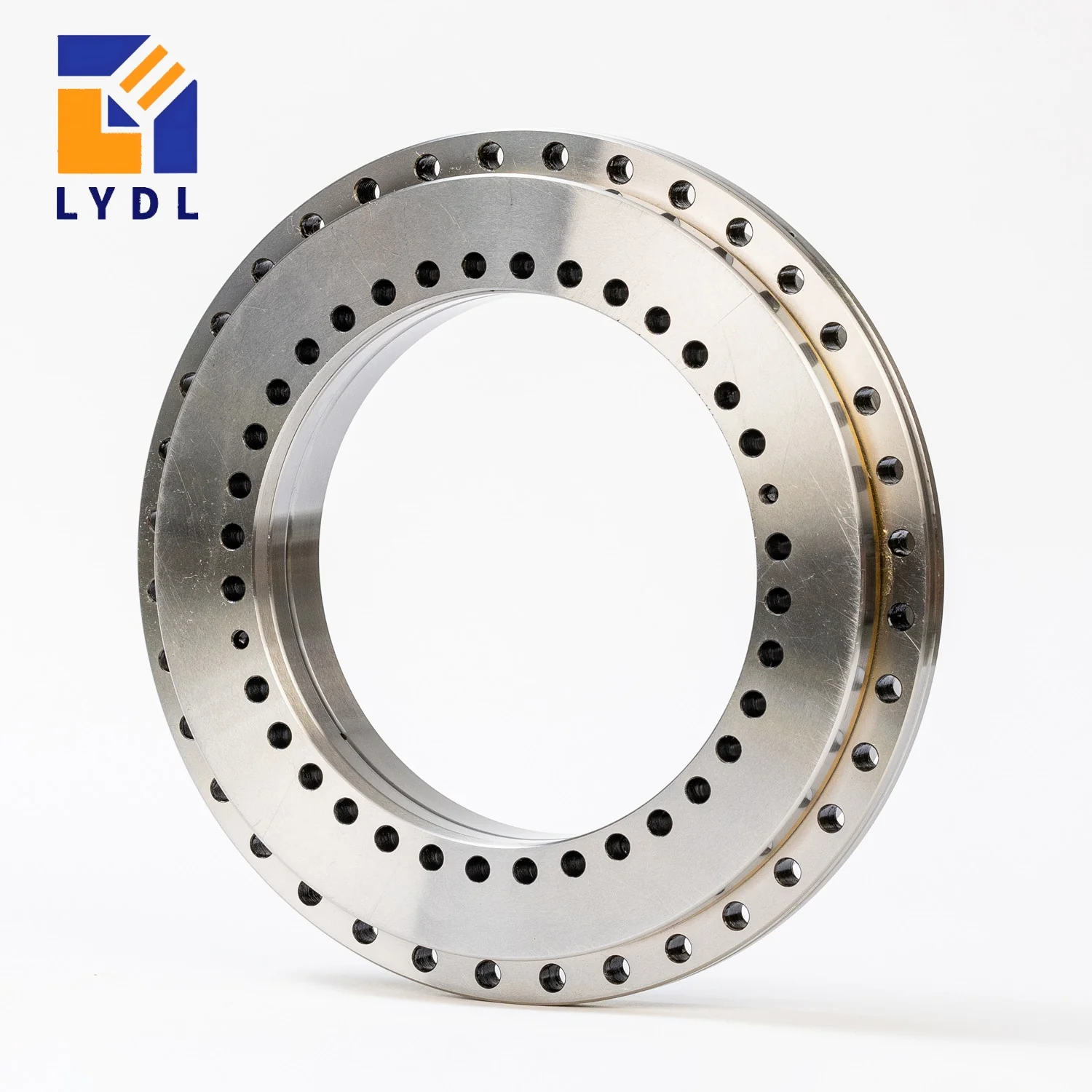
The LYDL ZKLDF100 rotary table bearing has a 100 mm bore, 185 mm outside diameter and 38 mm overall height. Its double-row angular-contact ball arrangement is intended for rotary-axis projects that combine axial loading, radial guidance and overturning moment within one bearing position. This is the smallest model in the ten-size LYDL ZKLDF selection presented here. Its particular design question is how to preserve a useful central opening without allowing the surrounding fixture, drive and mounting plate to consume the available space.
Compare the complete range in the ZKLDF series selection guide. The dimensions below reproduce LYDL’s published selection data; the accepted drawing defines the delivered configuration, tolerances and inspection requirements.
| Parameter | Symbol | Value | Unit |
|---|---|---|---|
| Bore diameter | d | 100 | mm |
| Outside diameter | D | 185 | mm |
| Overall height | H | 38 | mm |
| Ring profile reference | H1 | 25 | mm |
| Inner fixing pitch circle | J | 112 | mm |
| Outer fixing pitch circle | J1 | 170 | mm |
| Inner fixing holes | nI × d1 | 16 × Ø5.6 | quantity × mm |
| Outer fixing holes | nA × d3 | 15 × Ø5.6 | quantity × mm |
| Inner counterbore diameter | d2 | 10 | mm |
| Counterbore depth | a | 5.4 | mm |
| Extraction thread reference | G | M5 | metric |
| Extraction positions | — | 3 | quantity |
| Retaining screw reference | — | 2 | quantity |
| Published mass reference | m | 4.5 | kg |
Dimensions and mass: LYDL series table. Symbols follow its structure diagram. Mass is a reference; drawing approval defines the supplied unit. Load ratings, limiting speed, preload and numerical tolerances require configuration-specific confirmation.
The 100 mm opening identifies the bearing bore, rather than a guaranteed free passage after assembly. A hollow shaft, cable protection tube, rotary union or internal sleeve reduces the usable diameter. Place these components into the same section drawing before choosing a slip ring or routing a cable bundle. A nominally suitable bore can otherwise become inaccessible when the flange and its fasteners are added.
The radial section calculated from the boundary dimensions is 42.5 mm: half the difference between 185 and 100 mm. This geometric value helps with an initial layout; it is not the available width of a support shoulder. Ring steps, bolt seats and adjacent clearances must be taken from the detailed profile. The 25 mm H1 reference also describes a particular ring feature, so it must not replace the 38 mm overall height in a stack-up.
ZKLDF100 lists 16 inner-ring fixing holes and 15 outer-ring fixing holes, on 112 and 170 mm pitch circles respectively. Those quantities should be copied directly into the interface review. Do not turn both rings into a symmetrical sixteen-hole pattern simply because that arrangement is easier to model. Auxiliary features and the angular starting position need their own drawing references.
Check the tool approach at every screw position while the surrounding motor, encoder support and protective cover are shown. An installation can fit inside the 185 mm envelope but still prevent a socket from reaching a recessed head. The published 5.6 mm fixing-hole diameter and 10 mm counterbore diameter are interface data, not permission to choose a screw torque from diameter alone.
For assembly, prepare clean, continuous locating surfaces and measure their relationship to the axis datum. Bring the rings into contact without using the screws to pull a visibly tilted assembly flat. Tighten progressively in the sequence specified for the accepted assembly. A useful inspection record separates the unloaded bearing reading from the reading after the final flange and fixture are fitted.
| Model | Bore d | Outside D | Height H |
|---|---|---|---|
| ZKLDF100 | 100 | 185 | 38 |
| ZKLDF120 | 120 | 210 | 40 |
| ZKLDF150 | 150 | 240 | 40 |
The move to ZKLDF120 enlarges the bore by 20 mm, the outside diameter by 25 mm and the height by 2 mm. That is a packaging change for the shaft, housing and cover, rather than a minor label change. Choose the larger size when the central services or support geometry need it; establish capacity from the actual load case separately.
The published YRT100 roller-bearing page describes the same nominal boundary envelope. Its cylindrical-roller arrangement changes the engineering comparison. Matching d, D and H does not establish identical friction, stiffness, preload or fixing details. The YRT family guide is useful when the design team is choosing the bearing concept before releasing the surrounding parts.
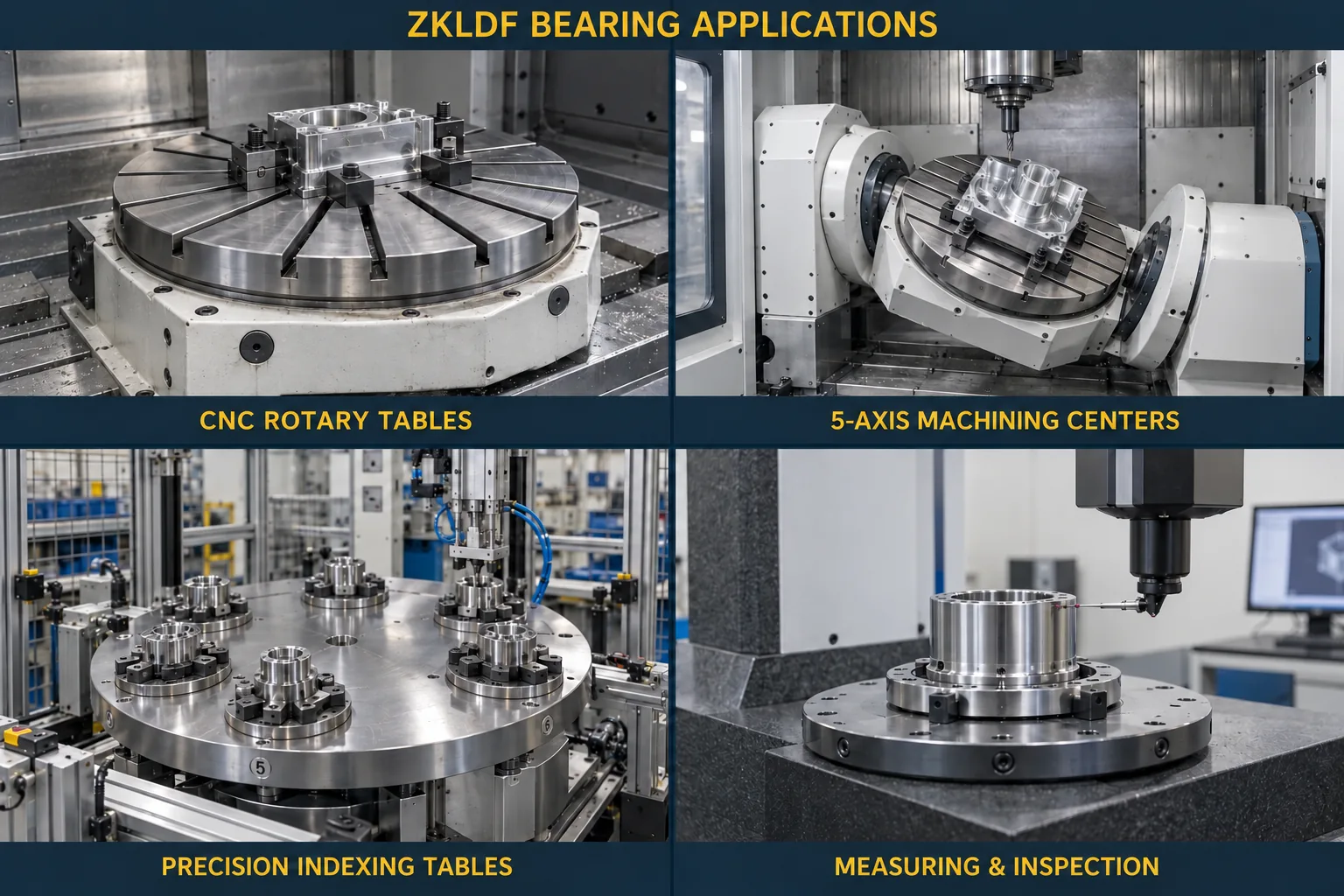
One candidate use is an inspection fixture carrying a small workpiece while camera, illumination or sensor services pass through the axis. The bearing provides the mechanical rotary support; the encoder and calibration method determine how angle is measured. A precise bearing does not remove errors caused by an eccentric fixture datum or an incorrectly aligned sensor.
For this arrangement, document the workpiece centre of gravity, the distance from that point to the bearing plane and the range of fixture orientations. Evaluate the moment created by an offset workpiece even when its weight seems modest. Also reserve space for cable bend radius throughout the rotation range. These are design-review examples, not claims that the pictured machines contain ZKLDF100 bearings.
Record operating speed as a cycle: acceleration, steady rotation, reversals and rest periods. A short inspection move followed by a long dwell has different thermal behaviour from a continuously spinning fixture. Ask for the lubrication and permissible operating conditions of the actual supplied bearing, rather than importing a maximum speed from another manufacturer’s catalogue.
Establish an initial turning-torque baseline after the intended mounting sequence. Then repeat the observation with cables connected and protective seals in place. A rise can originate in the cable path, external seal or mounting distortion, so separating those stages makes investigation more useful. Select P5, P4 or P2 as an enquiry requirement and define the associated measured features on the order drawing; the model code alone does not specify the inspection limits.
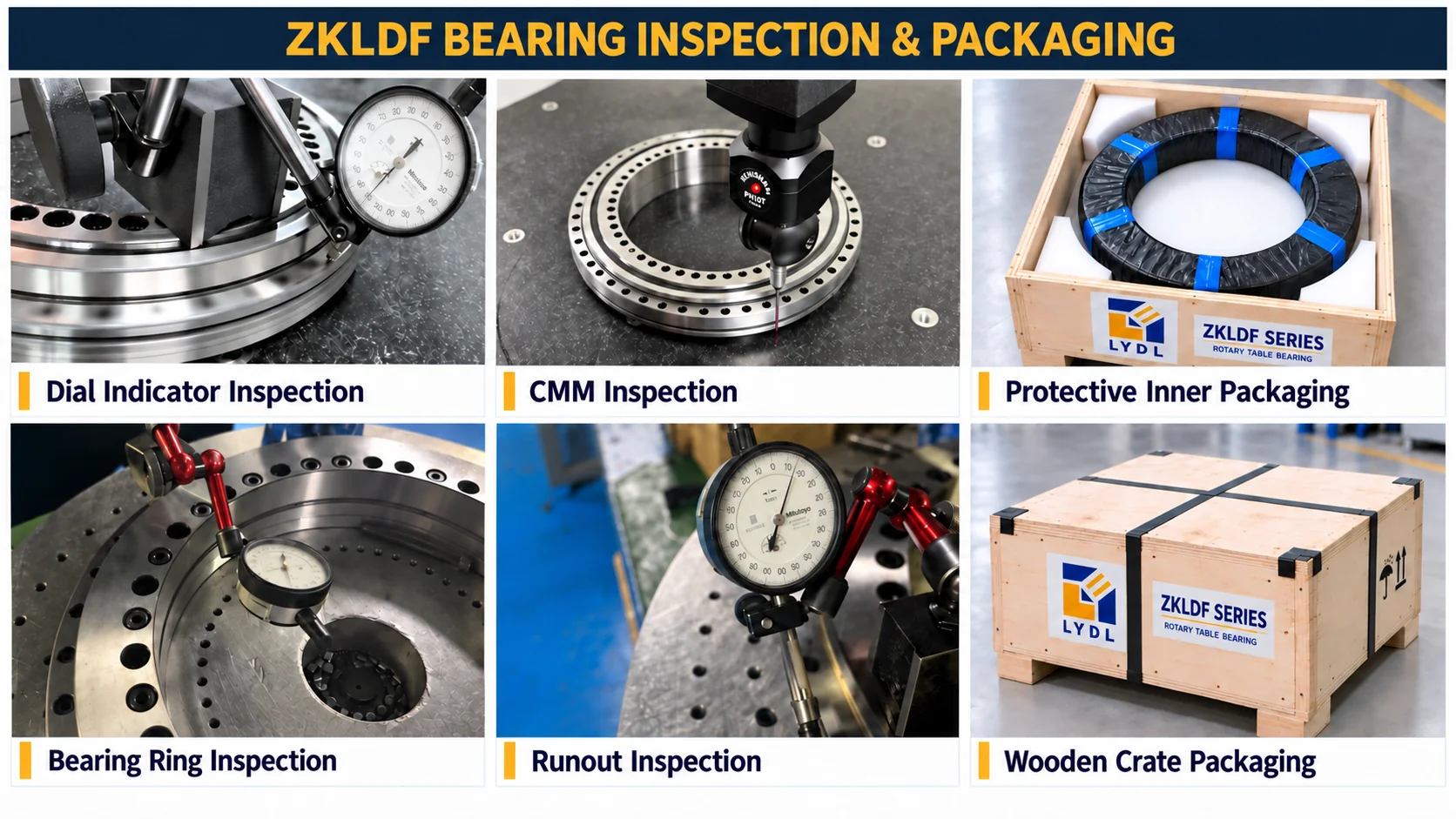
For ZKLDF100, request identification against the complete designation, bore and outside dimensions, mounting features and agreed running-accuracy measurements. Specify the datum setup and report format before manufacture. A table of nominal dimensions supports purchasing, while a traceable inspection record addresses whether the particular supplied assembly meets its accepted limits.
The series illustration below shows inspection and packing concepts. It does not certify a completed ZKLDF100 test. Agree corrosion protection, contact-surface covering and carton or case arrangements for the transport route. Keep loose accessories from touching the finished rings. On receipt, inspect the package, confirm the item marking and retain its identification with the machine build record.
It is the nominal bearing bore. The installed shaft wall, union mounting flange and any protection sleeve occupy additional space. Send a section of the complete rotating passage so the clear opening can be checked through every component.
The LYDL selection lists sixteen inner and fifteen outer fixing holes. Preserve those quantities and verify the full angular layout on the model drawing. Counting visible holes in the shared photograph cannot establish the ZKLDF100 drilling pattern.
Its 120 × 210 × 40 mm envelope differs in all three principal dimensions. A change requires review of the shaft, housing, support faces, bolt circles and axial stack; it is not a direct size substitution.
No. Bearing runout is one contributor. Workholding concentricity, encoder installation, axis alignment and measurement calibration must also be evaluated against the inspection task and the permitted error at the workpiece.
Include quantity, installation orientation, loading diagram, rotation cycle and desired precision. Add the shaft and housing sections, available fixing access and delivery destination. Identify any existing part that must remain compatible so the review addresses that interface explicitly.
Contact LYDL with the ZKLDF100 designation and your assembly information. The rotary table bearing overview provides a route back to the wider family. Structure terminology can also be checked in Schaeffler TPI 120; external catalogue performance is not a LYDL acceptance specification.
Email: sales@luoyangdeeplink.com. Browse the ZKLDF product category for published family entries.