


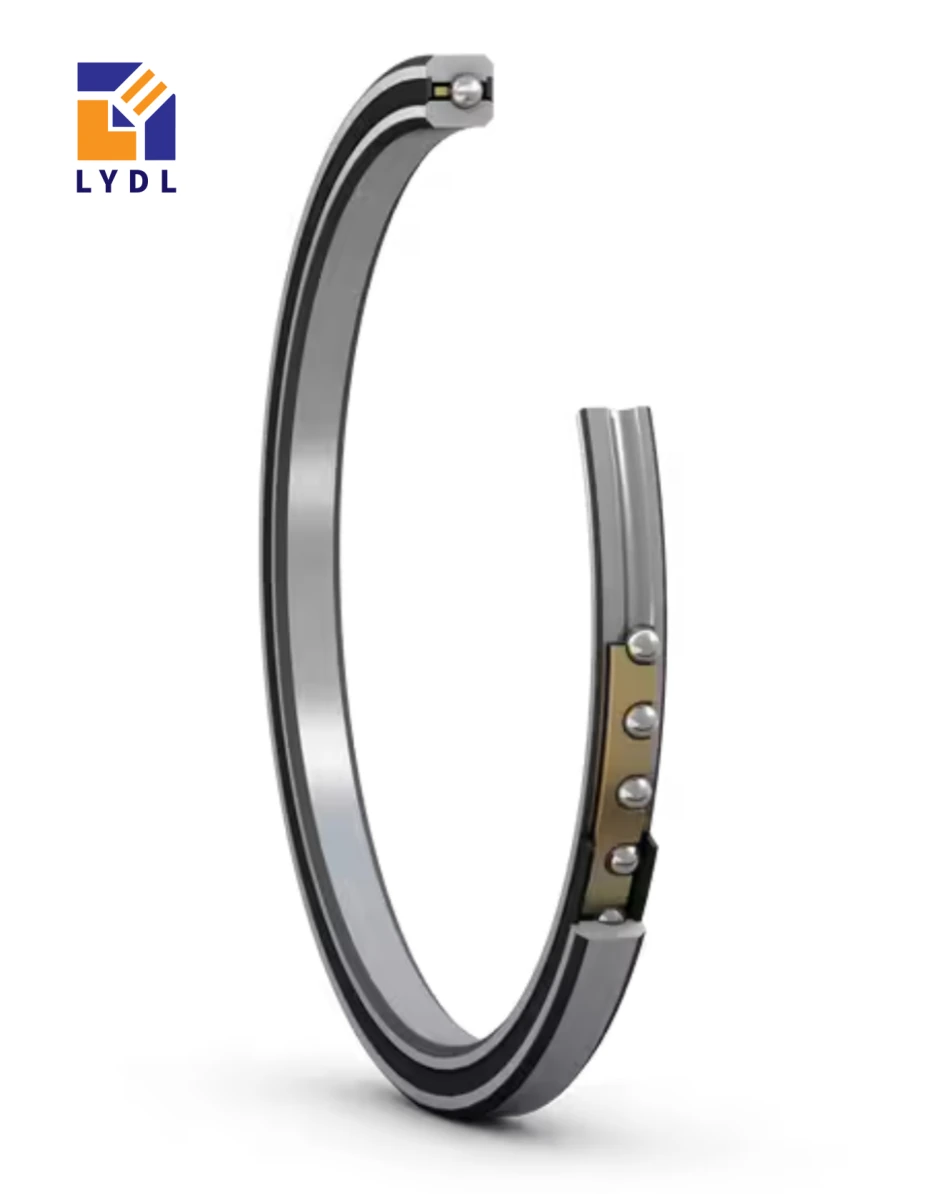

K10013CP0 corresponds to the reference identity for LYDL PC10013, an open Type C bearing measuring 100 × 126 × 13 mm. This product is useful to evaluate when a 100 mm shaft seat can accommodate more section space. The key comparison is not simply the largest load number in a catalog: the calculation method, bearing envelope and supported installation must all be understood. The data below separates those issues so engineers and buyers can compare quotations consistently.
| Parameter | LYDL PC10013 |
|---|---|
| Bore diameter, d | 100 mm |
| Outside diameter, D | 126 mm |
| Axial width, B | 13 mm |
| Radial cross section | 13 mm |
| Design | Open radial contact, Type C |
| Approximate catalog mass | 0.32 kg |
| KAYDON comparison model | K10013CP0 |
LYDL places this model in the 13 mm open group of its LYDL metric radial-contact series.
The KAYDON reference table publishes two dynamic radial figures for the same model. One follows the KAYDON rating method, while the other is an ISO-based comparison figure. They describe different rating bases, not two selectable grades of PC10013. A larger number in the ISO column does not indicate that another supplier has upgraded the physical bearing.
When comparing quotations, ask which rating basis is being used and whether the value belongs to the offered product or a reference brand. Keep the same method throughout a life comparison. Do not enter an ISO comparison value into a calculation whose other assumptions were established for a different method without engineering justification.
Static and dynamic values also answer different questions. A dynamic rating is not a maximum load for every cycle, and a static rating does not predict running life. The actual reaction load, duty and ring support must be considered before translating catalog values into a machine selection.
Discuss the PC10013 drawing and operating conditions.
KAYDON reference data — K10013CP0. These published figures are not LYDL test results or a certified LYDL load rating.
| Radial rating basis | Reference value |
|---|---|
| Dynamic, KAYDON method | 9,522 N |
| Dynamic, ISO method | 15,328 N |
| Static | 16,485 N |
The catalog identifies ISO 281:1990 as the ISO calculation basis, for comparison only. Keep the two dynamic ratings separate. Dynamic values use one million revolutions of L10 life; static values assume rigid shaft and housing support. The LYDL table labels force capacities in kg, so those entries have not been relabeled as N.
No model-specific operating speed is quoted from the open reference table. Obtain LYDL limits for the selected lubricant, internal setting and actual duty before approving operation.
A designer reviewing PC10008 may have room to consider PC10013 instead. At the same nominal bore, outside diameter increases from 116 to 126 mm and width from 8 to 13 mm. These changes require a revised housing bore, shoulder arrangement and axial stack.
The reference tables give different radial capacities, but no stiffness value is supplied here for the complete LYDL assembly. Assess deflection and seat support separately. The thicker envelope is a candidate for a revised design, not a direct drop-in upgrade that can be approved from the bore dimension alone.

Mark which components change when moving to the 13 mm section. Check the housing wall remaining outside the larger bore and whether the wider bearing affects retaining features, adjacent parts or the shaft's axial position. Review the fitting tools as well as the final installed envelope.
Document the required internal condition and lubricant for the revised assembly. The open PC10013 relies on the machine's protection and lubrication strategy, so changing the bearing section does not remove those requirements. No operating-speed value is inferred from the smaller sealed series.
For a supplier comparison, use one approved application sheet with the same load cases, service life objective and mounting description. Request written clarification whenever a proposal combines values from different catalogs or labels a reference-brand capacity as a measured supply result.
Use PC10013 as the LYDL product designation and K10013CP0 as the verified comparison model. The current sources reviewed do not confirm a standard paired sealed reference. This page therefore retains an open-only title and avoids creating a J-model by extrapolation.
In KAYDON's metric code, C means radial contact, P identifies the standard formed snap-over separator, and 0 denotes class 1 / ABEC 1F. K is the open steel series; J identifies steel bearings with two nitrile seals. These suffixes do not certify LYDL material, accuracy or clearance.
NSK NBC radial bearings are listed with their own basic load ratings and inch-family dimensions. Their ratings and dimensional codes need to be read in that catalog's context. A similar-looking number is not sufficient to establish either equal geometry or equal life.
Specify dimensional inspection separately from bearing-life calculations. An inspection report can document measured size or runout, but it does not by itself demonstrate fatigue life under your machine duty. If a supplier quotes performance against a drawing or calculation, retain the assumptions and revision with the order. Approve the actual offered configuration rather than a collection of favorable figures from unrelated products.

The catalog reports KAYDON and ISO calculation bases separately. Those values are not two materials or two precision options. Use the basis required for the intended comparison and preserve its assumptions. Ask the supplier which method supports the rating of the actual LYDL bearing being offered.
Not directly. A dynamic rating is a reference quantity used within a life calculation, not a universal operating-load ceiling. The required life, equivalent loading and application conditions must be evaluated. The catalog specifically presents its ISO value for comparison and identifies the calculation edition.
The nominal bore is shared, but the outside diameter and width are different: 126 versus 116 mm, and 13 versus 8 mm. A housing and axial-stack redesign is needed. Check wall thickness, shoulder support and adjacent components before approving the change.
No complete assembly stiffness value is established by that rating. Ring support, housing and shaft deformation, internal condition and loading all matter. If deflection is the limiting requirement, request the information needed for a stiffness assessment instead of ranking candidates solely by dynamic capacity.
Ask each supplier to identify the quantity, unit, method and product to which the value applies. Do not relabel a kg column as newtons or compare static values against dynamic values. Keep a common comparison sheet and resolve ambiguous entries before making a capacity-based purchasing decision.
Compare the thinner 100 mm-bore envelope or another size within the 13 mm section using a consistent rating basis:
K10008CP0 / J10008CP0 — 100 × 116 × 8 mm · K15013CP0 — 150 × 176 × 13 mm
Provide the required life objective, radial load cases, speed and proposed housing section. If replacing an 8 mm bearing, identify which mating dimensions may change. Request LYDL load-rating clarification, an approval drawing and an inspection proposal with the PC10013 quotation.
Send your PC10013 selection details to LYDL.