


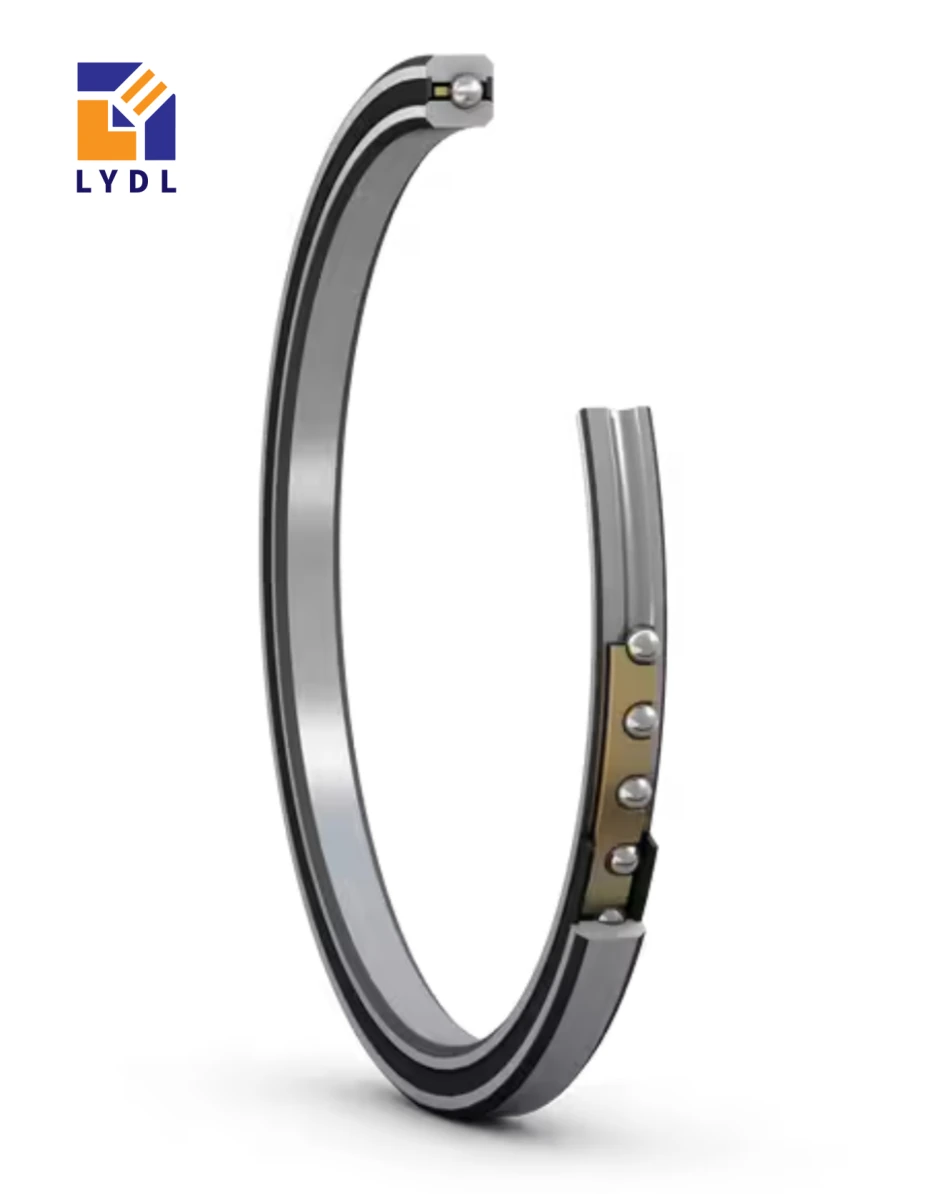

K05008CP0 / J05008CP0 identify the reference sizes for LYDL PC5008 / PC5008UU, a 50 × 66 × 8 mm radial contact bearing offered open or double sealed. In a compact pulley assembly, the useful starting point is the force on the shaft, not the motor's power rating. This page focuses on establishing that radial load and selecting a closure arrangement that the machine can support. The product offered is manufactured under the LYDL identity; the KAYDON numbers support cross-reference research.
| Specification | LYDL PC5008 | LYDL PC5008UU |
|---|---|---|
| Closure | Open | Double sealed |
| Contact geometry | Radial contact, Type C | Radial contact, Type C |
| Bore / outside diameter | 50 / 66 mm | 50 / 66 mm |
| Width / radial section | 8 / 8 mm | 8 / 8 mm |
| Approximate catalog mass | 0.08 kg | 0.08 kg |
| KAYDON reference | K05008CP0 | J05008CP0 |
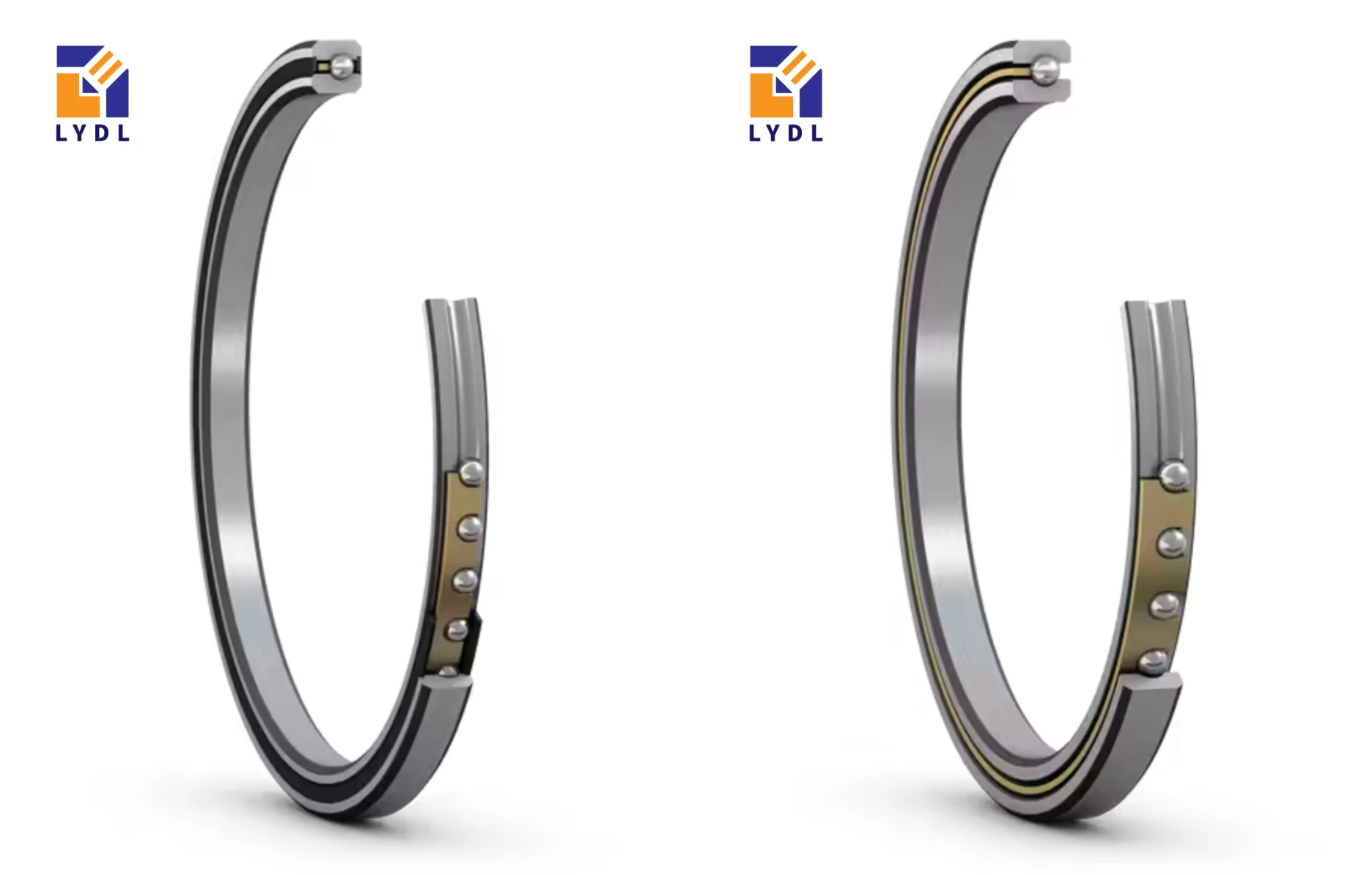
The two closure options appear together in the LYDL metric radial-contact series.
A belt drive applies forces through both its tight and slack spans. Their vector sum determines the load transmitted to the pulley shaft; the difference between span tensions relates to transmitted torque. Consequently, two drives with similar output torque can impose different radial bearing loads when their initial tension or belt routing differs.
Prepare a simple shaft layout showing pulley center, bearing centers and any overhang. Resolve belt forces in the actual directions, then calculate the reaction at each support. Include the installation tension, operating tension range and transient events such as acceleration or a jam. Avoid dividing the pulley force equally between bearings unless the geometry and loading justify that assumption.
The 8 mm section helps fit a small annular space, but it does not remove the need for sufficiently supported seats. Review whether the proposed support spacing and shaft stiffness keep tilt within the bearing arrangement's acceptable range. Type C is primarily a radial-load design; substantial thrust or overturning duty needs a separate arrangement review.
Discuss the PC5008 drawing and operating conditions.
KAYDON reference data — K05008CP0 / J05008CP0. These published figures are not LYDL test results or a certified LYDL load rating.
| Radial rating basis | Reference value |
|---|---|
| Dynamic, KAYDON method | 3,432 N |
| Dynamic, ISO method | 6,200 N |
| Static | 5,452 N |
The catalog identifies ISO 281:1990 as the ISO calculation basis, for comparison only. Keep the two dynamic ratings separate. Dynamic values use one million revolutions of L10 life; static values assume rigid shaft and housing support. The LYDL table labels force capacities in kg, so those entries have not been relabeled as N.
For J05008CP0, the catalog lists 3180 rpm at loads up to 20% of dynamic capacity and 0.04 N·m maximum no-load torque, with standard internal fit and lubricant at room temperature and under 5 lbf thrust. Neither number establishes the permissible duty of the supplied LYDL configuration. No-load torque is frictional resistance, not moment capacity.
Consider a roller that moves parts through a camera station. The belt drive, roller weight and process contact create separate radial force components. The optical system may also impose a runout target at the roller surface, which is an assembly requirement rather than an automatic consequence of the bearing designation.
PC5008 can be considered inside a clean enclosure with a defined lubricant supply. PC5008UU adds two seals where nearby belt debris makes grease retention and particle exclusion useful. Select the actual seal and lubricant specification with LYDL. The sealed option does not establish a washdown rating or replace the machine's own guards.

If belt tension is set by moving the bearing housing, maintain alignment between the supports throughout that adjustment. An eccentric adjustment or a slotted mounting plate can change shaft angle while increasing belt tension. Record the final position and check rotation after the mounting bolts are tightened.
During pressing, apply force to the ring being fitted and support the opposing assembly appropriately. Do not transmit installation force through the balls. Shoulder contact, retainer clearance and tool access should be resolved in the drawing before the bearing arrives.
After assembly, compare rotation before and after applying belt tension. A marked increase in resistance can indicate excessive reaction load, distorted seats or misalignment. Investigate the cause rather than compensating with more motor torque. Use the intended operating tension for the final functional check.
Order the open configuration as PC5008 and the sealed configuration as PC5008UU. The associated reference numbers are K05008CP0 and J05008CP0. Keep the selected closure on the purchase line and inspection record, even when both configurations share one website page.
In KAYDON's metric code, C means radial contact, P identifies the standard formed snap-over separator, and 0 denotes class 1 / ABEC 1F. K is the open steel series; J identifies steel bearings with two nitrile seals. These suffixes do not certify LYDL material, accuracy or clearance.
NSK uses NBC for its radial thin-section family in the cited inch-design catalog. Similar-looking bore digits are not an exact metric size specification. An NBC naming example is therefore not a substitute part number for PC5008.
Agree the required seat dimensions, installed radial runout and rotation check before sample approval. For a roller, specify the measurement surface and its distance from the supports; bearing-ring runout and roller-surface runout are different measurements. Record belt condition during testing. For repeat orders, retain the approved drawing revision, closure choice and lubricant identification so that a purchasing substitution does not change the machine's baseline.

No. Torque describes the tension difference that drives the pulley, while bearing reactions depend on both span forces and their directions. Supply the belt layout, preload or installation tension, pulley radius and support spacing. A load calculation should also consider starts, stops and any process force acting on the roller.
A bearing seal and a machine guard serve different purposes. PC5008UU can be evaluated for local particle exclusion and grease retention, but belt debris, larger fragments and liquid exposure still require an appropriate enclosure. Keep guard design independent from the choice of bearing closure.
Tension adds load, and the adjustment can move the housings out of alignment. Compare the assembly before tensioning, after tensioning and after final bolt tightening. This sequence helps separate load-related resistance from seat distortion or angular error. Do not loosen a specified fit as a troubleshooting shortcut.
Some axial load can be accommodated under suitable conditions, but this page does not provide a permissible axial rating for the LYDL assembly. A sustained helical-drive thrust requires its magnitude, direction and duty to be reviewed. The radial catalog value cannot be used directly as an axial limit.
Specify PC5008 or PC5008UU, the mating-seat drawing, calculated reactions, roller speed and lubricant preference. Add the runout test location and agreed acceptance condition. If an existing part is being replaced, include its full marking and drawing rather than relying on the 50 mm bore alone.
If the pulley shaft diameter is still under review, compare these larger seats while recalculating the same belt-force case:
K06008CP0 / J06008CP0 — 60 × 76 × 8 mm · K08008CP0 / J08008CP0 — 80 × 96 × 8 mm
Send the belt routing sketch, pulley offset, support spacing, load cycle and target roller runout. State annual quantity and whether you need PC5008 or PC5008UU. LYDL can review the proposed configuration and provide a drawing for approval before the purchasing specification is finalized.
Send your PC5008 selection details to LYDL.