


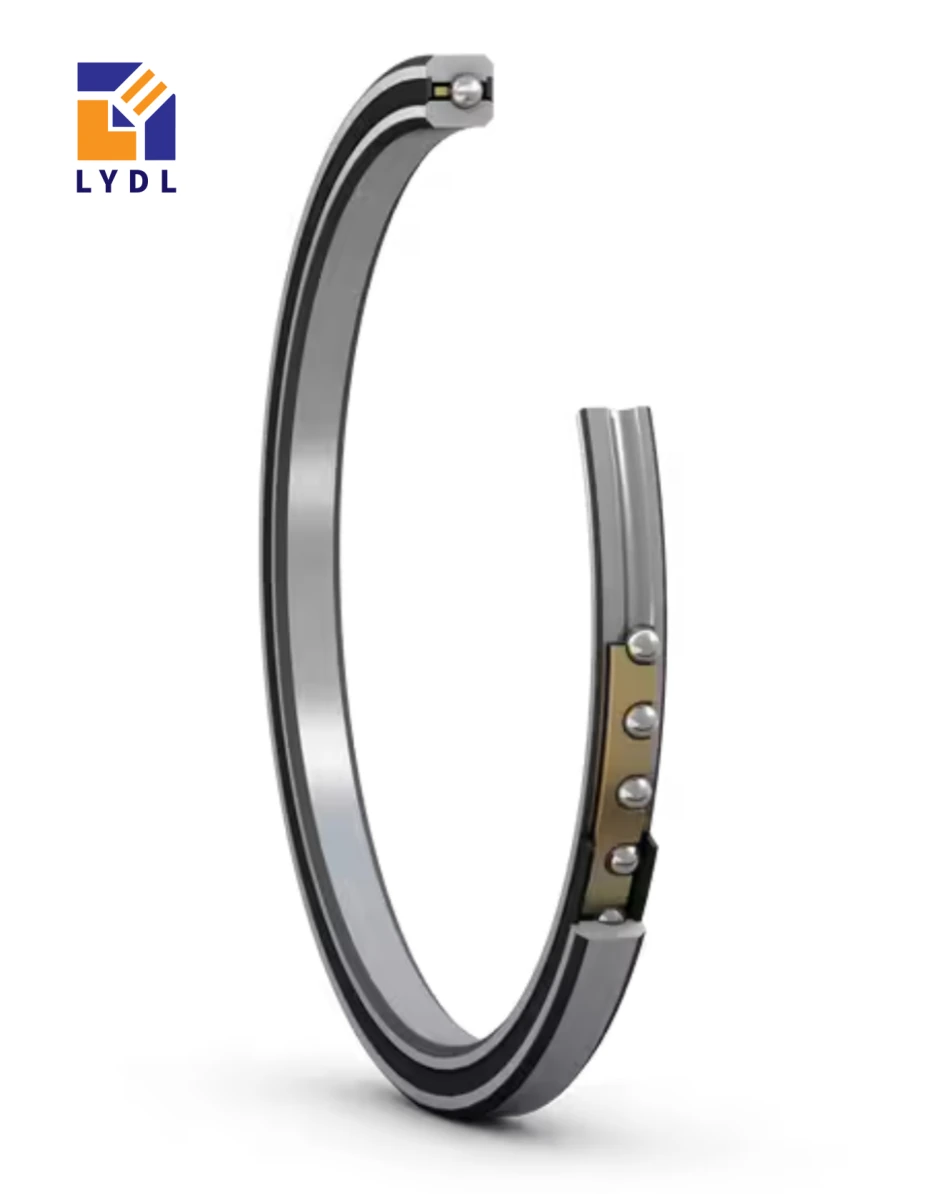

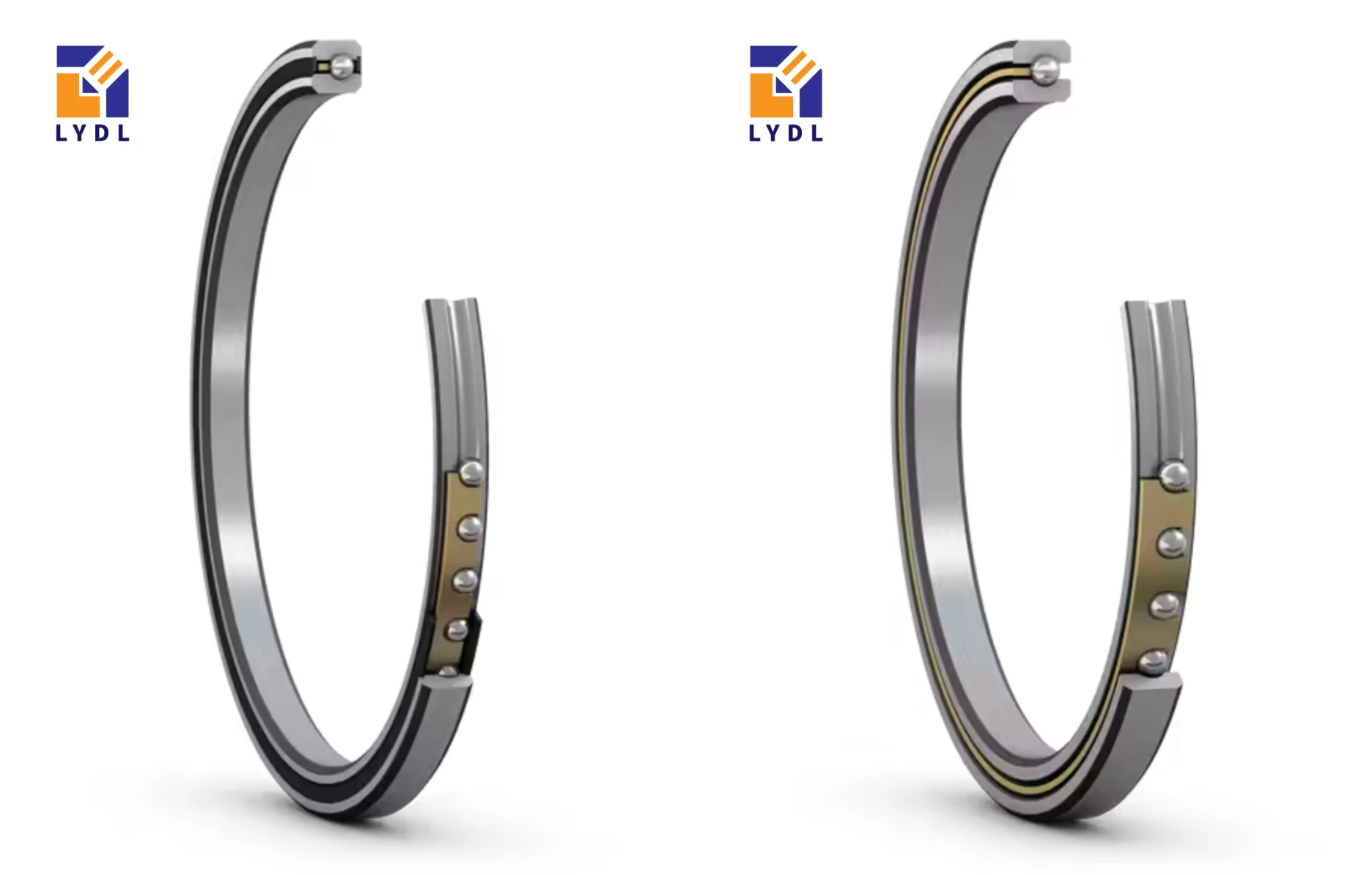
K06008CP0 / J06008CP0 reference the 60 × 76 × 8 mm envelope of LYDL PC6008 open and PC6008UU double-sealed bearings. For a measuring module, an acceptable sample must do more than turn by hand. Noise, vibration, radial motion and running torque affect different parts of the instrument's performance. This Type C page explains how to specify a useful acceptance test while keeping the LYDL supply identity separate from the KAYDON catalog references.
| Specification | LYDL PC6008 | LYDL PC6008UU |
|---|---|---|
| Closure | Open | Double sealed |
| Contact geometry | Radial contact, Type C | Radial contact, Type C |
| Bore / outside diameter | 60 / 76 mm | 60 / 76 mm |
| Width / radial section | 8 / 8 mm | 8 / 8 mm |
| Approximate catalog mass | 0.09 kg | 0.09 kg |
| KAYDON reference | K06008CP0 | J06008CP0 |
Check the nominal size and closure grouping in the LYDL metric radial-contact series.
A quiet bearing is not automatically a low-torque bearing, and a low hand-turning resistance does not establish small radial motion. Acoustic noise depends on the microphone location and surrounding structure. Vibration depends on the sensor, frequency range and mounting. Torque depends on speed, lubricant, load and seals. Treat each requirement as a separate measurable quantity.
For an instrument project, start with the machine-level error or disturbance that matters. A camera may be sensitive to motion during exposure, while a force sensor may be affected by changing friction. Translate that need into an agreed test with defined speed, radial load, temperature and orientation.
Use the same fixture and procedure for approval samples and subsequent batches. A numerical limit without a test method is difficult to reproduce across suppliers. The bearing's small section also makes fixture support significant: clamping a thin ring differently can change the result even when the supplied bearing has not changed.
Discuss the PC6008 drawing and operating conditions.
KAYDON reference data — K06008CP0 / J06008CP0. These published figures are not LYDL test results or a certified LYDL load rating.
| Radial rating basis | Reference value |
|---|---|
| Dynamic, KAYDON method | 3,766 N |
| Dynamic, ISO method | 6,645 N |
| Static | 6,433 N |
The catalog identifies ISO 281:1990 as the ISO calculation basis, for comparison only. Keep the two dynamic ratings separate. Dynamic values use one million revolutions of L10 life; static values assume rigid shaft and housing support. The LYDL table labels force capacities in kg, so those entries have not been relabeled as N.
For J06008CP0, the catalog lists 2710 rpm at loads up to 20% of dynamic capacity and 0.05 N·m maximum no-load torque, with standard internal fit and lubricant at room temperature and under 5 lbf thrust. Neither number establishes the permissible duty of the supplied LYDL configuration. No-load torque is frictional resistance, not moment capacity.
A compact optical inspection cartridge may use a 60 mm seat to preserve room for a central component. The bearing can support radial loading while the complete shaft arrangement establishes axial location. Type C should not be assumed to provide the moment stiffness of a four-point contact stage.
An open PC6008 may suit a protected cartridge where lubricant is controlled by the assembly process. A PC6008UU can be considered when sealing the bearing itself simplifies local contamination management. Test the chosen version with the instrument's drive and sensor arrangement; a closure change can alter friction even though the boundary dimensions remain the same.

Locate the rings with representative seat geometry and avoid concentrated clamp loads. Document the housing material, retainer tightening sequence and measurement datums. Check the empty fixture and drive for their own noise or vibration before attributing every recorded signal to the bearing.
Measure in a stable environment and allow the assembly to reach the agreed test condition. Record sensor position, sampling settings and any filtering applied to the data. Retain raw results where practical so that a later change in reporting does not hide a shift in behavior.
If a sample is noisy, compare it under the same controlled setup before changing lubrication or clearance. Repeated removal and reinstallation may itself alter the result. A useful investigation changes one variable at a time and records the corresponding response.
PC6008 identifies the LYDL open option; PC6008UU identifies its double-sealed catalog option. The verified KAYDON pair is K06008CP0 / J06008CP0. Specify the actual LYDL part and approved test procedure on the order rather than using a reference-brand designation as a performance certificate.
In KAYDON's metric code, C means radial contact, P identifies the standard formed snap-over separator, and 0 denotes class 1 / ABEC 1F. K is the open steel series; J identifies steel bearings with two nitrile seals. These suffixes do not certify LYDL material, accuracy or clearance.
The NBC designation in NSK's N Series means radial contact within an inch-design family. It does not translate the KAYDON precision suffix into an NSK noise grade. No exact NBC replacement is assigned to this 60 mm metric product.
Agree whether measurements are made before installation, in a representative fixture or in the finished cartridge. State which results are for information and which determine acceptance. Keep sample identification with the test record, and note open or sealed construction. Where the equipment requires a special cleanliness or lubricant condition, list it explicitly for quotation; the standard model reference alone does not establish that condition.

Only after checking what each value measures. Sound pressure, vibration velocity and vibration acceleration are different quantities. Even matching units do not guarantee comparable results when speed, frequency band or sensor placement differs. Agree a common test method before ranking samples by their reported numbers.
No. The reference suffix identifies a catalog precision class, not the completed instrument's error budget. Seat geometry, shaft stiffness, thermal behavior and sensor mounting also contribute. Ask for the required bearing tolerances and then verify the assembled instrument at the actual measurement location.
Seal contact and lubricant behavior can contribute to resistance. Hand feel is subjective and does not establish an operating torque limit. If the drive has little torque margin, measure starting and running behavior at agreed temperature and speed using the intended mounted configuration.
Do not change the supplied lubricant or preservation condition without an agreed procedure. Cleaning can alter lubrication and introduce contamination. Define whether the sample is tested as supplied or after a controlled preparation step, and apply that same procedure to every comparison sample.
Provide the speed trace, sensor position, frequency data, mounting details and when the peak occurs. Include whether it appears during acceleration, steady running or reversal. Results from the empty drive fixture can help distinguish a bearing-related response from motor, coupling or housing excitation.
For a smaller cartridge or a larger shaft interface, review these sizes without carrying over the instrument acceptance limits automatically:
K05008CP0 / J05008CP0 — 50 × 66 × 8 mm · K10008CP0 / J10008CP0 — 100 × 116 × 8 mm
Provide the cartridge drawing, radial load, rotational profile and the measurement disturbance you need to control. Include your proposed noise or vibration procedure and the required closure. LYDL can quote against a defined sample specification and agreed inspection scope.
Send your PC6008 selection details to LYDL.