

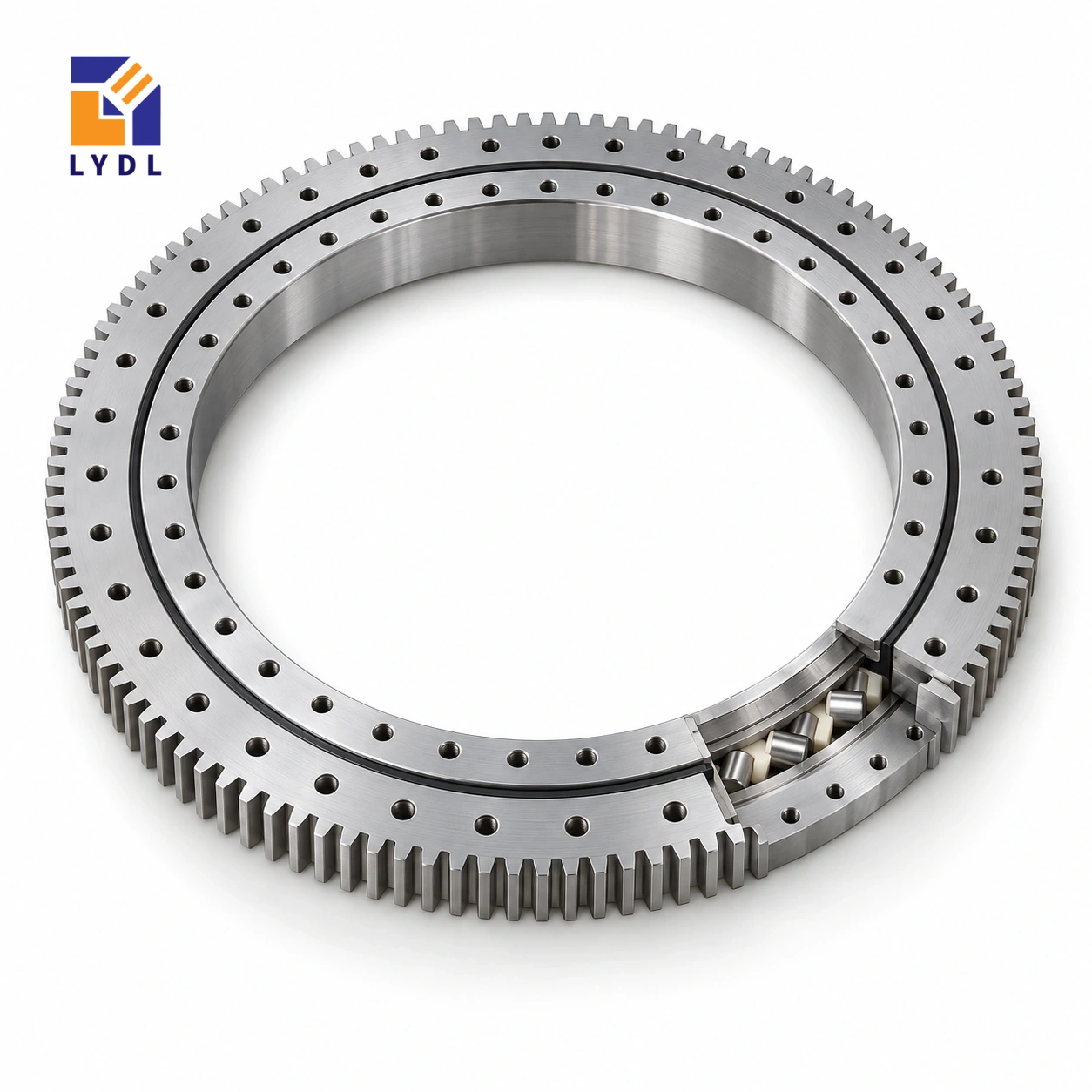
The XA140540 externally geared slewing reference has a 471 mm bore and 640.3 mm outside diameter in the LYDL table. Its 48 mm height and module 6, 105-tooth gear form a different package from the similarly geared XSA140544 reference.
XA140540: nominal LYDL listing. INA interchange unverified. Supplied execution requires an agreed drawing.
XA specification tables · Family technical reference
| Bore (mm) | Outside (mm) | Height H (mm) | Mass ≈ (kg) |
|---|---|---|---|
| 471 | 640.3 | 48 | 39 |
| Outer PCD La (mm) | Inner PCD Li (mm) | Outer holes na | Hole dB (mm) | Secondary h (mm) |
|---|---|---|---|---|
| 585 | 495 | 40 | 13 | 41 |
| Pitch d0 (mm) | Module m (mm) | Teeth z | Width b (mm) |
|---|---|---|---|
| 630 | 6 | 105 | 41 |
The XA140540 listing and XSA140544 reference share the 640.3 mm outer envelope and 630 mm pitch diameter. Their nominal bores differ at 471 mm and 474 mm, and their heights differ at 48 mm and 56 mm. A drive that appears to fit can still leave an incompatible pilot or axial stack. Review both fixing interfaces and the complete supplied execution before deciding whether any original machine parts can be retained.
LYDL lists forty outer positions on a 585 mm circle and a 495 mm inner circle, with 13 mm hole diameter. Do not transplant the XSA hole count or inner circle into the XA drawing.
Measure the entire central feed assembly, including clamp collars, connectors and the space needed to install them. A few millimetres of bore difference may be immaterial in an open layout but decisive around an established feed housing. Compare the proposed locating features with the housing rather than checking nominal clearance alone. Identify the equipment working level on the section and show how the 48 mm reference package would sit between the existing plates.
If an adapter is proposed, include its locating function and the added force path. The outside gear can appear compatible with the XSA reference while the bearing-to-machine connections remain different. Review the actual outer hole count and the inner circle from the XA row; do not let a shared transmission size populate the rest of the drawing automatically. For a packaging turret, include filling or sealing reactions and the most uneven product loading allowed by operation.
Describe how the external drive is accessed when products, guards and feed components are present. The result should be a comparison of complete machine arrangements. Once that comparison supports a proposal, use one agreed LYDL drawing revision for the supply, mating parts and inspection requirements.
The XA140540 gear row describes external teeth with module 6 and 105 teeth. Their product is 630 mm, matching the listed nominal pitch diameter. That arithmetic checks the relationship between three entries; it does not calculate a permissible tooth force. The physical outside diameter is 640.3 mm and the bore is 471 mm, so neither should be replaced by the pitch-circle value in a clearance drawing. Overall height H is 48 mm. Locate the gear face and the two mounting planes from the offered section before positioning a pinion. The tooth form, engagement, quality requirement and supplied material execution remain separate specification items. Keeping these definitions distinct prevents a correct transmission number from being used as the wrong housing dimension.
This envelope offers a 471 mm bore within a listed 48 mm overall height. Those dimensions may be attractive when the equipment must surround a central feature while preserving working height. Check the entire stack, including adapters, screw heads and the moving plate. A shallow bearing does not by itself make the completed table shallow.
At the outside, account for 640.3 mm of nominal tooth envelope plus the pinion and its enclosure. Identify whether the drive can be reached from above, below or the side. A central column that dictates the opening may also limit assembly access, so examine the mounting sequence before fixing the flange orientation.
A process fixture may be limited in height yet carry a force far above its seating. Show that force with its actual point of application and list the tooling that moves with the platform. Include partial loading and permitted changes in fixture orientation. Do not replace those cases with a single total weight.
The support plate and its joints contribute to the result measured at the tool. Define the acceptable installed behaviour at a useful datum, with the operating condition stated. Ask for review of the proposed ring execution and supporting structure against that requirement. The 39 kg approximate component mass and the slim envelope are identification and handling information, not evidence of a particular stiffness or load capability.
The module 6, 105-tooth arrangement gives a 630 mm nominal pitch diameter. Compare the proposed pinion geometry, bracket and reduction with the desired motion sequence. State whether the station approaches its working positions in one direction or reverses frequently. Gear geometry should not be used as a substitute for a defined positioning test.
The separate h and gear-width entries are both 41 mm, whereas total H is 48 mm. Keep each label on the section used to establish pinion height. Confirm the offered tooth execution and engagement before assigning an operating force. A change in pinion face or support may require review even when the ring model remains unchanged.
Show the 585 mm outer and 495 mm inner circles, each with forty listed fixing positions, on the actual mating parts. Check access near the drive and any central service column. Include the screw engagement and locating shoulder details from the offered drawing, along with the flange backing beneath those connections.
For this extended XA reference, LYDL's nominal row supports the page while original-brand interchange remains unverified. Submit the dimensional constraints and process duty with the enquiry. Agree any requested receiving inspection and preserve the accepted revision in the maintenance record. This gives a future spare order a clear interface basis without implying that neighbouring references or shared photographs establish compatibility.
XSA140544 offers a closely related radial comparison at 474 mm bore and the same listed 640.3 mm outside dimension, with module 6 and 105 teeth. Its overall height is 56 mm, compared with 48 mm here. The two XSA ring patterns also differ from the forty-position connection in this XA row.
For a height-limited platform, mark the fixed working plane and existing bracket on both sections. Shared tooth-count arithmetic does not locate the tooth face or preserve the screw interfaces. Ask for the offered drawing before deciding whether either arrangement can retain the drive. Keep this extended XA identity distinct from an independently established original-brand equivalent, which has not been verified.
Include adapter thickness when recording the accepted fixture working plane.
A packaging turret around a fixed feed tube is an illustrative design study. The small difference in centre clearance can matter once the feed housing, seals and installation tolerances are included.
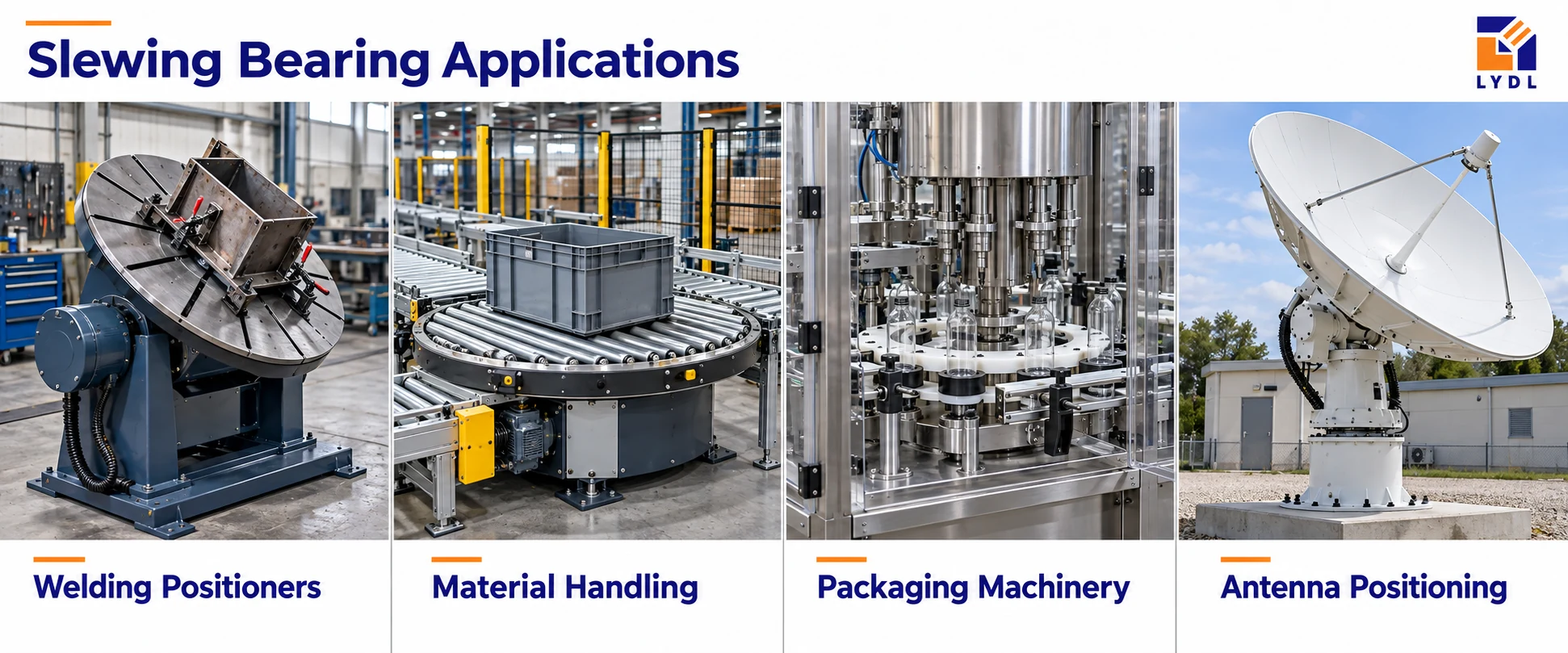
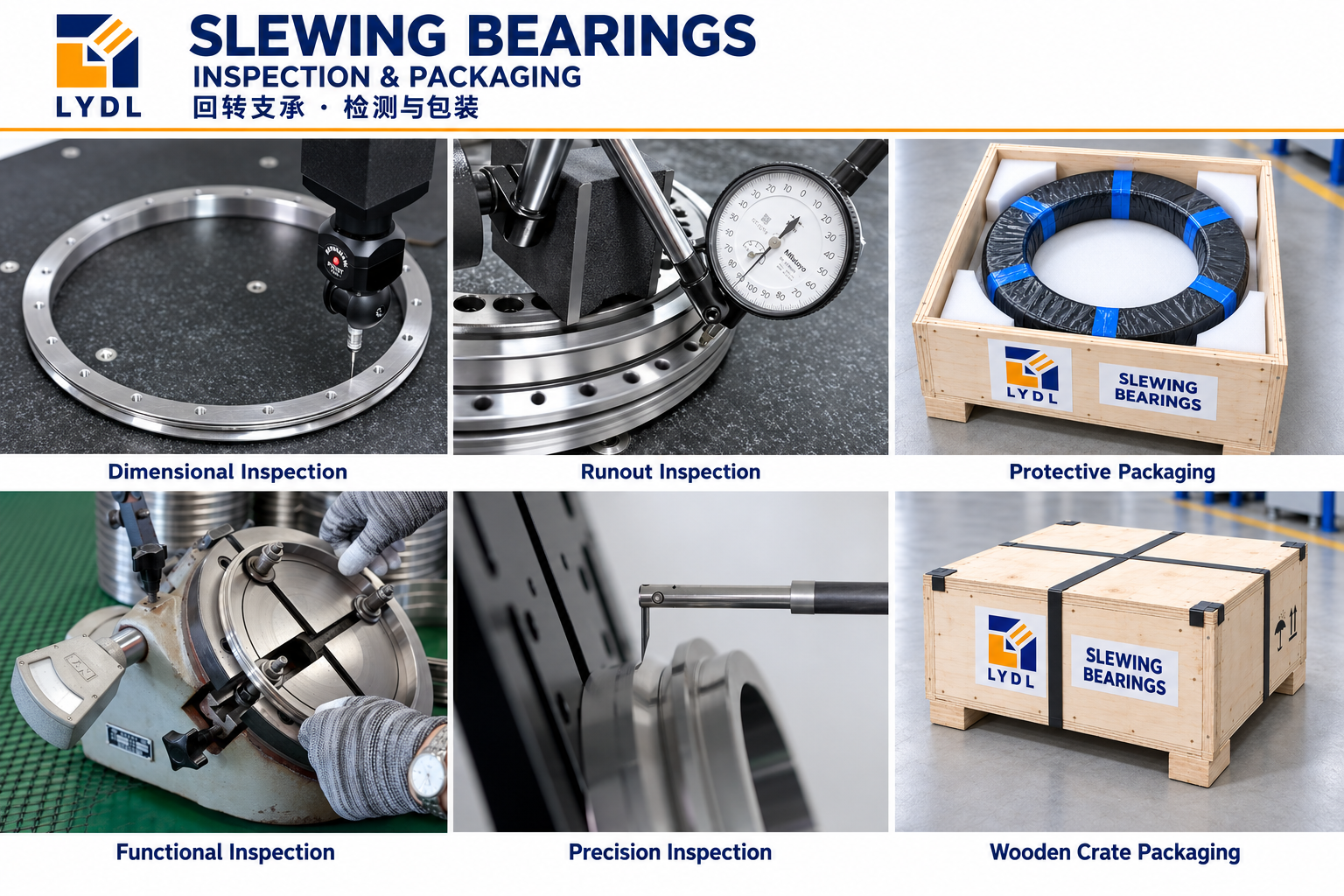
State which pilot and mounting faces govern acceptance. Protect those locating surfaces independently of the external gear when defining shipment restraints.
The LYDL XA row lists 471 mm. The 474 mm bore belongs to the different XSA140544 reference.
The external gear uses module 6, 105 teeth and a 630 mm pitch diameter in the current table.
No. Compare the complete interfaces: XA140540 lists forty outer positions and a 495 mm inner fixing circle, among other differences.
It is the overall bearing-height entry in the source row. The machine stack still needs separate allowance for plates and fasteners.
An exact standard match was not established. Treat the LYDL row as reference information pending an agreed supply drawing.
Pinion inside: XI series. Standard external-gear group: XSA range.
For XA140540 replacement review, send the existing centre-feed and flange drawings, not only the tooth count.