

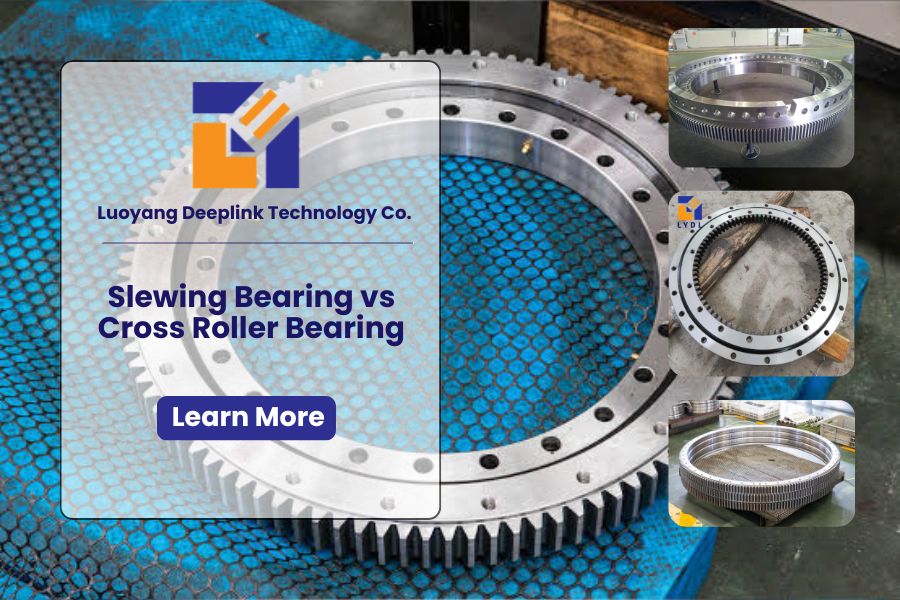
Slewing bearings and cross roller bearings both support rotation while carrying axial, radial, and moment loads at the same time. That overlap is exactly why engineers confuse the two. The real difference comes down to scale and purpose. Slewing bearings are built for large diameter, heavy load rotation. Cross roller bearings are built for compact size and high precision rotation.
This guide breaks down how each bearing is constructed, how they compare on load, rigidity, precision, and speed, and which one actually belongs in your design. LYDL Bearing manufactures both product lines in Luoyang, China, so the comparison below reflects real production tolerances rather than generic marketing claims.
What Is a Slewing Bearing
A slewing bearing, also called a slewing ring or turntable bearing, is a large diameter rotary bearing that combines the inner ring, outer ring, rolling elements, and often a gear into a single assembly. It is designed to carry heavy radial loads, axial loads, and tipping moments in one unit, which is why it replaces separate shaft and bearing arrangements in large rotating equipment.
Common rolling element configurations include single-row four-point-contact ball, double-row ball, three-row roller, and cross roller. Slewing bearings typically range from several hundred millimeters up to a few meters in diameter, and they are built to handle the shock loads and slow, continuous or oscillating rotation found in heavy machinery.
What Is a Cross Roller Bearing
A cross roller bearing uses cylindrical rollers set at 90 degrees to each other between a shared raceway on the inner and outer rings. This crossed arrangement lets a single row of rollers absorb radial load, axial load, and moment load together, which is what gives the bearing its high rigidity in a thin cross section.
Cross roller bearings are precision components. Standard inside diameters run from around 20 mm up to 2000 mm, and they are manufactured to accuracy grades such as P0, P5, P4, and P2, with P2 reserved for the tightest rotational accuracy requirements. They are the standard choice wherever backlash and runout have to be controlled to microns rather than millimeters.
Structural Differences
The biggest structural difference is how the load path is built. A slewing bearing is often a three-ring or gear-integrated design, sized to distribute heavy loads across a large diameter raceway. Some slewing bearings use crossed rollers internally, but many use ball rolling elements arranged in single row, double row, or three row configurations depending on load requirements.
A cross roller bearing is almost always a compact two-ring design. The alternating 90-degree roller pattern means one row does the work that would otherwise require two or three separate bearings, which keeps the cross section thin. This is why cross roller bearings fit into tight spaces on robot joints and rotary tables where a bulky slewing ring would not fit.
Load Capacity and Rigidity
Slewing bearings are built for total load, not just precision. Their large diameter and multi row roller or ball designs let them absorb the impact loads from cranes, excavators, and wind turbine yaw systems, where shock loading and long term fatigue resistance matter more than micron level accuracy.
Cross roller bearings prioritize rigidity per unit size. Because both rollers in the crossed pair contact the raceway along a line rather than a point, load is distributed evenly and elastic deformation stays low. This gives cross roller bearings very high stiffness relative to their size, but at a smaller absolute load ceiling than a large slewing ring built for heavy equipment.
In short, choose a slewing bearing when the load is large and the diameter has room to grow. Choose a cross roller bearing when stiffness and compactness matter more than raw load rating.
Precision and Rotational Accuracy
This is where the two bearing types diverge the most. Cross roller bearings manufactured in China to defined accuracy grades under ISO 492 style tolerance classes. P0 is standard grade, suitable for general automation. P5 and P4 tighten bore, outer diameter, and runout tolerances for CNC rotary tables and robotic joints. P2 is the highest grade, used in semiconductor equipment and aerospace instruments where radial runout has to stay below a few microns.
Slewing bearings can be manufactured to tighter tolerances as well, and cross roller slewing rings used in CT scanners or radar antenna bases often specify P4 tolerance with preload. But as a category, most slewing bearings are produced to standard tolerance grades because their primary job is load support across a large diameter, not micron level positioning.
If your application depends on repeatable positioning accuracy at a small to mid size diameter, a cross roller bearing in P5 or P4 grade is usually the right call. If the application depends on carrying heavy, variable loads across a large rotating platform, a slewing bearing is the better fit even if its tolerance grade is lower.
Size Range Comparison
| Factor | Cross Roller Bearing | Slewing Bearing |
|---|---|---|
| Typical bore size | 20 mm to 2000 mm | 300 mm to several meters |
| Ring construction | Two-ring, single-row crossed rollers | Two, three, or gear integrated rings |
| Common precision grades | P0, P6, P5, P4, P2 | P0 standard, P5 or P4 for precision variants |
| Typical rotation | Continuous, high accuracy | Continuous or oscillating, heavy duty |
| Cross section | Thin and compact | Larger and bulkier |
| Primary strength | Rigidity and positioning accuracy | Total load and moment capacity |
Speed, Motion Type, and Backlash
Cross roller bearings are built for machines that start, stop, and reverse direction often, such as robot arms and indexing tables. Low backlash and minimal runout keep positioning consistent through thousands of direction changes, which matters more than top speed in most of these applications.
Slewing bearings more commonly handle slow, continuous rotation or oscillating motion under heavy load, such as a crane boom swinging or a wind turbine yaw system tracking wind direction. Fretting corrosion from repeated small oscillations is a known failure mode in these applications, so lubrication and preload matter as much as the bearing design itself.
Applications Compared
Cross roller bearings are the standard in industrial robots and welding arms, CNC rotary tables and indexing heads, precision measuring instruments, medical imaging and surgical robotics, and semiconductor manufacturing equipment. Anywhere backlash-free, repeatable rotation in a compact footprint is the priority, a cross roller bearing is usually specified.
Slewing bearings dominate in cranes, excavators, and other construction equipment, wind turbine pitch and yaw systems, tunnel boring machines, ship deck equipment, and rotary platforms on military and radar systems. These slewing bearing applications share large physical scale and combined heavy loading, which favors a slewing ring over a compact cross roller design.
How to Choose Between Them
Start with diameter and load. If the rotating assembly is large and needs to carry heavy combined loads, a slewing bearing is almost always the correct category, and the remaining decision is which rolling element type, ball or cross roller, fits the load and precision profile. If the assembly is compact and precision positioning matters more than raw load, a cross roller bearing is the better starting point.
Next, check your accuracy requirement. Cross roller bearing applications with tight positioning tolerances, low vibration requirements, or frequent direction reversals call for P5 or P4 grade. Applications where shock loading, fatigue life, and total load capacity are the main concern point toward slewing bearings, even in lower tolerance grades.
Finally, confirm mounting and space constraints. Cross roller bearings are designed to fit thin cross sections and tight envelopes. Slewing bearings, especially gear-integrated versions, need more radial and axial space but eliminate the need for separate drive and support bearings.
Frequently Asked Questions
Is a cross roller bearing a type of slewing bearing?
Not exactly. Cross roller bearing is a rolling element design, and it can appear both as a standalone precision bearing and as one of several rolling element options inside a slewing ring. A cross roller slewing bearing combines both terms to describe a large diameter slewing ring built with a crossed roller raceway.
Which one has higher precision, a slewing bearing or a cross roller bearing?
Cross roller bearings generally offer higher rotational accuracy for a given size, since they are manufactured to defined precision grades up to P2. Slewing bearings can reach similar precision in specialized cross roller slewing configurations, but standard slewing rings are produced to less demanding tolerances because load capacity is the primary design goal.
Can a slewing bearing replace a cross roller bearing?
In most compact machinery, no. A slewing bearing’s larger cross section and lower standard precision make it unsuitable for tight robotic or rotary table applications. Slewing bearings make sense once the diameter and load exceed what a cross roller bearing is designed to carry.
What load types can each bearing handle?
Both can carry radial load, axial load, and tilting moment simultaneously because of their crossed or multi-contact rolling element arrangement. The difference is scale. Cross roller bearings handle these loads efficiently at smaller diameters, while slewing bearings handle much higher absolute loads across larger diameters.
Which industries use cross roller bearings the most?
Robotics, machine tools, semiconductor equipment, and medical device manufacturing rely on cross roller bearings for their combination of rigidity, low backlash, and compact size.
Final Thoughts
Slewing bearings and cross roller bearings solve the same basic problem, supporting combined loads during rotation, but at different scales and for different priorities. Slewing bearings win on total load capacity and diameter. Cross roller bearings win on rigidity per unit size and rotational accuracy. Matching the bearing type to your load profile, precision requirement, and available space will settle the decision faster than comparing specs in isolation.


