Precision machines that rotate — inspection turrets, index tables, wafer handlers, robot wrists — usually rely on one of two bearing technologies: the air bearing stage or the cross roller bearing stage.
Both deliver smooth, accurate rotary motion, but they reach it by very different routes. One floats the rotor on a film of pressurized air; the other carries load on crossed cylindrical rollers. The right choice depends on your accuracy target, load and moment, speed, environment, and budget. This guide compares the two side by side and closes with a quick selection checklist.
What Is an Air Bearing Stage?
An air bearing stage supports its rotating part on a thin cushion of pressurized air, typically only 5–15 µm thick. Because there is no metal-to-metal contact, friction is nearly zero, no wear particles are generated, and rotational accuracy can reach the sub-micron level. Air bearing stages are usually supplied as complete units — rotor, stator, and a precision air-feed system.
The trade-offs: an air film has limited stiffness, load capacity is moderate, and the stage depends on a steady supply of clean, dry compressed air. For a full walkthrough of aerostatic vs aerodynamic designs, porous media vs orifice feed, and spindle vs rotary table formats, see our rotary air bearings guide.
What Is a Cross Roller Bearing Stage?
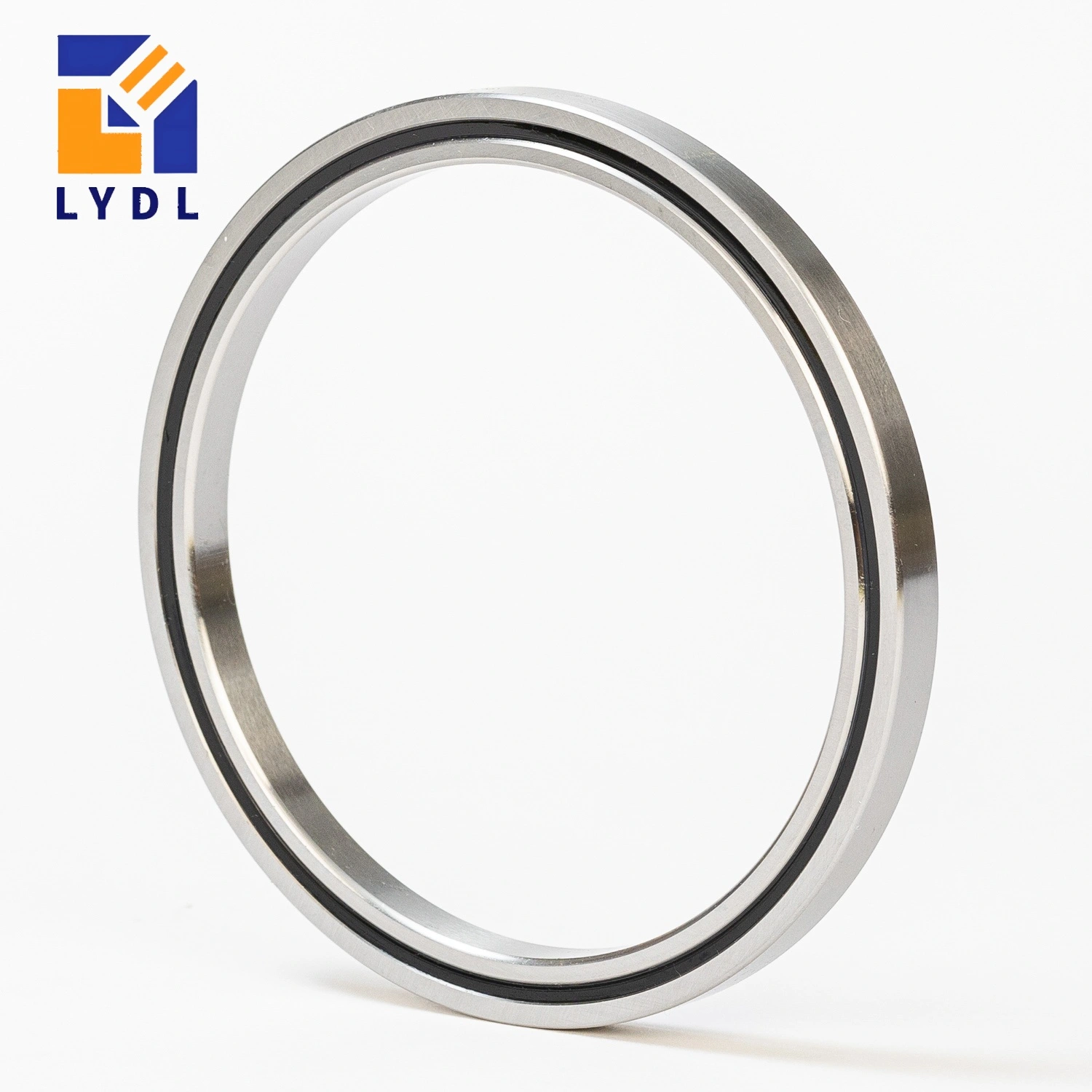
A cross roller bearing guides rotation with cylindrical rollers spaced by retainers and oriented at 90° to one another. Adjacent rollers carry load in opposite directions, so one compact bearing simultaneously handles radial load, axial load, and tipping (moment) loads.
Compared with an air bearing stage, a cross roller bearing stage gives up a little ultimate smoothness in exchange for far higher rigidity, much greater load capacity, and tolerance of ordinary shop environments — no air supply, no special filtration. YRT rotary table bearings serve heavy precision tables, while ultra-thin series such as RAU crossed roller bearings fit space-constrained robot joints. A full overview is in our cross roller bearings guide.
Air Bearing Stage vs Cross Roller Bearing: Head-to-Head
| Factor | Air Bearing Stage | Cross Roller Bearing Stage |
|---|---|---|
| Rotational accuracy | Sub-micron possible; no rolling elements | Micron-level; excellent for industrial tables |
| Friction and wear | Essentially zero (non-contact) | Rolling contact; minimal but nonzero |
| Rigidity | Moderate — air film is compressible | Very high — line contact, steel on steel |
| Load and moment capacity | Moderate | High, in a single compact bearing |
| Speed | Very high, little heat generated | Moderate to high; lubricant dependent |
| Environment | Needs clean, dry compressed air | Sealed options tolerate dust and temperature swings |
| Maintenance | Air filter care; no wear parts | Periodic relubrication or greased-for-life seals |
| Vacuum and cleanroom | Excellent when configured for it | Possible with special lubricants |
| System cost | Higher — stage plus air preparation | Cost-effective; standard catalog sizes |
When an Air Bearing Stage Is the Right Choice
- Your spec demands sub-micron repeatability or extremely low angular error — metrology instruments, optical scanners, lithography.
- Continuous high-speed rotation with minimal heat — high-speed spindles and scanning systems.
- The process cannot tolerate lubricant — cleanroom, medical, or contamination-sensitive equipment.
- Vibration from rolling elements would show up in the measurement.
When a Cross Roller Bearing Stage Wins
- Heavy or off-center loads: the crossed roller pattern carries moment loads that would collapse an air film — robot arm wrists, indexing tables, machine tool turrets.
- Shock, vibration, and general shop air (or no compressed air at all).
- Tight budgets or tight schedules — standard YRT, RU, and RAU sizes ship from catalogs at a fraction of a complete air bearing system’s cost.
- Minimal installation depth — thin-section crossed roller bearings integrate directly into the rotating joint.
For rotary tables, YRT series rotary table bearings combine axial, radial, and moment capacity in one unit; for robot joints and gimbals, RAU ultra-thin series save cross-section space. If you are new to the type codes, our types of cross roller bearing overview maps each series to its applications.
Can a Machine Use Both?
Yes, and many do. A common architecture pairs a cross roller bearing turntable for heavy, coarse positioning with an air bearing fine-angle stage mounted on top. Semiconductor equipment frequently uses exactly this split: robust cross roller handling for wafer transport, air bearings for exposure-grade motion. Choosing one does not mean excluding the other — it means putting each technology where its strengths pay off.
Quick Selection Checklist
- Accuracy spec finer than ±1 µm or arc-second class? → Air bearing.
- Heavy or moment load, shock, dirty environment? → Cross roller.
- Continuous speed above roughly 10,000 rpm? → Air bearing.
- No clean compressed air available? → Cross roller.
- Cleanroom or lubricant-free process? → Air bearing, or sealed crossed roller specified for the environment.
- Budget- or schedule-driven? → Cross roller — standard sizes are readily available.
Frequently Asked Questions
Is an air bearing stage always more accurate than a cross roller bearing?
In absolute terms, yes — contact-free support removes rolling-element geometry error. In practice, most industrial rotary tables work comfortably in the micron range, where a precision crossed roller bearing delivers sufficient accuracy with far greater rigidity and lower total cost.
Do cross roller bearings need lubrication?
Yes. Crossed roller bearings run on grease or oil, with relubrication intervals set by speed and duty. Many small and thin-section types come sealed and greased for life. Air bearings, by contrast, wear only if the air supply is contaminated.
Can a cross roller bearing replace an air bearing in an existing design?
Only if your accuracy budget allows it. If the machine was specified around sub-micron, non-contact motion, a drop-in swap will not hold the spec. If the requirement is micron-level rotary indexing under load, a YRT or thin-section crossed roller bearing is often the more robust and economical answer.
Still weighing options for a specific turntable or joint? Our application engineers can review your load, speed, and accuracy targets and recommend a YRT, RU, or ultra-thin RAU configuration — just send us your requirements.