


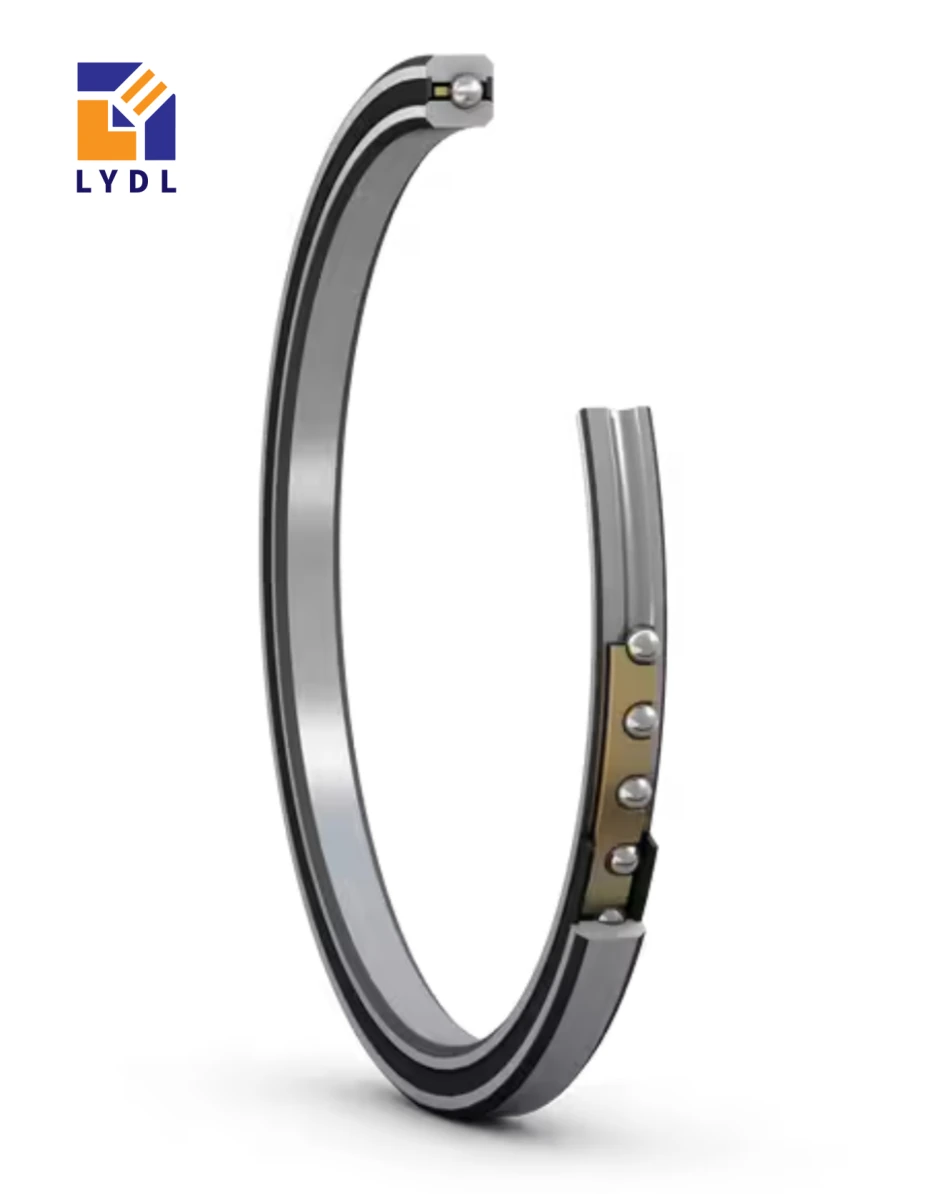

K15008CP0 / J15008CP0 are reference models for LYDL PC15008 open and PC15008UU double-sealed bearings, sized 150 × 166 × 8 mm. At this bore, a thin radial support can fit into a compact roller or shaft system, but a large bore does not guarantee resistance to shaft bending or housing misalignment. This page focuses on support spacing and the complete load path so that the bearing is assessed as part of the machine.
| Specification | LYDL PC15008 | LYDL PC15008UU |
|---|---|---|
| Closure | Open | Double sealed |
| Contact geometry | Radial contact, Type C | Radial contact, Type C |
| Bore / outside diameter | 150 / 166 mm | 150 / 166 mm |
| Width / radial section | 8 / 8 mm | 8 / 8 mm |
| Approximate catalog mass | 0.20 kg | 0.20 kg |
| KAYDON reference | K15008CP0 | J15008CP0 |
Nominal dimensions and the paired supply models are recorded in the LYDL metric radial-contact series.
Map each applied force to its position along the shaft. A pulley, gear or working roller placed outside the bearing span produces a different reaction pattern from the same force located between supports. Calculate both bearing reactions and the shaft deflection relevant to the working surface.
Increasing the distance between supports can change reactions and shaft bending in different ways, depending on where the load acts. Treat spacing as a design variable rather than assuming that wider is always better. Include the stiffness of the support structure and any flexible coupling or cantilevered element.
A Type C bearing is primarily intended for radial loading. It should not be selected as a self-aligning bearing or as a single-bearing substitute for an independently reviewed moment-support arrangement. If the operating shaft slope is significant, evaluate the whole support concept and obtain the supplier's allowable conditions instead of relying on the 150 mm bore size.
Discuss the PC15008 drawing and operating conditions.
KAYDON reference data — K15008CP0 / J15008CP0. These published figures are not LYDL test results or a certified LYDL load rating.
| Radial rating basis | Reference value |
|---|---|
| Dynamic, KAYDON method | 6,257 N |
| Dynamic, ISO method | 9,317 N |
| Static | 15,347 N |
The catalog identifies ISO 281:1990 as the ISO calculation basis, for comparison only. Keep the two dynamic ratings separate. Dynamic values use one million revolutions of L10 life; static values assume rigid shaft and housing support. The LYDL table labels force capacities in kg, so those entries have not been relabeled as N.
For J15008CP0, the catalog lists 1160 rpm at loads up to 20% of dynamic capacity and 0.35 N·m maximum no-load torque, with standard internal fit and lubricant at room temperature and under 5 lbf thrust. Neither number establishes the permissible duty of the supplied LYDL configuration. No-load torque is frictional resistance, not moment capacity.
Consider a process roller driven by a pulley beyond one end support. Roller weight, process contact and belt forces act at different positions. The drive-end bearing may therefore see a reaction unlike that at the opposite end, even when both seats use PC15008.
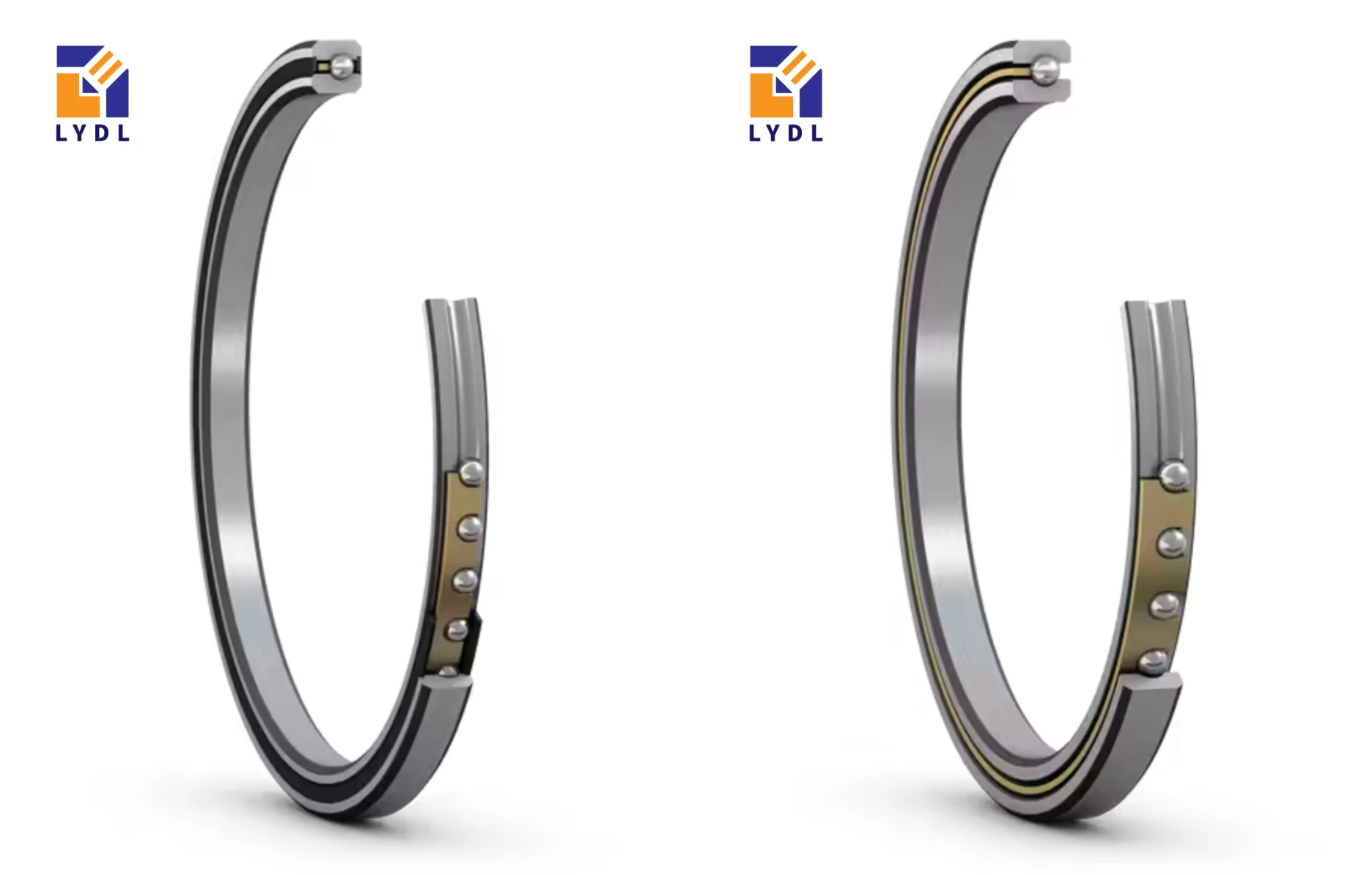
Open bearings can be considered inside a common protected enclosure. Double-sealed PC15008UU versions provide a different local protection arrangement for more exposed stations. Using the same closure at both ends may simplify procurement, but selection should follow each station's environment and lubrication access rather than purchasing convenience alone.

Inspect housing locations relative to the machine datum that controls the shaft axis. Checking each bearing bore individually does not prove that separated supports are coaxial. Include mounting-face flatness and the effect of the final base or frame fastening condition.
During installation, support the shaft so that its weight does not force the first bearing to carry an unintended cantilever load while the second support is being assembled. Use suitable lifting and insertion tooling for the complete component, not the bearing rings as lifting points.
After both supports are secured, verify rotation, axial arrangement and the working-surface alignment. A coupling should not be used to pull a misaligned shaft into position. If readings change after drive connection, inspect the coupling setup and external loads before concluding that the bearing itself is at fault.
For LYDL procurement, specify PC15008 or PC15008UU. The corresponding reference numbers are K15008CP0 for open construction and J15008CP0 for double seals. The reference pair shares nominal dimensions, but the selected supply configuration still needs an approved specification.
In KAYDON's metric code, C means radial contact, P identifies the standard formed snap-over separator, and 0 denotes class 1 / ABEC 1F. K is the open steel series; J identifies steel bearings with two nitrile seals. These suffixes do not certify LYDL material, accuracy or clearance.
NSK's NBC family describes radial thin-section bearings in an inch series. Its bearing type may be relevant to a design comparison, but neither its numbering nor its alignment requirements should be transferred to the PC15008 assembly without checking the actual product data.
Define whether acceptance includes shaft straightness, support coaxiality and loaded deflection at a process point. Record the drive connection and external load state during checks. For spare-bearing purchasing, retain these assembly criteria with the bearing drawing so that a replacement is evaluated under the same conditions. Ask for the required dimensional inspection and packaging identification in the quotation.

It should not be treated as a self-aligning bearing. The acceptable angular condition depends on the bearing and complete installation. Measure the support geometry and calculate operating shaft slope, then review those results with the supplier. Do not use hand rotation alone to approve a misaligned arrangement.
The result depends on the locations of all applied forces. A change can reduce one reaction while changing shaft deflection or another support load. Recalculate the actual beam and support layout. A general rule based only on span length can miss the effect of an overhung drive.
An offset pulley, coupling force or gear load can create unequal reactions. The two stations may also differ in temperature or housing stiffness. Compare their actual loads and installation conditions before assuming that matching bearing numbers should produce identical temperature or friction readings.
No. Align the shaft and driven equipment using the specified mounting procedure before securing the coupling. Pulling the assembly into place can introduce forces that are absent from the bearing calculation. Recheck alignment after tightening because the final mounting condition can shift the result.
Consider it when the current envelope or confirmed performance cannot meet the calculated duty, but first resolve seat support and alignment. PC15013 changes the outside diameter and width, so it needs a revised installation. A larger radial rating does not by itself correct an inaccurate pair of housings.
Compare a thicker 150 mm-bore option or a larger-bore thin section after establishing the required support geometry:
K15013CP0 — 150 × 176 × 13 mm · K20008CP0 — 200 × 216 × 8 mm
Send the shaft span, load positions, overhang dimensions and housing datums. Include speed, axial-location strategy and the permitted working-surface deflection. Identify the desired open or sealed model and quantities so LYDL can prepare a configuration and inspection proposal.
Send your PC15008 selection details to LYDL.