


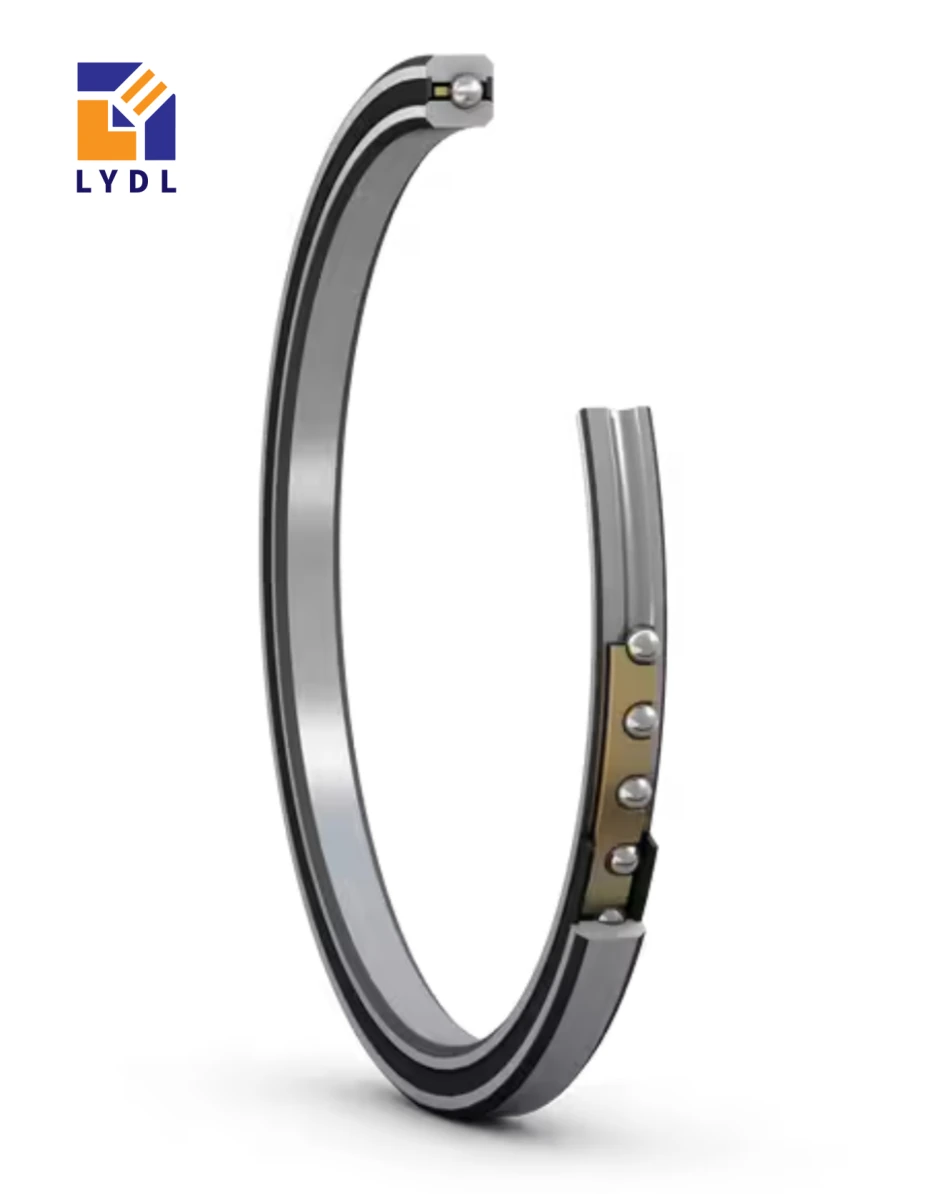

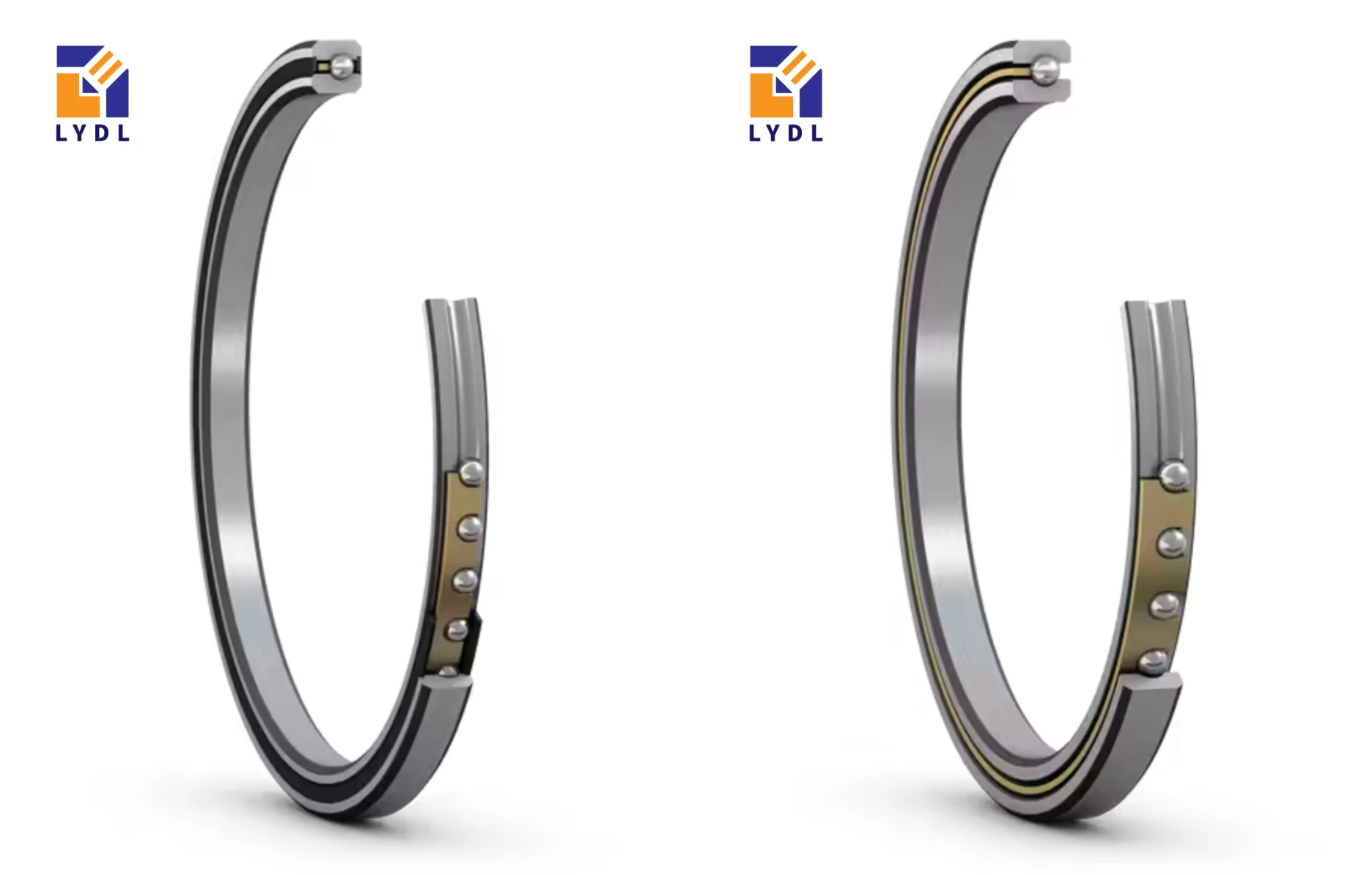
K12008CP0 / J12008CP0 identify the KAYDON references associated with LYDL PC12008 / PC12008UU, a 120 × 136 × 8 mm radial contact thin section bearing. A useful application to examine at this size is a rotating drum supported on a stationary hub. In that arrangement the outer ring may rotate, so familiar shaft-bearing assumptions can lead to the wrong fit strategy. The following selection guidance concentrates on ring loading, seat support and controlled assembly.
| Specification | LYDL PC12008 | LYDL PC12008UU |
|---|---|---|
| Closure | Open | Double sealed |
| Contact geometry | Radial contact, Type C | Radial contact, Type C |
| Bore / outside diameter | 120 / 136 mm | 120 / 136 mm |
| Width / radial section | 8 / 8 mm | 8 / 8 mm |
| Approximate catalog mass | 0.16 kg | 0.16 kg |
| KAYDON reference | K12008CP0 | J12008CP0 |
For the official LYDL size and closure entries, consult the LYDL metric radial-contact series.
Describe which ring rotates and whether the external load direction stays fixed in the machine. A load that travels around a ring's circumference creates different seating demands from one that remains in the same position relative to that ring. Bearing fit selection should account for this relative motion, not just the words “shaft” and “housing.”
For a drum rotating around a fixed hub under a stationary external force, the rotating outer ring needs particular attention. Discuss the risk of ring movement in its seat and the effect of the proposed fit on bearing internal clearance. No universal interference value is appropriate without the actual ring, drum and operating details.
Include drum-wall thickness, material and temperature in the review. A thin sleeve may deform during pressing or fastening, while thermal expansion can change the fit in service. The 136 mm outside diameter is a nominal boundary dimension, not a finished housing tolerance specification.
Discuss the PC12008 drawing and operating conditions.
KAYDON reference data — K12008CP0 / J12008CP0. These published figures are not LYDL test results or a certified LYDL load rating.
| Radial rating basis | Reference value |
|---|---|
| Dynamic, KAYDON method | 5,502 N |
| Dynamic, ISO method | 8,588 N |
| Static | 12,376 N |
The catalog identifies ISO 281:1990 as the ISO calculation basis, for comparison only. Keep the two dynamic ratings separate. Dynamic values use one million revolutions of L10 life; static values assume rigid shaft and housing support. The LYDL table labels force capacities in kg, so those entries have not been relabeled as N.
For J12008CP0, the catalog lists 1440 rpm at loads up to 20% of dynamic capacity and 0.22 N·m maximum no-load torque, with standard internal fit and lubricant at room temperature and under 5 lbf thrust. Neither number establishes the permissible duty of the supplied LYDL configuration. No-load torque is frictional resistance, not moment capacity.
A hollow drum can preserve a central route for a stationary structural member while rotating its outer surface. PC12008 provides an 8 mm radial and axial section around the 120 mm seat. The layout must still include the necessary second support or other means of controlling the drum's overall alignment and axial position.
The open variant can be considered inside an engineered lubrication enclosure. The double-sealed PC12008UU may simplify local lubricant retention when the drum assembly makes servicing difficult. Confirm seal suitability for the actual particles, liquids and temperatures rather than describing the sealed bearing as universally protected.

Develop an installation tool that loads the fitted ring evenly and supports the sleeve against local distortion. Avoid pressing through the inner ring when the outer ring is being installed into the drum. Verify shoulder contact and the clearance of retaining features against the approved drawing.
Measure the drum seat before installation at more than one angular position and axial plane where appropriate. After fitting, check the relevant running surface against the hub datum. A single outside-diameter reading cannot separate drum machining error from mounting error or bearing behavior.
Record the final retainer condition and repeat the functional check after the complete drum is assembled. If a cover or flange changes the reading, inspect how its tightening affects the thin sleeve. Correct the support geometry rather than assuming a different bearing accuracy class will eliminate housing distortion.
PC12008 is the open LYDL designation and PC12008UU the double-sealed designation. Their reference pair is K12008CP0 / J12008CP0. Keep the actual manufacturer and closure visible in the purchase record; a KAYDON search reference does not mean the supplied bearing carries KAYDON branding.
In KAYDON's metric code, C means radial contact, P identifies the standard formed snap-over separator, and 0 denotes class 1 / ABEC 1F. K is the open steel series; J identifies steel bearings with two nitrile seals. These suffixes do not certify LYDL material, accuracy or clearance.
NSK catalogs NBC radial bearings using inch-based boundary dimensions. For example, a bore code near 120 does not establish an exact 120 mm seat. Compare the published d, D and B before considering any alternative naming system.
A drum application may need limits on its working surface rather than only on the bearing rings. Define that surface, the reference axis and the checking load. Preserve the mounting orientation and ring retention condition in the inspection instructions. If both open and sealed variants are purchased, maintain separate sample records so that seal-related friction is not confused with a change in drum alignment.

No. The correct fit depends on how the load acts relative to the ring, as well as support, temperature and accuracy requirements. A stationary ring can encounter changing or rotating load directions. Provide the motion and load diagram so that both ring fits can be evaluated.
Do not transfer it automatically. A rotating drum reverses which ring moves, and the housing material or wall thickness may differ substantially. Review relative ring loading, possible creep and internal-clearance change for the drum assembly before reusing a tolerance from another machine.
It can indicate a change in sleeve shape, shoulder contact or assembly alignment. Compare readings through the tightening sequence and inspect the mating faces. Bearing accuracy is only one contributor. Keep the final fastener condition consistent when comparing parts or evaluating corrective machining.
Not necessarily. The bearing seal specification and the enclosure's exposure must be checked together. A sealed bearing is not automatically a liquid-tight drum assembly. Supply the fluid, exposure method and cleaning process so that suitable external protection and bearing materials can be considered.
Send a section showing the fixed hub, rotating sleeve, retainers and neighboring support, plus the existing bearing marking. Include load direction and operating temperature. Those details reveal the seating and alignment requirements that cannot be inferred from 120 × 136 × 8 mm alone.
Use these smaller and larger envelopes when reviewing the hub diameter; each requires its own drum-seat design:
K10008CP0 / J10008CP0 — 100 × 116 × 8 mm · K15008CP0 / J15008CP0 — 150 × 166 × 8 mm
Provide a sectional drum drawing, identify the rotating ring and show the applied radial force directions. Add sleeve material, wall thickness, temperature range and the required surface runout. State PC12008 or PC12008UU so the quotation and approval drawing identify the intended closure.
Send your PC12008 selection details to LYDL.