

Search a model or enter any known dimensions.
Exact dimensions in mm. B/H is the overall width or height. Check mounting details on the product page.
Showing 109–112 of 112 results
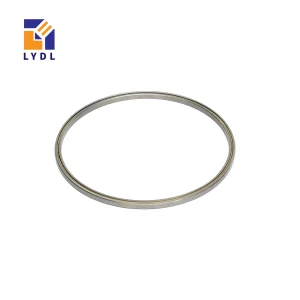
Thin Section Bearing Reference
127 × 152.4 × 12.7 mm
Bore d × Outside D × Width / height B/H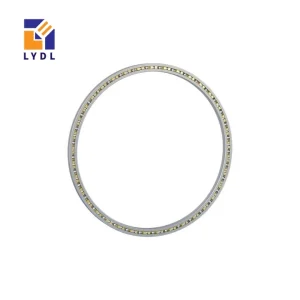
Thin Section Bearing Reference
203.2 × 222.25 × 9.525 mm
Bore d × Outside D × Width / height B/H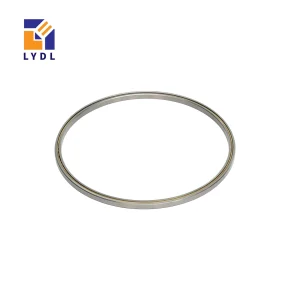
Thin Section Bearing Reference
152.4 × 177.8 × 12.7 mm
Bore d × Outside D × Width / height B/H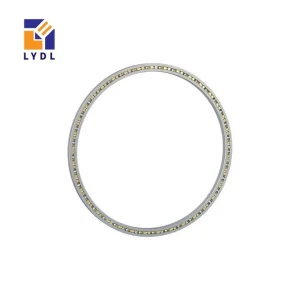
Thin Section Bearing Reference
203.2 × 228.6 × 12.7 mm
Bore d × Outside D × Width / height B/HThin section ball bearings save space and weight in compact machines. Their cross-section stays small even when the bore gets large. This lets designers fit smooth, accurate rotation into tight housings.
LYDL supplies metric thin section ball bearings for automation, robotics, medical equipment, and other precision applications. This page explains the types, sizes, options, and selection points so you can choose the right bearing.
A thin section ball bearing has a narrow ring wall and a small radial cross-section compared with its bore. The rings are thin, the balls are small, and the whole bearing takes up very little room.
In many thin section series, the cross-section stays the same as the bore grows. A bearing with a 100 mm bore and one with a 200 mm bore can share the same profile. This is why they are also called constant section bearings.
Standard ball bearings grow thicker as the bore increases. That adds weight and requires larger housings. Thin section bearings avoid this problem.
Thin section bearings come in three main contact designs. Each handles load differently.
Radial contact bearings have deep raceway grooves. They carry radial loads well. They also take light axial loads in both directions. This is the most common type for general automation and light to medium duty use.
Angular contact bearings carry combined radial and axial loads. The axial load works in one direction only. They are often used in pairs or sets to handle thrust from both sides and to set preload.
Four-point contact bearings take radial load and axial load from both directions in one bearing. They work like a double row angular contact bearing. This saves space when a single bearing must hold a shaft against thrust either way.
LYDL’s range on this page focuses on metric thin section radial contact ball bearings. For angular contact or four-point contact needs, send us your drawing and load details.
Metric thin section bearings follow standard dimension series. The common ones are the 618 and 619 series. These are thin versions of the more familiar 6000 and 6200 series.
The table below shows reference dimensions for the 618 series. Use it to check basic fit and envelope size.
| Bearing No. | Bore (mm) | Outside Diameter (mm) | Width (mm) |
|---|---|---|---|
| 61800 | 10 | 19 | 5 |
| 61801 | 12 | 21 | 5 |
| 61802 | 15 | 24 | 5 |
| 61803 | 17 | 26 | 5 |
| 61804 | 20 | 32 | 7 |
| 61805 | 25 | 37 | 7 |
| 61806 | 30 | 42 | 7 |
| 61807 | 35 | 47 | 7 |
Need a larger bore, a different cross-section or a non-standard size? We can quote custom dimensions on request.
The right closure depends on your environment and your maintenance plan.
If the bearing runs at high speed, shields are usually a good balance. If the housing is dirty or washed down, choose seals.
Ring and ball material. Chrome steel is the standard choice and gives good hardness and fatigue life. Stainless steel suits corrosive or humid conditions. Ceramic balls can be requested for special speed or electrical insulation needs.
Cage type. Pressed steel cages are the common option. Other cage materials can suit higher speed or special temperature ranges.
Precision grade. Light, accurate machines need tight running accuracy. State the grade you need when you request a quote, so the rings and balls are made to match it.
Internal clearance. Normal clearance suits most uses. Smaller or larger clearance can be chosen to control stiffness, noise, and heat.
Lubrication. Grease is standard. Special greases can be selected for low torque, high speed, low noise, or wide temperature ranges.
Thin section ball bearings work where space and weight are limited, and where motion must stay accurate.
| Feature | Thin Section Bearing | Standard Ball Bearing |
|---|---|---|
| Cross-section | Small and often constant across bore sizes | Grows as the bore grows |
| Weight | Low | Higher |
| Housing space | Compact | Larger |
| Load capacity | Light to medium | Medium to heavy |
| Large bore designs | Practical and light | Heavy and bulky |
| Best use | Space and weight-limited designs | General purpose machinery |
Thin section bearings carry less load than a standard bearing of the same bore. If your load is heavy, consider a cross roller bearing instead. Cross roller bearings carry radial, axial, and moment loads in one compact unit.
Check these points before you order.
LYDL Bearing is a precision bearing manufacturer based in Luoyang, China. We supply standard metric thin section ball bearings and can quote custom sizes, materials, closures, and lubrication for OEM projects.
To get a quote, send us your drawing or these details: bore, outside diameter, width, bearing type, closure, material, precision grade, lubricant, and annual quantity.
It is a ball bearing with a very small cross-section compared with its bore. It saves space and weight while keeping smooth, accurate rotation.
A standard bearing gets thicker as the bore gets larger. A thin section bearing keeps a slim profile at larger bore sizes. This makes it lighter and easier to fit in compact designs.
Four-point contact bearings handle axial load in both directions. Angular contact bearings handle it in one direction. Radial contact bearings take light axial loads in both directions.
Choose open bearings for the lowest friction in clean conditions. Choose shielded or sealed bearings when dust or moisture is present.
They suit light to medium loads. For heavy loads or moment loads, a cross roller bearing is often a better choice.
Yes. We can quote custom sizes, materials, closures, and lubricants for OEM and project orders.
Send us your bearing number or drawing and your quantity. Our team will reply with pricing and lead time.