

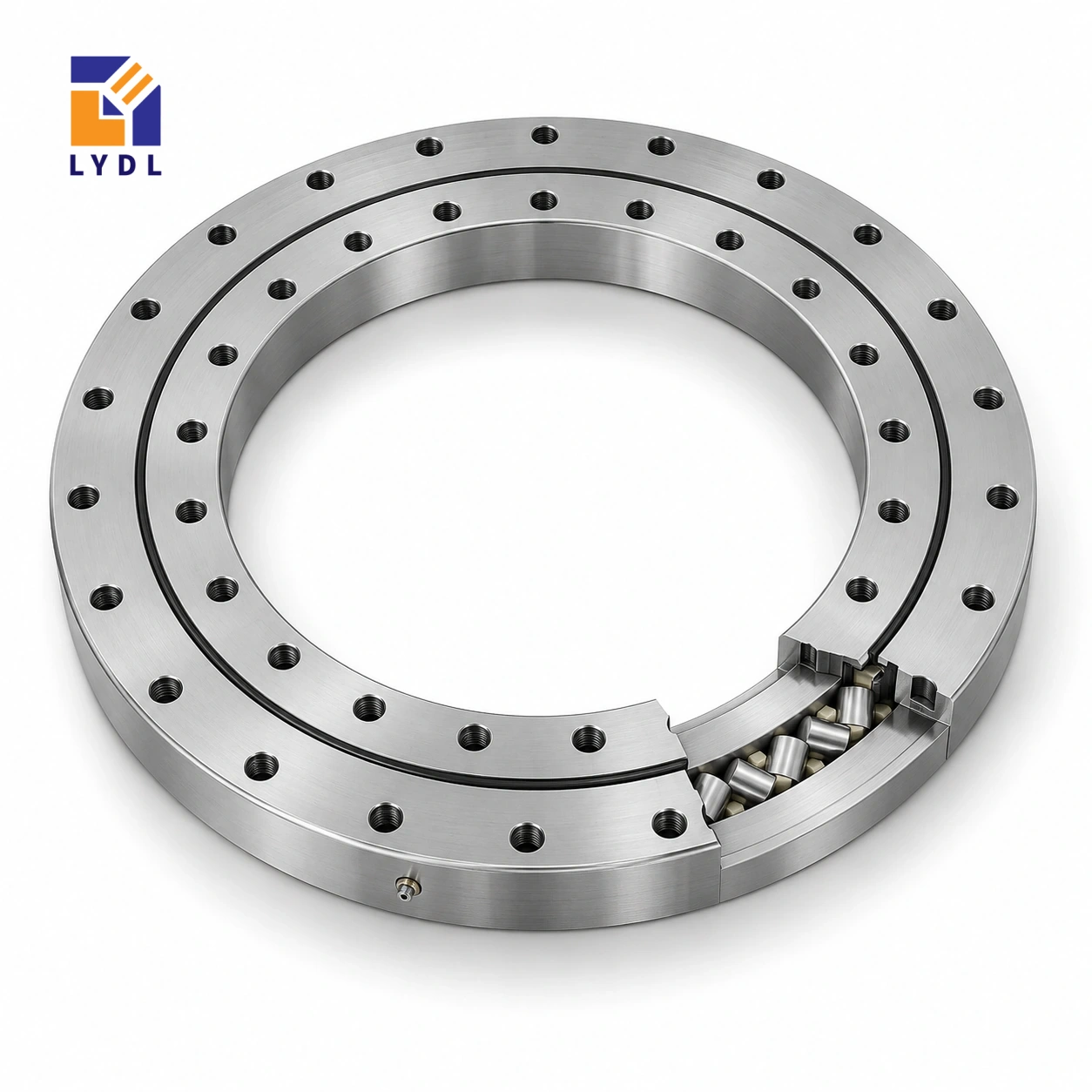
XU080264 is a shallow, ungeared crossed roller reference with a 215.9 mm bore, 311 mm outside diameter and 25.4 mm height. Its relatively open centre makes service routing attractive, while the exact decimal fixing geometry remains important for a replacement interface.
XU080264 original-reference geometry: Catalogue 404, pp. 90–93. LYDL supply follows its accepted drawing.
XU specification tables · Family technical reference
| Bore (mm) | Outside (mm) | Height H (mm) | Mass ≈ (kg) |
|---|---|---|---|
| 215.9 | 311 | 25.4 | 6.9 |
| Outer PCD La (mm) | Inner PCD Li (mm) | Outer holes na | Inner holes ni | Hole dB (mm) |
|---|---|---|---|---|
| 295.3 | 231.8 | 12 | 12 | 9 |
Catalogue 404 identifies this XU reference among the designs without a relubrication facility. Do not add a grease-nipple assumption to the maintenance plan simply because larger slewing rings use one. Establish the supplied lubrication arrangement, environment, duty and intended service interval with LYDL. The large central passage should also be checked for contamination paths from nearby equipment; available bore area does not remove the need for an enclosure design.
Keep the outer fixing circle at 295.3 mm and the inner circle at 231.8 mm in the reference comparison. Twelve positions per ring and a 9 mm fixing-hole reference are listed; confirm the mating tolerances separately.
An antenna housing should direct rainwater away from the support and avoid trapping condensation near the ring. Describe that enclosure when discussing the lubrication execution; a catalogue reference without a grease fitting does not establish a maintenance-free outdoor system. Identify drain paths, idle storage conditions and the way cables enter the housing. The bearing review concerns its supplied configuration, while the designer remains responsible for the environmental boundary created by the surrounding machine.
The XU080264 dimensions describe several different interfaces. Bore 215.9 mm and outside diameter 311 mm set the basic radial envelope; overall H = 25.4 mm sets the bearing's axial reference. Fixing circles La = 295.3 mm and Li = 231.8 mm locate the outer and inner attachment patterns, rather than the free opening or roller diameter. The reference lists 12 fixing positions on each ring. A circle and a count do not fully describe a hole: seat details, thread engagement and angular orientation still belong on the accepted drawing. Approximate mass 6.9 kg is a component property, not an approved payload. Reading these fields separately helps prevent a correct catalogue number being transferred to the wrong feature of a mating plate.
Start with a section of the antenna housing that shows the ring, central services and the paths by which moisture or debris could reach them. Identify covers, drains and any opening exposed while the machine is idle. An enclosure may protect the bearing during operation but admit condensation or water during storage. Describe those states separately when discussing the supplied configuration.
The original reference is marked without a relubrication facility, so the equipment maintenance plan should not assume an accessible grease nipple. Ask how the offered LYDL execution is lubricated and what information is needed to assess the actual duty. Do not translate that feature into a claim of maintenance-free outdoor operation. State the expected movement, contamination and idle periods instead. The surrounding housing creates the environmental boundary, while the purchased bearing needs a defined configuration within it. Keeping those responsibilities visible is particularly useful when the platform will be installed remotely and routine access is limited.
Draw the full cable or service assembly through the 215.9 mm reference bore, including connectors and restraints. Check its position at the extremes of travel and its temporary size during installation. A central component can fit when assembled yet require additional room to be inserted or withdrawn.
The shallow 25.4 mm ring package should be placed in a complete axial stack showing both support plates and their shoulders. Confirm that the inner attachment remains accessible beside the service equipment. Keep the decimal fixing-circle values in the machining comparison rather than rounding them to simplify the drawing. Identify which features locate the rotating platform and which only provide clearance. If an existing machine includes locally made covers, measure and document those parts independently of the bearing. This helps prevent an accessible cover diameter from being mistaken for a nominal ring dimension during a replacement enquiry.
Describe the smallest routine movement as well as the largest travel. An antenna platform may make frequent reversals during tracking, then a larger repositioning movement at a different duty. State the time spent holding position and any long idle periods. These conditions should be available to the component review instead of being reduced to a single average rotational speed.
Provide environmental forces and their points of application on the actual antenna structure. The bearing dimensions alone cannot establish a wind-load or pointing capability. Identify the location used to judge angular or linear movement and distinguish it from a free-ring inspection. Include the drive support and cable reaction in the equipment drawing. A change in enclosure, antenna size or service routing may alter the approved operating cases even when the same bearing reference remains in place. Record those limits with the machine information so a spare-part decision does not silently become a wider design change.
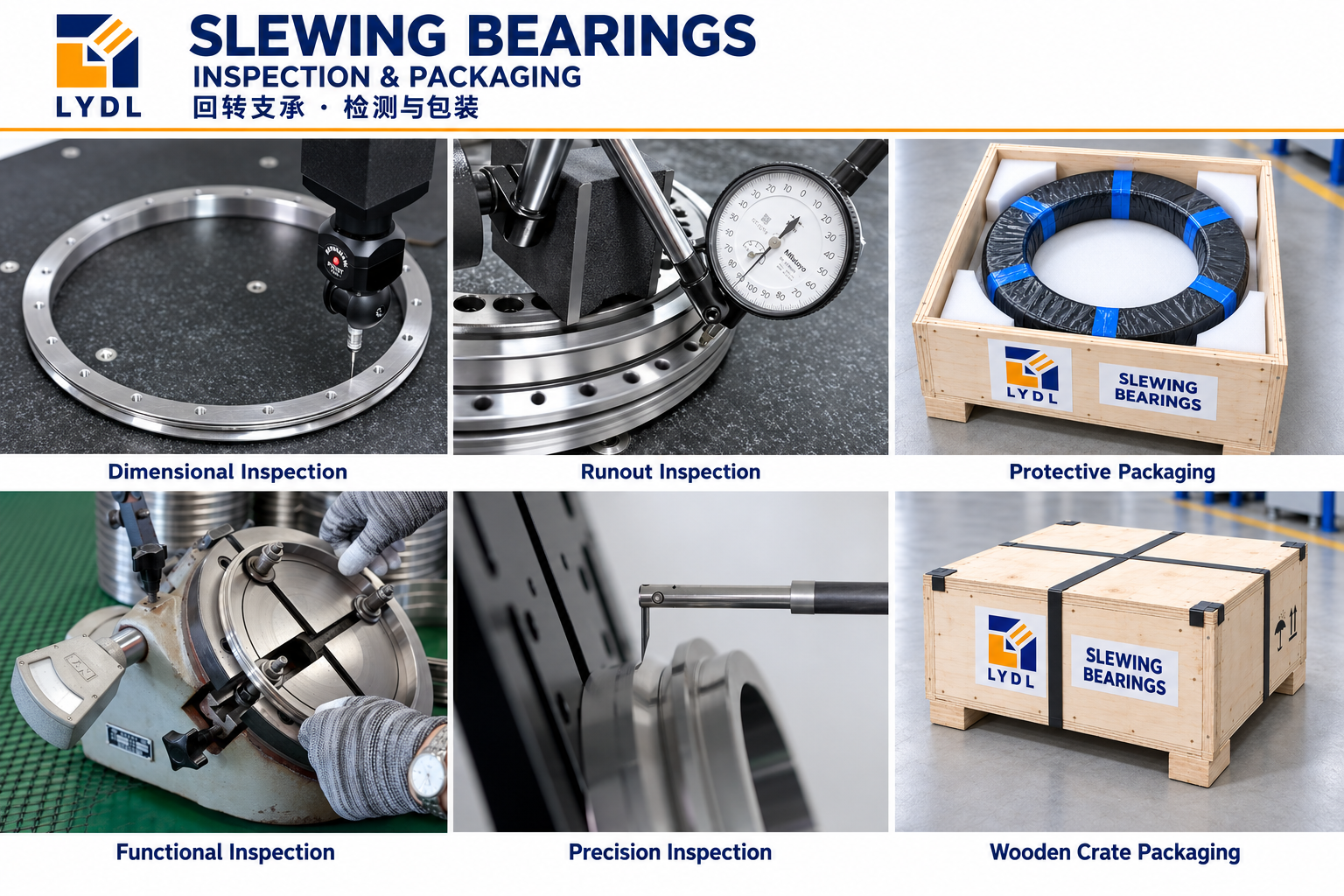
Agree the delivered identity, drawing revision and preservation requirements before dispatch. Specify the measurements relevant to the mounting interfaces and any functional checks under stated conditions. Storage duration and the route to the assembly location should be considered when defining protective packing, rather than assuming a generic crate image establishes adequate protection.
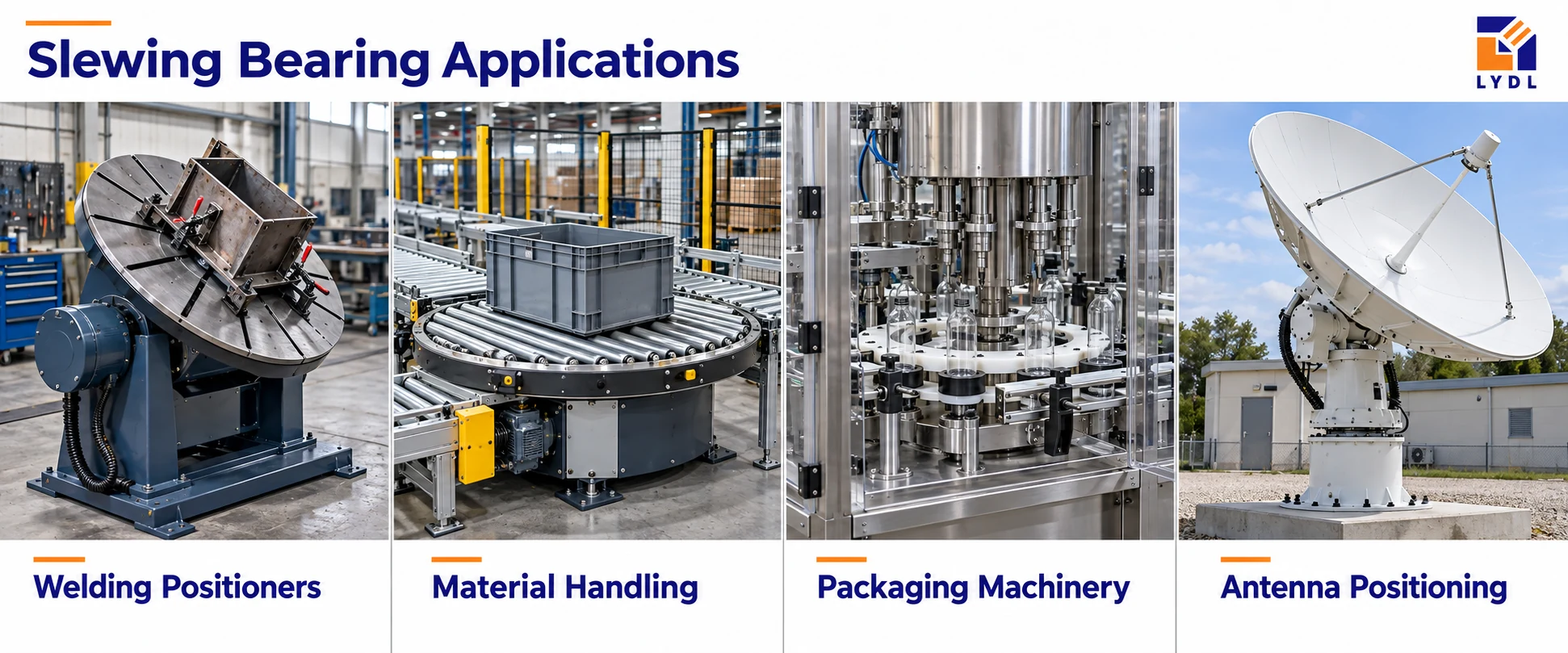
At installation, inspect the seating and resolve interference before fastening. Confirm the service routing and enclosure details in the same state used for the operational check. Retain observations at the equipment output, including the motion and loading condition. Those records can help distinguish later changes in structure, drive or environmental exposure from a component issue. The product main image is a family reference, and the application montage is illustrative. Neither is evidence of the supplied lubrication execution or a documented antenna installation. A clear enquiry connects the actual equipment conditions with the proposed LYDL drawing and acceptance requirements.
For an initial dimensional shortlist, place XU080264 (215.9 × 311 × 25.4 mm) beside XU160260 (191 × 329 × 46 mm) and XU120222 (140 × 300 × 36 mm). These nearby requested references provide a useful envelope comparison, not a sequence of increasing approved load ratings. Compare their actual bolt circles and support faces before deciding which deserves a detailed drawing review. A smaller bore can conflict with the service route, while a different outside diameter changes the available backing annulus. Retain the complete model in every enquiry so a proposal is tied to the intended row. Only the accepted execution and application assessment can resolve the final choice.
A low-profile antenna positioning platform is an illustrative study. Evaluate wind-induced loading, enclosure sealing and cable twist together, without reading a wind rating into the bearing dimensions.
Clarify the delivered lubrication and preservation information on the order record. Maintain the protective wrapping until the dry, clean assembly location is ready.
The main height is 25.4 mm. Verify additional housings and seal covers in the complete installation stack.
No. Catalogue 404 marks this reference as having no relubrication facility. Confirm the actual supplied lubrication execution with LYDL.
The cited catalogue uses 295.3 mm and 231.8 mm. The web table uses rounded values, which should not govern machining.
It establishes one space constraint. Wind moments, tracking motion, enclosure protection and required pointing performance need an application assessment.
State contamination, humidity, cycling frequency and accessible servicing points. Ask which supplied configuration supports the intended maintenance approach.
Roller interface comparison: XSU series. Ball-contact option: VU range.
For XU080264, describe the maintenance access, outdoor enclosure and planned operating cycle alongside the mounting drawing.