

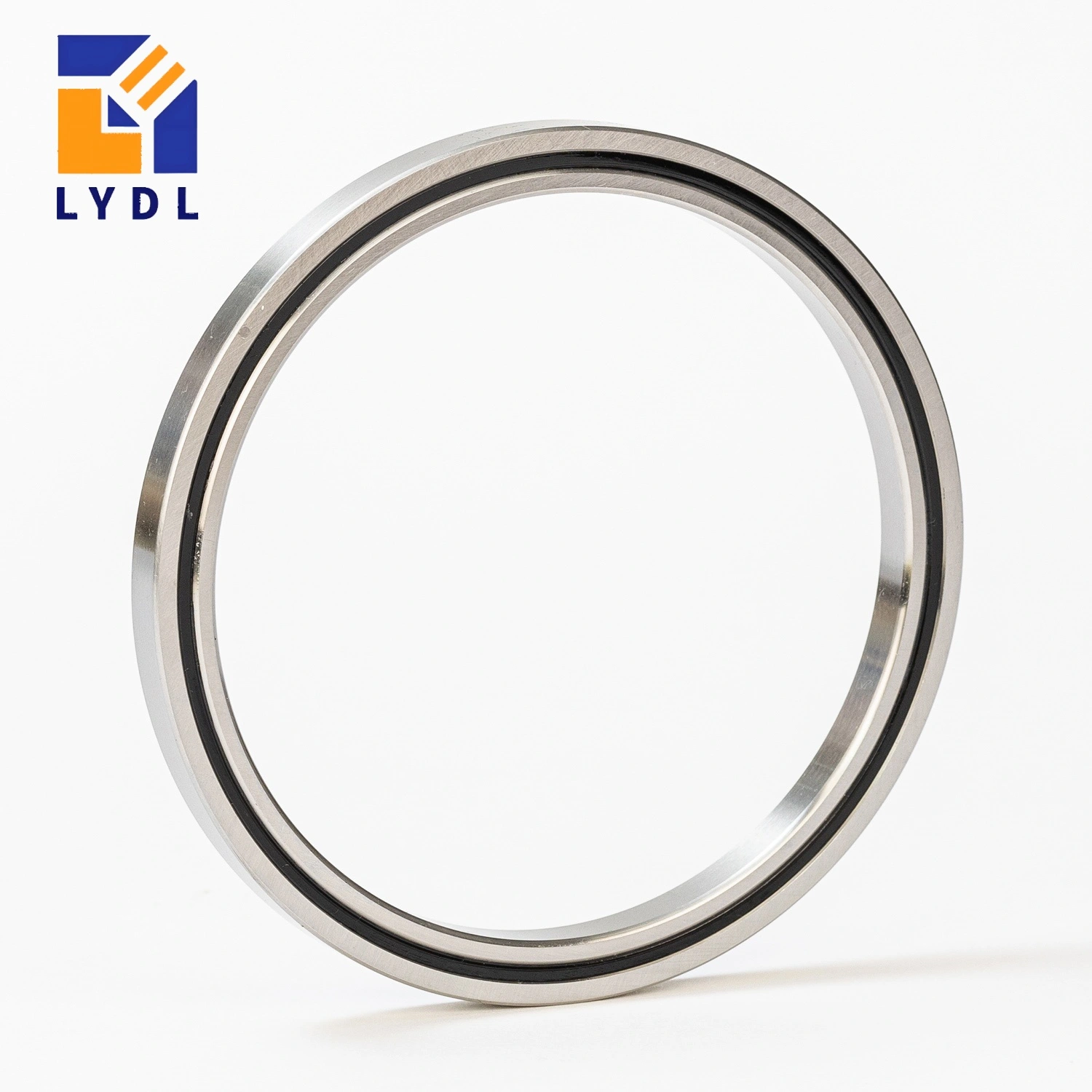
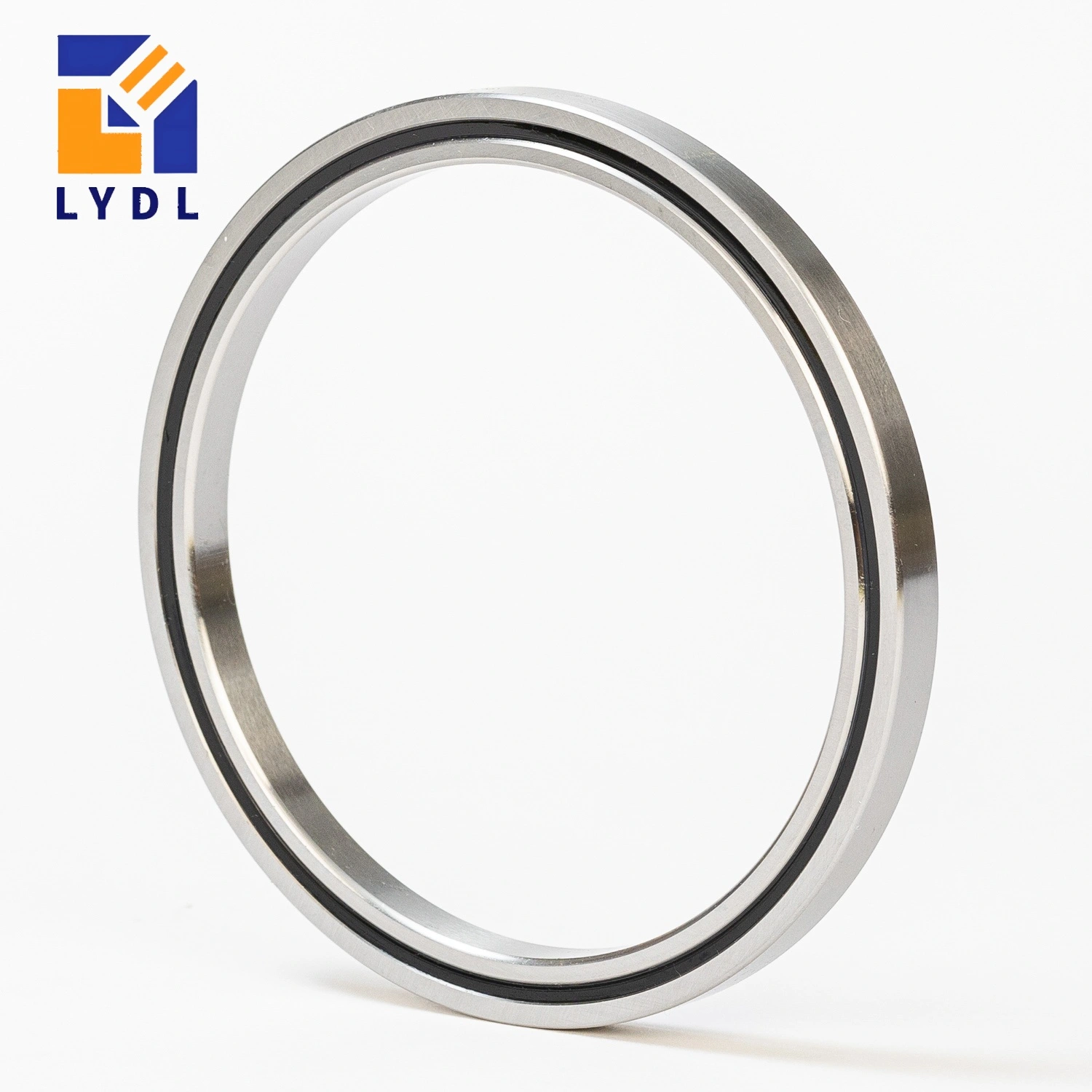
The RAU10008 cross roller bearing measures 100 × 116 × 8 mm and is part of THK’s RA-compatible reference group. Integral reference rings allow a design review for either inner-ring or outer-ring rotation. The designation is RAU10008, not an abbreviated RAU1008; keeping the complete code avoids confusion between bore and width information. [1, 2]
A 100 mm bearing seat can support a hollow-axis arrangement when a suitable hub is designed through it. The actual clear passage is smaller than the bearing bore if a shaft wall occupies that space. Consult the cross roller bearing selection guide and define the hub section, retaining faces and service route together before describing the available central clearance.
| Parameter | THK RAU10008 |
|---|---|
| Bore d | 100 mm |
| Outside diameter D | 116 mm |
| Width B / B1 | 8 mm |
| Radial section (D – d) / 2 | 8 mm |
| Roller pitch circle dp | 107 mm |
| Minimum chamfer r | 0.5 mm |
| Shaft shoulder ds (maximum) | 103.5 mm |
| Housing shoulder Dh (minimum) | 110.5 mm |
| Dynamic radial load rating C | 7.15 kN |
| Static radial load rating C0 | 13.90 kN |
| Reference mass | 0.14 kg |
| Lubrication holes | 4 x Ø1.5 mm |
THK publishes 7.15 kN dynamic radial rating C and 13.90 kN static radial rating C0 for RAU10008, with 0.14 kg reference mass. They are not motor-torque limits or permissible loads for a complete rotary platform. The platform geometry, axial force and applied moment must be reviewed using the correct load combinations. Use the figures as traceable reference inputs while LYDL’s approved order drawing defines supply. [2, 6]
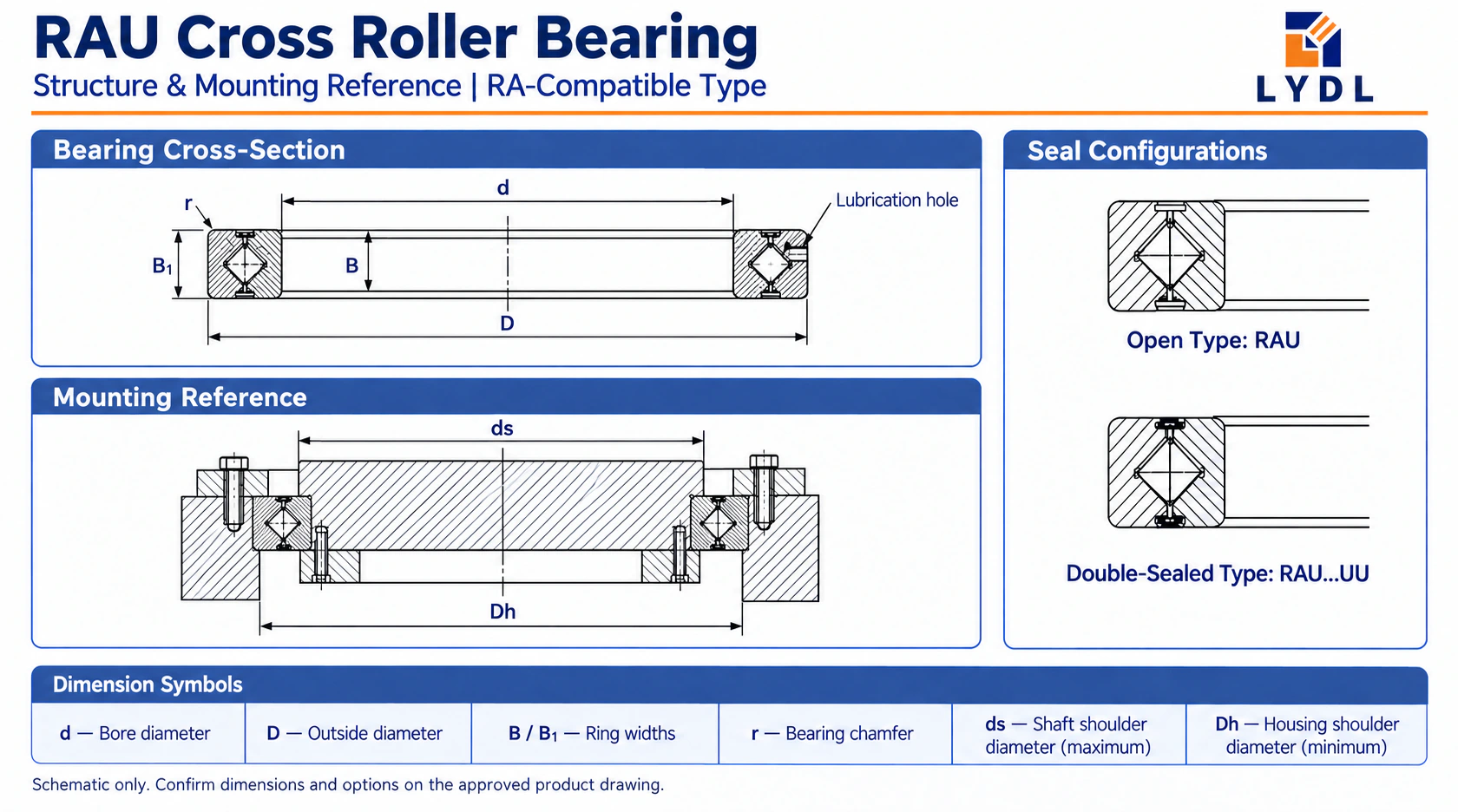
The structure key assigns d = 100 mm, D = 116 mm and B/B1 = 8 mm. The roller pitch reference is 107 mm. Maximum shaft shoulder diameter ds is 103.5 mm and minimum housing shoulder diameter Dh is 110.5 mm. These shoulder diameters locate suitable supporting regions; they do not specify shaft or housing fit classes. The lubrication opening and optional sealed section should be read as separate features. [2]
Lay out the central hub around the bearing seat, then check the resulting service opening. Wall thickness, a liner, internal fasteners and connectors can reduce the usable passage. Where services turn with the hub, confirm their swept envelope and the route to any rotary connector. Avoid treating the bare 100 mm bearing hole as the finished machine’s available opening.
Compare models in the RAU series size range after estimating the hub structure. An 8 mm-wide bearing is only one part of the axial stack; the support flange, seals or covers and encoder attachment add height. Check access for installing and removing these parts. Serviceability can become difficult if the cartridge is dimensioned around the bearing alone and then surrounded by permanent structure.
Identify the ring that rotates under load and the requirement at its reference surface. Select seals and radial clearance or preload independently of rotation accuracy. THK’s reference numbering separates these fields, so one suffix should not stand in for the complete order specification. If a replacement has a one-sided seal, show the marked face and assembly orientation rather than describing it only verbally. [3]
For a same-envelope split-ring alternative, inspect the RA series comparison. Compare the retaining method and installation sequence as well as boundary dimensions. A supplier’s nominal matching size does not settle lubricant access or thermal behaviour in the existing housing. Keep the full original designation and its drawing available during the replacement discussion.
A bearing fitted between dissimilar hub and housing materials can experience changes in its operating fit as temperatures change. Describe the assembly materials and temperature range to the reviewer; no general fit class on a product page can resolve every condition. Add expected heat sources such as a nearby drive motor and the duration of warm operation.
Compare the CRBH / CRBHV bearing options if the mechanism can accept a larger outside diameter or greater axial section. Such a change needs a fresh load, support and thermal review. The goal is to choose a coherent axis arrangement, not to increase one catalogue number while leaving the shaft, housing or retention too flexible to support the chosen bearing.

Apply the ds maximum and Dh minimum to the support geometry, while using the approved bearing dimensions to establish fits. Relieve mating corners so they do not interfere with the reference chamfer. Check both retaining faces for flat contact and avoid forcing the ring into a distorted seat. The specified support geometry is more useful than assuming a generic tolerance from a neighbouring model. [2, 4]
RAU10008 has four Ø1.5 mm lubrication holes in the reference drawing. Show how lubricant reaches them when the hub, guards and drive are installed. These openings do not replace flange fastening. Review the insertion plug position against the dominant load direction and keep the agreed orientation identifiable during assembly. Do not relocate or enlarge a port from the simplified structure graphic. [2, 5]
Record rotation resistance at initial assembly and after the machine reaches its representative operating temperature. Use comparable speed and load conditions when interpreting the two checks. A thermal change may originate in the surrounding fit or service bundle as well as the bearing. This information supports diagnosis without assigning an unsupported temperature capability to the product.
Record the complete RAU10008 designation and accepted configuration with dimensional, clearance and ring-accuracy limits. Identify the fixture and measurement datum.
Support the bearing independently of loose hardware, protect seating surfaces and provide legible labels. Agree corrosion protection and batch records. The shared illustration describes general methods; order-specific documentation establishes the supplied configuration and inspection scope.

RAU10008 is the complete catalogue designation for the 100 × 116 × 8 mm reference. Omitting a digit changes the model string and can create ambiguity in quotations or database matching. Use the full code on drawings, enquiries, media descriptions and carton identification. [2]
Usually not. The bearing bore locates a shaft or hub outside diameter. The useful passage is determined by that part’s inside diameter, wall thickness, liners and routed connectors. State the finished clear passage as a separate assembly dimension.
A final fit review should include temperatures, hub and housing materials, rotation and loading. Differential expansion can change the installed condition. The shoulder values on this page are geometry limits rather than fit classes, so they do not replace that review. [4]
Motor torque drives rotation about the axis. An overturning moment tends to tilt the supported member and depends on force offsets. Both may influence the assembly, but the radial C or C0 rating cannot be used directly as a motor-torque specification. [6]
Name the measured feature, datum, temperature, load and motion condition. Keep these consistent with the specified operating state and compare them with the initial assembly check where useful. A temperature reading without its measurement context does not establish bearing accuracy or fit stability.
Supply the hollow-hub drawing, materials, operating temperatures and routed services alongside forces and moments. Identify the required ring accuracy and seal arrangement. To discuss RAU10008, contact LYDL with quantity and the unabridged original model code. Request the proposed drawing, acceptance conditions and packing identification before confirming the order.
Reference review: 10 October 2026. Brand names identify technical sources, not LYDL affiliation. The agreed LYDL drawing and quotation define supply.