

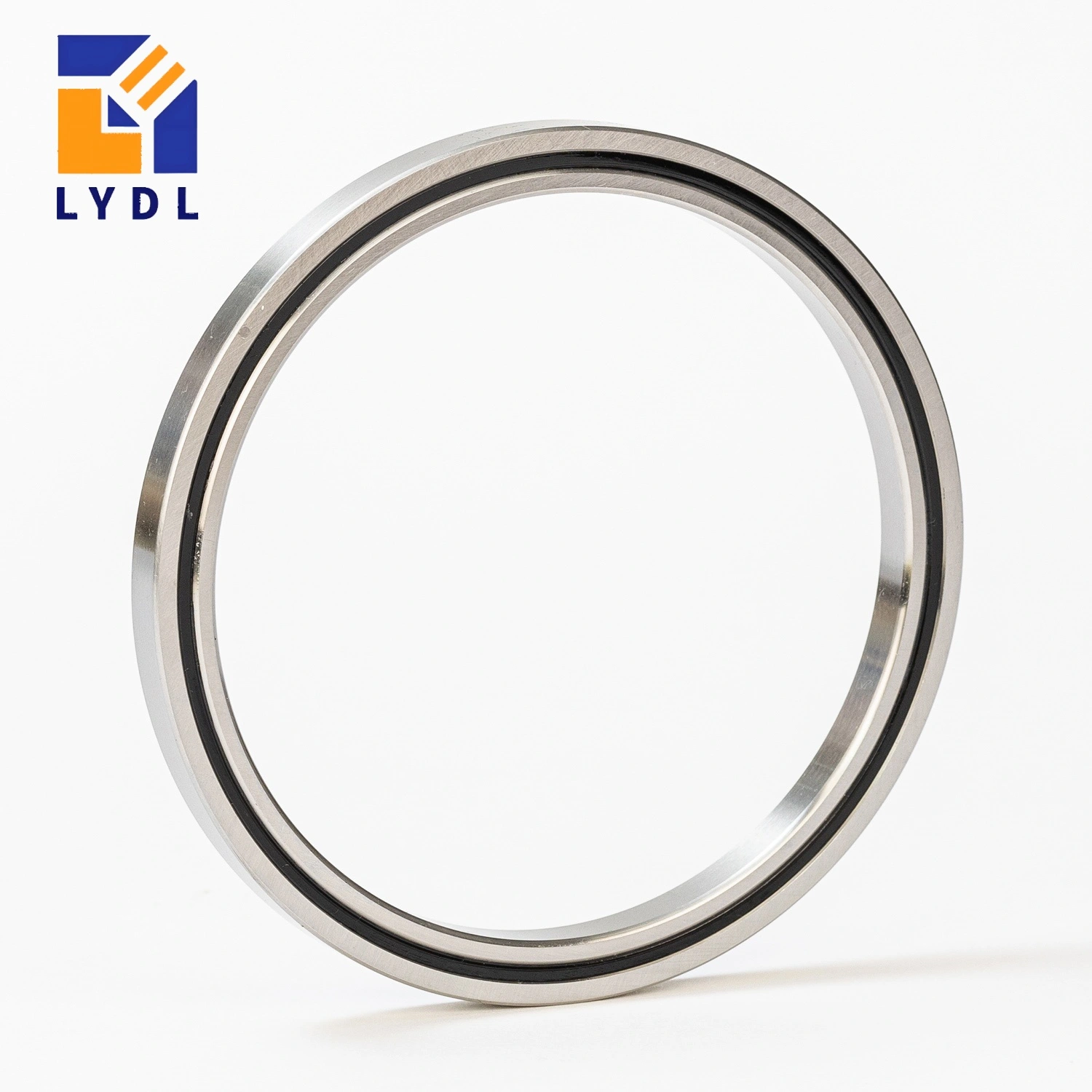
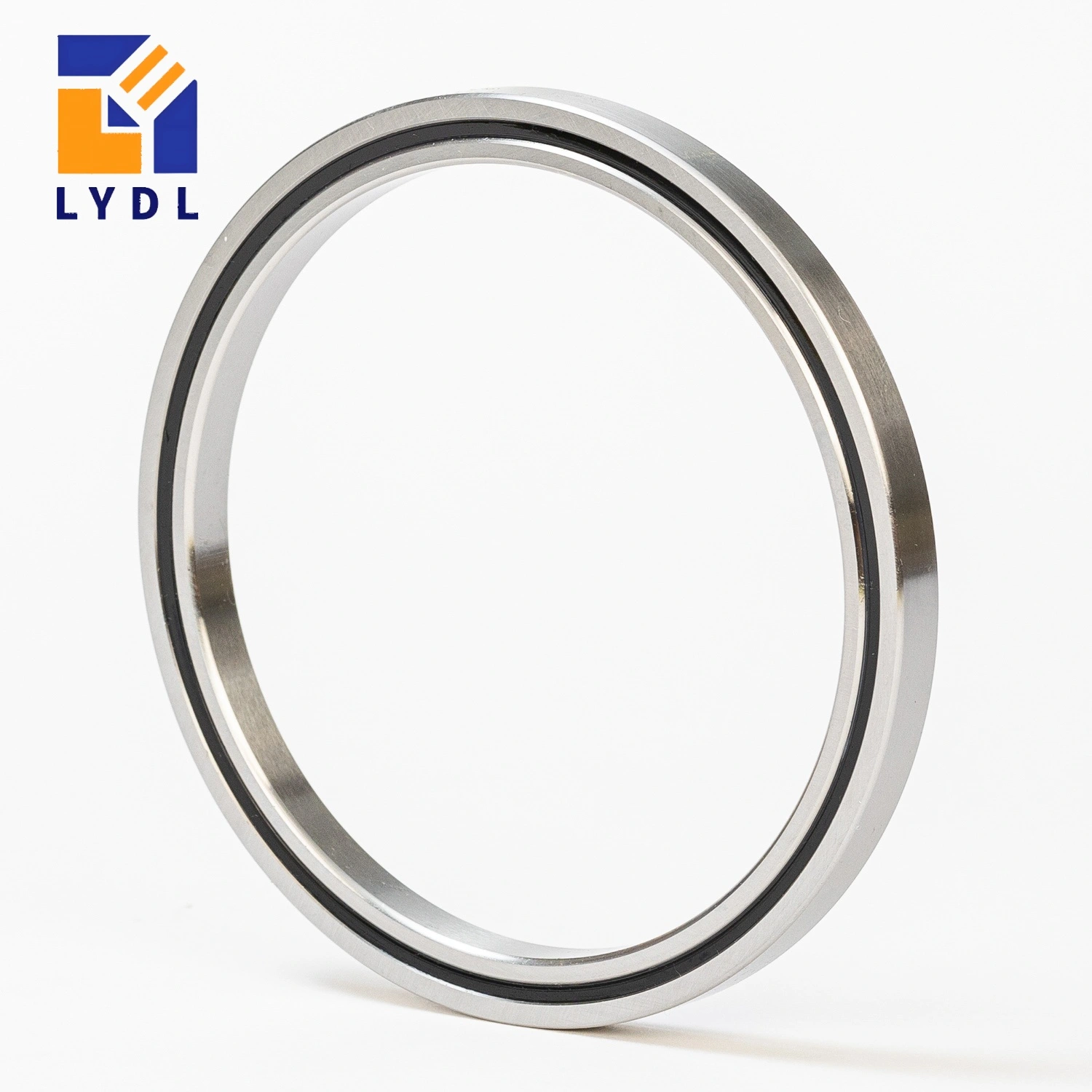
The CRBT205A cross roller bearing reference fits a 20 mm bore, 31 mm OD and 5 mm width. THK RAU2005C0 has the same nominal envelope but different published load data and lubrication features. This page keeps both technical references visible for a compact gripper or instrument-axis enquiry. Matching external dimensions is the beginning of a comparison, not its conclusion. [1, 3]
An offset gripper force can be more important than the tool’s weight. Define the force direction and distance to the bearing centre before selecting a small pivot. The cross roller bearing selection guide explains the available rotary bearing arrangements; use it with the actual finger or bracket geometry rather than treating a bearing photograph as an assembly specification.
| Parameter | IKO CRBT205A | THK RAU2005C0 |
|---|---|---|
| Bore d | 20 mm | 20 mm |
| Outside diameter D | 31 mm | 31 mm |
| Width (IKO B / THK B, B1) | 5 mm | 5 mm |
| Radial section (D – d) / 2 | 5.5 mm | 5.5 mm |
| Roller pitch circle dp | Not stated in cited IKO row | 24.7 mm |
| Minimum chamfer r | 0.15 mm | 0.15 mm |
| Shoulder (IKO da / THK ds max) | 22.5 mm | 22.5 mm |
| Shoulder (IKO Da / THK Dh min) | 27 mm | 27 mm |
| Dynamic radial load rating C | 1.40 kN | 1.49 kN |
| Static radial load rating C0 | 1.290 kN | 1.40 kN |
| Reference mass | 14.8 g | 15 g |
| Lubrication holes | None in standard CRBT…A | 2 x Ø1 mm |
| Reference seals | Open type | Open; seals not supported |
| Reference clearance / accuracy | C1 / normal grade 0 | C0 / normal grade 0 |
IKO lists dynamic C 1.40 kN and static C0 1.290 kN for CRBT205A. THK lists 1.49 kN and 1.40 kN for RAU2005. The differences are retained in separate columns, with masses 14.8 g and 15 g respectively. They are radial ratings from the source designs. A gripping force at a lever arm also creates moment, so the useful tip capacity cannot be taken directly from either column. [1, 3, 6]
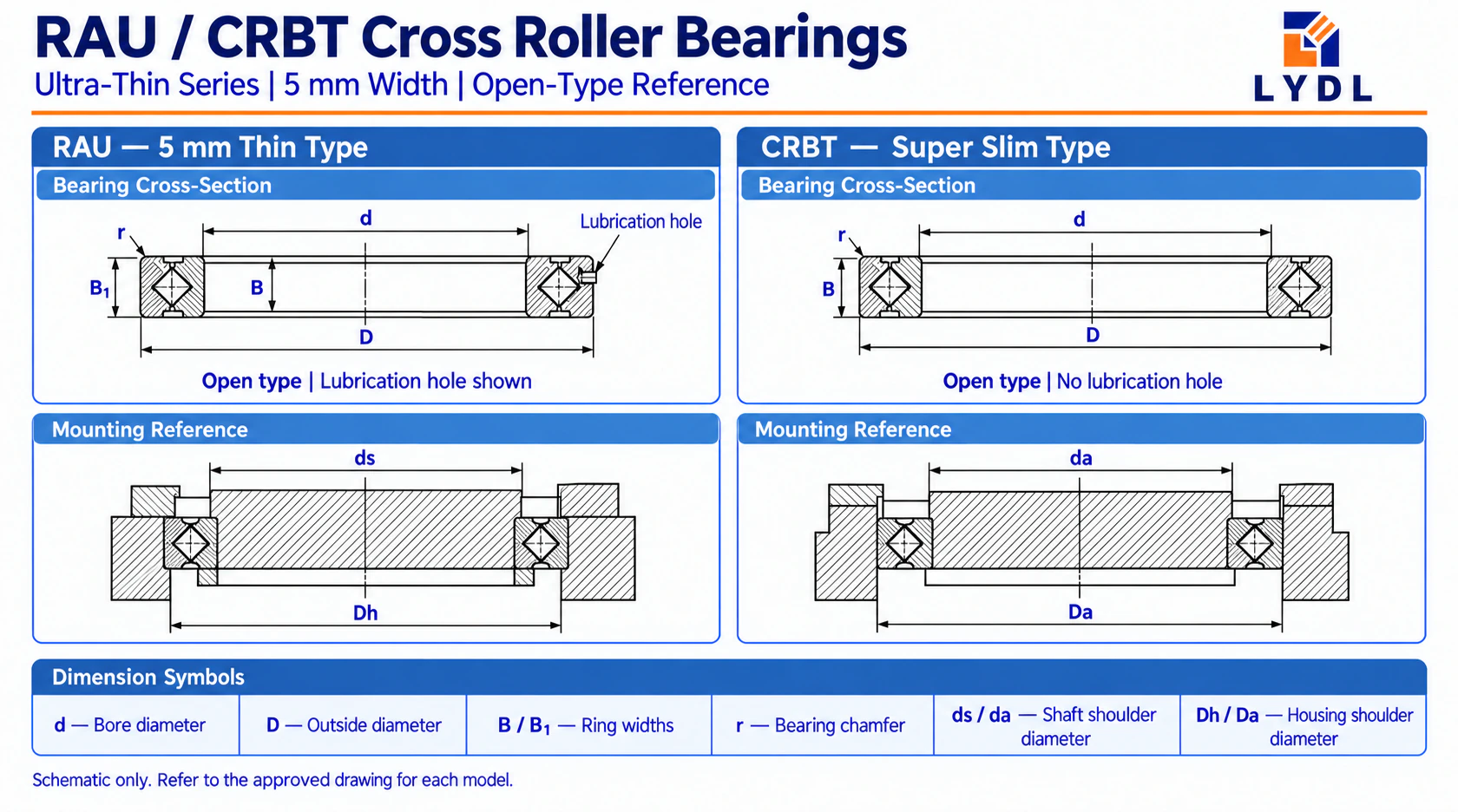
The schematic assigns d = 20 mm, D = 31 mm and width 5 mm. THK lists a 24.7 mm roller pitch circle and ds maximum 22.5 mm / Dh minimum 27 mm shoulders. IKO uses da and Da mounting references. Select the matching panel: RAU2005 includes two Ø1 mm lubrication holes; standard CRBT205A has none. The 5.5 mm radial section should not be confused with the 5 mm axial width. [1, 3]
Provide the jaw length, contact point and the force transmitted when a part is held. Add opening and closing acceleration, impacts at a stop and any external force applied to the held part. If a process force acts while the gripper is stationary, identify that held-load condition separately from the moving duty cycle.
Compare nearby envelopes in the CRBT / RAU ultra-thin bearing range once the 20 mm shaft seat and lever arrangement are known. A bigger bore may change hub stiffness or allow a different actuator connection, but it also changes the bearing seat. Consider the entire jaw pivot, including retention and access for cleaning, before deciding that a thin bearing solves the module’s packaging constraints.
For the standard manufacturer references, IKO CRBT…A uses open construction, C1 clearance and normal-grade accuracy. THK’s 5 mm RAU is open, C0 and normal grade 0 only. The cited catalogues do not support treating P5 as a standard configuration for this pair. Higher LYDL accuracy requests must be reviewed through numerical limits and a defined inspection method. [2, 3]
Use the RAU series size range to identify the separate RA-compatible range when comparing other thicknesses. Do not carry its seals or accuracy choices into RAU2005C0. For a replacement, specify the actual clearance requirement, lubricant route and full original model code. Similar C1/C0 terminology does not establish an automatic cross-brand suffix translation.
A small pivot may reverse repeatedly through a narrow angle and dwell under load. Describe this sequence, including the rate of starts and stops and the time spent gripping. The lubricant selection and inspection plan should reflect that use. Do not infer continuous high-speed capability or a maintenance interval from the compact section alone.
The CRBH / CRBHV bearing options offers larger-section choices where space permits. Compare their interfaces using the same jaw geometry, grip force and process-load conditions.

Keep ring support continuous within the approved geometry and verify mating corners against the 0.15 mm chamfer reference. The listed shoulder values guide support; they do not establish a bearing bolt circle. Choose the shaft and housing fits using the intended rotating ring and actual supplied dimensions. Do not force a thin assembly into a misaligned gripper body. [1, 3, 5]
An RAU-based housing must preserve the intended access to its two Ø1 mm reference holes. An IKO CRBT-based design should not assume those ports exist. Describe the lubricant route and any protection from handled-part debris on the mechanism drawing. Do not alter a bearing’s oil features from the shared illustration or use them for retention.
Check the pivot before attaching the jaw and actuator, then repeat with the full assembly in place. A rise in resistance can come from retention, jaw interference or the actuator connection. Record the sequence and inspect those interfaces. This approach helps diagnose the mechanism without asserting that every change in jaw behaviour comes from bearing clearance.
Set component acceptance and gripper-tip tests separately. Include the selected reference, inspection datum and loaded jaw condition.
Pack the open bearing apart from loose gripper hardware. Agree corrosion protection, configuration labels and records. The montage describes general methods; actual shipment evidence should identify the supplied item.

IKO publishes C 1.40 kN and C0 1.290 kN, while THK publishes 1.49 kN and 1.40 kN for its reference. Different internal designs and rating data can coexist with the same nominal envelope. Preserve the separate columns and review the intended supplied design. [1, 3]
No. The jaw applies force through its contact location and lever arm, producing moment as well as direct force. Describe the geometry and held-load condition. The static radial rating is an input to a bearing assessment, not a published maximum gripping force. [6]
Provide angular travel, reversal rate, acceleration, dwell and the load while gripping. Also identify stop events or impacts. Those details support lubricant and duty review; quoting only motor speed does not describe a pivot that mostly oscillates and holds position.
No. THK identifies it as the roller pitch circle for RAU2005. Retaining fasteners and jaw attachments need their own approved geometry. Use the structure diagram to understand symbols, not to derive mounting holes from an internal bearing dimension. [3]
Compare the retained pivot before and after connecting the actuator and jaw. Keep the measurement conditions consistent and check external rubbing or misalignment. The assembly record should identify where resistance changed, instead of assigning the full connected-mechanism torque to the bearing alone.
Provide the gripper section, jaw contact location, force, motion sequence and protection arrangement. Identify the CRBT205A or RAU2005C0 reference and any special numerical accuracy requirement. You can contact LYDL with quantity and the complete existing code to obtain a model-specific LYDL drawing and a quotation tied to the intended acceptance conditions.
Reference review: 10 October 2026. Brand names identify technical sources, not LYDL affiliation. The agreed LYDL drawing and quotation define supply.