

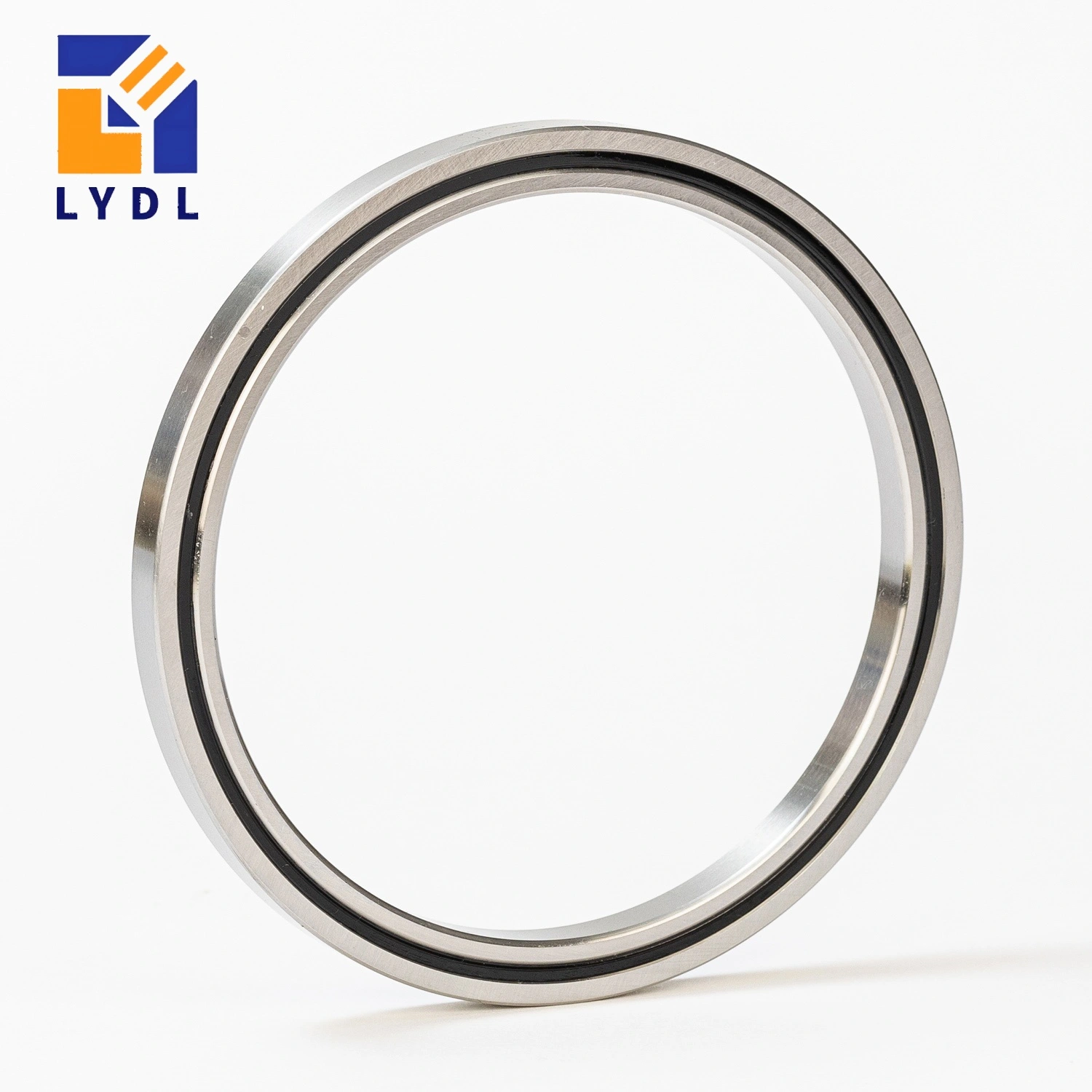
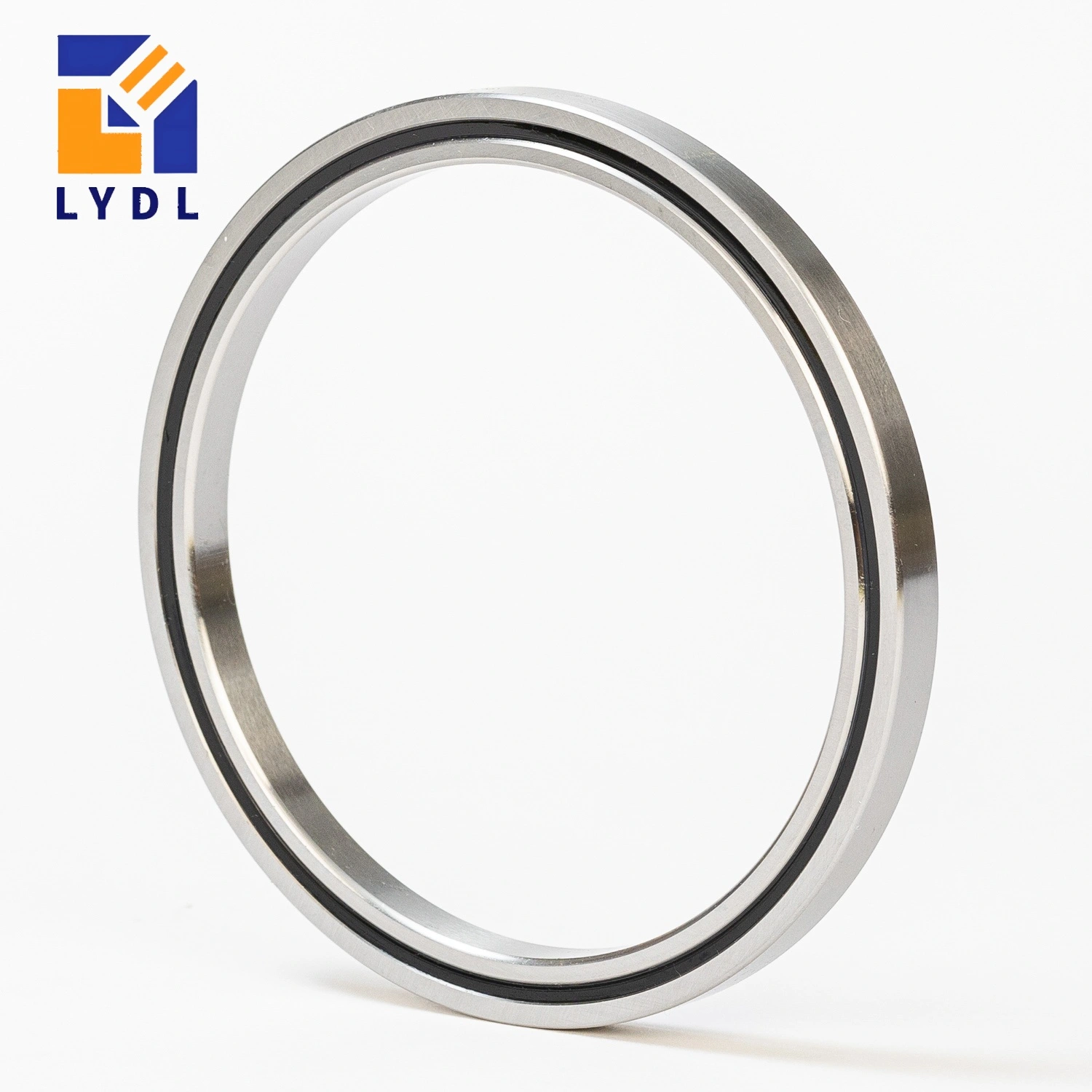
The CRBT505A cross roller bearing reference has a 50 mm bore, 61 mm outside diameter and 5 mm width. THK RAU5005C0 shares that thin envelope, with its own catalogue ratings and lubrication features. It must be distinguished from RAU5008, whose outside diameter and width are larger. A common 50 mm bore does not make these models the same product. [1, 3]
When axial packaging is the main constraint, compare the complete retained axis rather than the bearing width alone. The hub, flange and protection add to the available space requirement. Use the cross roller bearing selection guide to identify the suitable construction and the assembly features that need review before selecting a thin 50 mm-bore model.
| Parameter | IKO CRBT505A | THK RAU5005C0 |
|---|---|---|
| Bore d | 50 mm | 50 mm |
| Outside diameter D | 61 mm | 61 mm |
| Width (IKO B / THK B, B1) | 5 mm | 5 mm |
| Radial section (D – d) / 2 | 5.5 mm | 5.5 mm |
| Roller pitch circle dp | Not stated in cited IKO row | 54.7 mm |
| Minimum chamfer r | 0.15 mm | 0.15 mm |
| Shoulder (IKO da / THK ds max) | 52.5 mm | 52.5 mm |
| Shoulder (IKO Da / THK Dh min) | 57 mm | 57 mm |
| Dynamic radial load rating C | 2.28 kN | 2.43 kN |
| Static radial load rating C0 | 3.200 kN | 3.49 kN |
| Reference mass | 32.3 g | 32 g |
| Lubrication holes | None in standard CRBT…A | 2 x Ø1 mm |
| Reference seals | Open type | Open; seals not supported |
| Reference clearance / accuracy | C1 / normal grade 0 | C0 / normal grade 0 |
IKO lists CRBT505A with C 2.28 kN, C0 3.200 kN and mass 32.3 g. THK lists RAU5005 with C 2.43 kN, C0 3.49 kN and mass 32 g. Keep those radial source values separate. Choosing the smaller envelope may help packaging, but a payload or moment limit requires the actual load geometry and duty assessment. LYDL supplied specifications should be confirmed on the approved order drawing. [1, 3, 6]
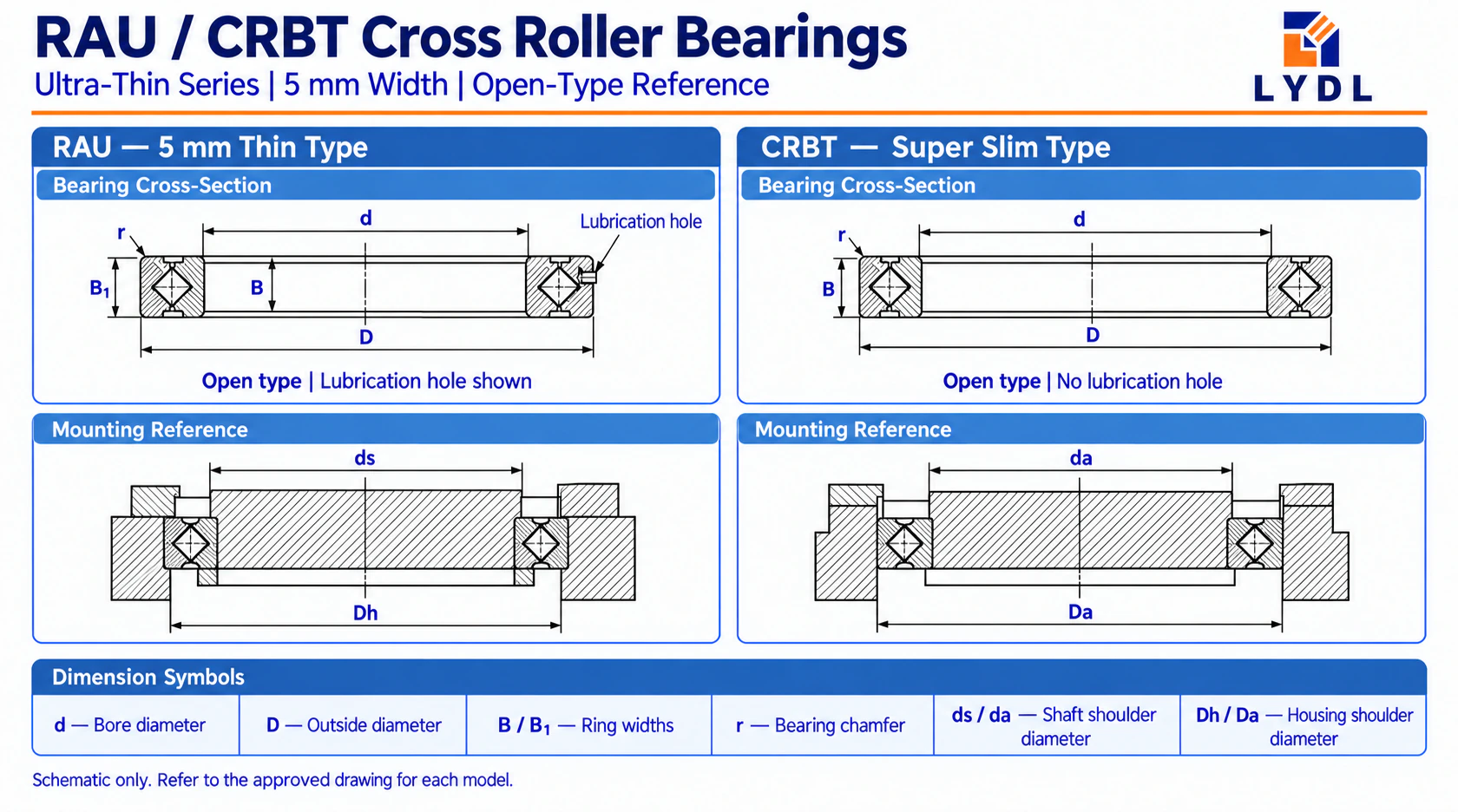
In both thin-family panels, d = 50 mm, D = 61 mm and the axial width is 5 mm. The radial section is 5.5 mm. THK’s roller pitch reference is 54.7 mm, with ds maximum 52.5 mm and Dh minimum 57 mm. The RAU reference shows two Ø1 mm lubrication holes; the IKO CRBT…A reference has no oil hole. Do not use the 8 mm RA-compatible structure graphic for this product pair. [1, 3]
The published RAU5008, 50 x 66 x 8 mm measures 50 × 66 × 8 mm. Relative to this thin pair, that adds 5 mm of outside diameter and 3 mm of width. It also belongs to a different reference group with different configuration options. Check whether the housing, flange and axial stack can accommodate those changes before calling it an alternative.
For the 50 × 61 × 5 mm layout, the housing must provide adequate support without consuming the saved space in improvised adapters. Show the shaft wall and useful passage, retaining faces and any cover in one section. If the original mechanism uses a different-width 50 mm bearing, a matching shaft diameter alone does not justify retaining its other mounting details.
The standard CRBT505A reference is open, with C1 clearance and normal-grade accuracy. The THK RAU5005 thin reference is open, C0 and normal grade 0 only. P5 is not listed as a standard option for these references in the cited catalogues. A tighter LYDL requirement needs separately approved numerical limits and inspection datums rather than an assumed cross-brand suffix match. [2, 3]
Browse the CRBT / RAU ultra-thin bearing range for the correct 5 mm size group. Do not transfer UU seal imagery or wider RAU accuracy choices into RAU5005C0. Matching manufacturer names in a comparison does not establish one universal configuration; identify the intended reference design and the actual LYDL item on the quotation.
The useful benefit of a thin bearing is determined after support and protection are included. A cover, encoder bracket or retaining flange may dominate the final height. Compare complete assembly sections for both candidates, including installation access. A reduction in bearing width should not be presented as an identical reduction in the finished mechanism.
Review the CRBH / CRBHV bearing options when larger sections are allowed. Use each alternative’s own seats and ratings with the same process forces and available space.

For the RAU5005 reference, apply ds ≤ 52.5 mm and Dh ≥ 57 mm to the support review. They differ from RAU5008’s shoulder dimensions. Verify mating corners against the thin family’s 0.15 mm minimum chamfer reference and agree actual fits from the supplied drawing. Do not use wider-family corner details simply because the shaft bore is unchanged. [3, 5]
Confirm the lubricant interface on the intended supplied design. Two Ø1 mm holes belong to RAU5005; standard CRBT505A has no oil hole. The four-hole, Ø1.5 mm RAU5008 reference is a different detail. Plan the housing route accordingly and do not use any lubricant opening as a flange fixing point. [1, 3]
Check the retained axis before fitting the drive and again after covers and services are connected. Use agreed datums to measure relevant runout. An assembled check helps identify whether the smaller envelope introduces interference or insufficient clearance around external parts. Preserve the test sequence if the mechanism will be reproduced or serviced later.
Record the selected 50 × 61 × 5 mm reference and agreed component limits. Define assembled-axis acceptance separately.
Protect the narrow ring and its seating faces during export. Labels must distinguish it from 8 mm same-bore models. Agree records and corrosion protection; the generic montage is not order-specific inspection evidence.

The nominal sizes differ: this thin reference is 50 × 61 × 5 mm, while RAU5008 is 50 × 66 × 8 mm. A common bore does not preserve housing seat, axial stack or shoulders. Review the complete assembly before proposing a replacement.
They belong to different reference groups. RAU5005C0 is the 5 mm open type with two Ø1 mm lubrication holes. RAU5008 has an 8 mm envelope and separate configuration options. Compare the mounting section and selected design before adopting the same support or protection arrangement. [3]
THK shows two Ø1 mm lubrication holes. It is not the four Ø1.5 mm arrangement of RAU5008. Standard IKO CRBT505A has no oil hole. These differences should remain identified when comparing the same-bore references and designing the housing feed. [1, 3]
Not from bearing width alone. RAU5008 is 3 mm wider, but flanges, covers, encoder interfaces and required clearances also determine assembly height. Compare complete retained sections before claiming a particular reduction in the finished mechanism.
IKO lists C/C0 as 2.28/3.200 kN, while THK lists 2.43/3.49 kN. They describe different source designs. Combining the higher entries into one common table could misrepresent either reference and does not establish LYDL supplied-product ratings. [1, 3]
Send the 50 mm hub section, required axial stack and current bearing designation. Identify CRBT505A or RAU5005C0 as the intended thin reference, plus loads and operating conditions. You can contact LYDL for a LYDL proposal with a clear configuration drawing, inspection criteria and any reviewed comparison against the wider RAU5008 envelope.
Reference review: 10 October 2026. Brand names identify technical sources, not LYDL affiliation. The agreed LYDL drawing and quotation define supply.