

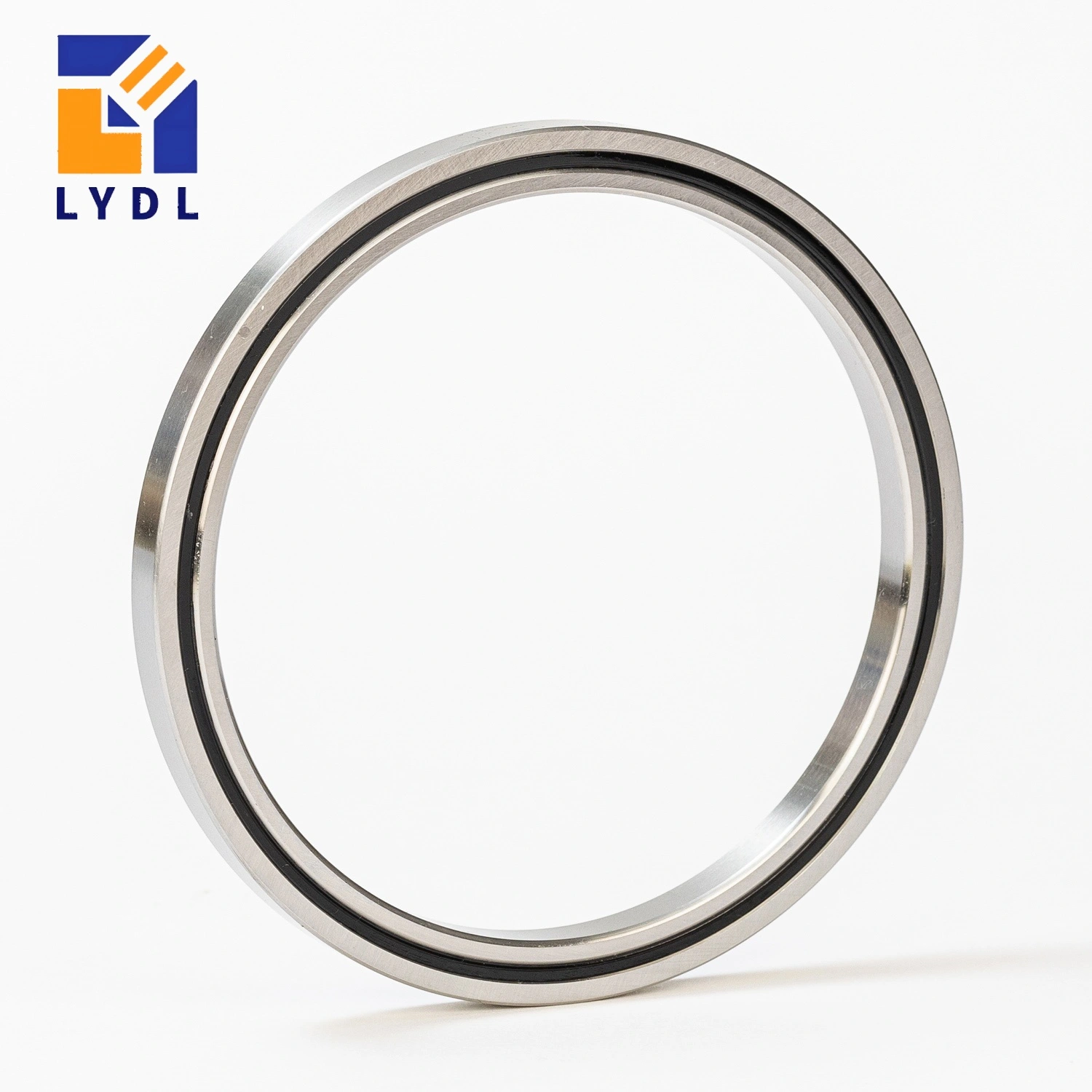
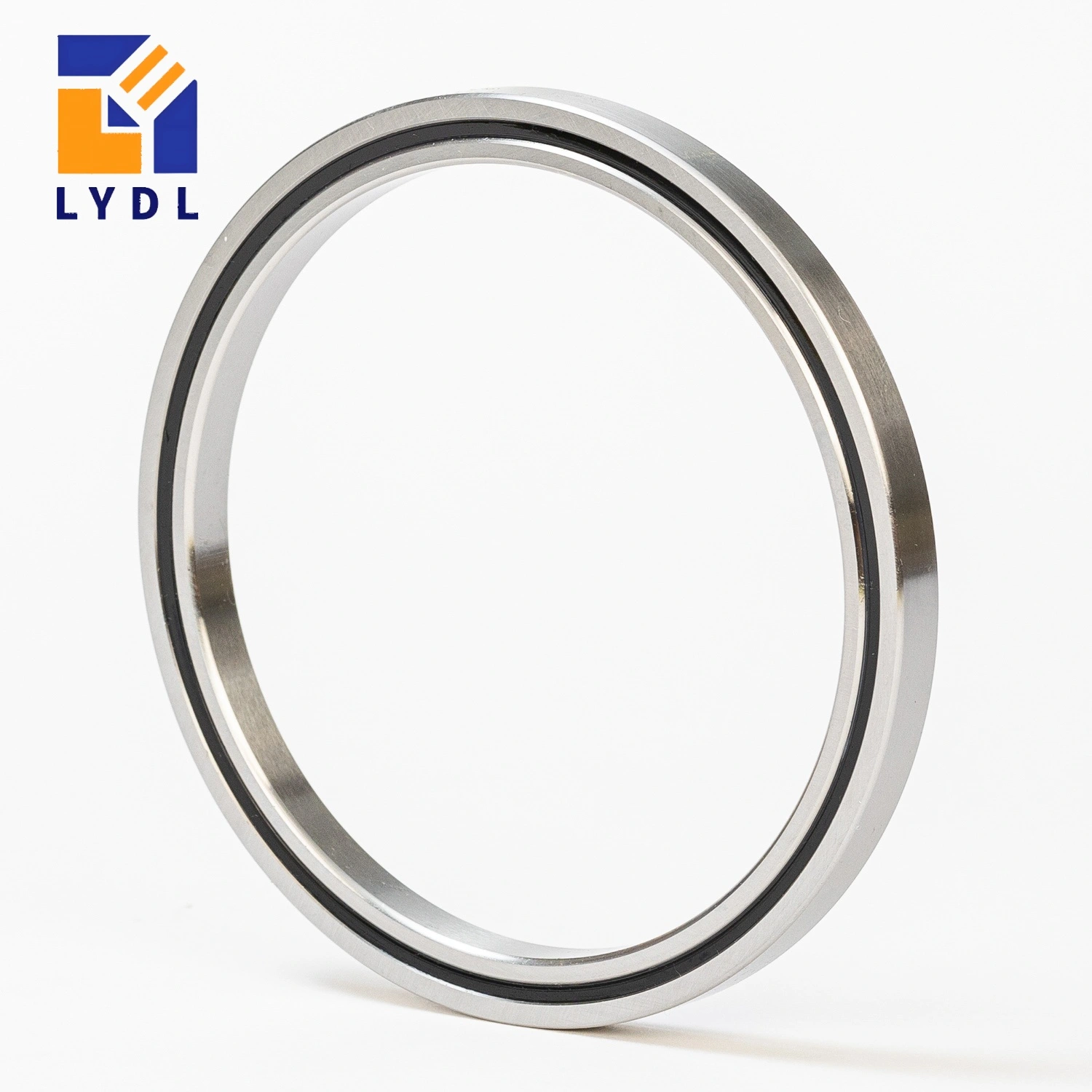
The RAU9008 cross roller bearing combines a 90 mm shaft seat with a 106 mm outside diameter and 8 mm width. THK places this reference model in its RA-compatible integral-ring family. Its crossed roller arrangement can be considered for a low-profile indexing axis, with the final choice depending on support stiffness and the actual load cycle. [1, 2]
A carousel often carries a changing distribution of samples rather than one centred payload. Bearing selection should describe the occupied stations, fixture positions and drive events. Start from the cross roller bearing selection guide and map the forces to the axis before choosing the nominal bore. The 90 mm bearing opening does not define the size of every service path through the hub.
| Parameter | THK RAU9008 |
|---|---|
| Bore d | 90 mm |
| Outside diameter D | 106 mm |
| Width B / B1 | 8 mm |
| Radial section (D – d) / 2 | 8 mm |
| Roller pitch circle dp | 97 mm |
| Minimum chamfer r | 0.5 mm |
| Shaft shoulder ds (maximum) | 93.5 mm |
| Housing shoulder Dh (minimum) | 100.5 mm |
| Dynamic radial load rating C | 6.76 kN |
| Static radial load rating C0 | 12.40 kN |
| Reference mass | 0.12 kg |
| Lubrication holes | 4 x Ø1.5 mm |
RAU9008 catalogue reference values are 6.76 kN dynamic radial rating, 12.40 kN static radial rating and 0.12 kg mass. A partly loaded carousel can produce a moment even when its total mass is modest. Consider loading asymmetry, index acceleration and any contact during loading or unloading. The reference ratings remain THK data; the agreed LYDL specification establishes the item delivered and the conditions used for acceptance. [2, 6]
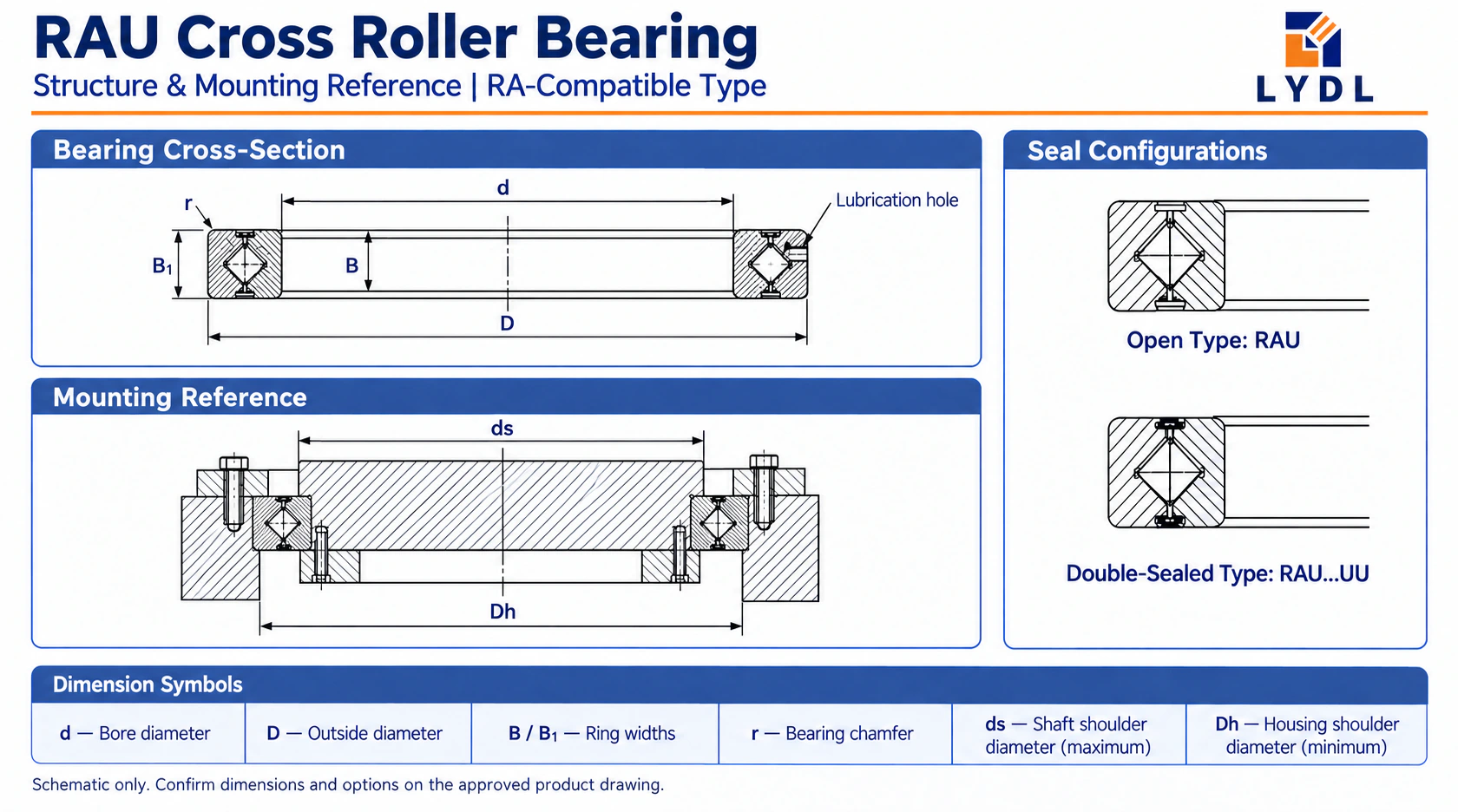
Use d for the 90 mm bore, D for the 106 mm OD and B/B1 for the 8 mm ring width. The 97 mm roller pitch circle is not a station-location circle. The shaft shoulder reference ds must not exceed 93.5 mm, while housing shoulder Dh must be at least 100.5 mm. Open and sealed sections illustrate the RA-compatible family. Four radial lubrication openings are distinct from the retention parts around the rings. [2]
Check the fully loaded platform, the most uneven loading pattern and the state during sample transfer. A loading arm may apply a local force while the opposite stations are empty. Record where each force acts relative to the bearing centre and which state combines the highest moment with movement. This is more informative than a single total payload entry.
Find adjacent seat sizes in the RAU series size range once the station layout is known. RAU9008 maintains an 8 mm radial section, but the support plate outside the bearing needs its own thickness and fastening arrangement. Include station brackets and any cut-outs in the housing review; a nominally circular platform can have uneven support where access windows remove material.
Specify the stop-start motion, angle per index and intended dwell. Seal choice, clearance or preload and rotation accuracy should be decided for that duty, rather than inferred from the model’s compact appearance. In the THK reference coding, these are independent fields. Mark the rotating ring and the inspection face so the quotation addresses the actual carousel axis. [3]
If the axial height must fall below 8 mm, consult the CRBT / RAU ultra-thin bearing range for a separate layout comparison. A 5 mm bearing requires another reference envelope and family-specific configuration review. It should not be squeezed into an RAU9008 seat with improvised spacers or treated as the same product because its bore also measures 90 mm.
The commanded index position is affected by the drive, encoder, couplings and platform stiffness as well as the bearing. Specify the point where the sample must arrive and the permitted settling period. If the carousel is inspected after loading, include the resulting fixture deflection in that test instead of evaluating only the unloaded mechanism.
The CRBH / CRBHV bearing options may suit a different packaging space if the surrounding mechanism allows a larger section. Compare the entire retained assembly and each candidate’s own ratings. For RAU9008, preserve service access and enough plate support around the 106 mm seat before deciding whether the thin envelope is beneficial to the finished station.
Use ds ≤ 93.5 mm and Dh ≥ 100.5 mm as shoulder references, then verify their compatibility with the actual ring faces. Supporting components need sufficient rigidity under a loaded station; bolt spacing alone does not establish that support. Confirm flange flatness, mating corners and the intended fitting method on the assembly drawing. The listed 0.5 mm minimum chamfer is not a blanket machining clearance. [2, 4]
Plan lubricant access to the four Ø1.5 mm reference holes before routing station wiring or enclosing the drive. They cannot be used as attachment points for cable clips. If the major loading direction stays fixed in the housing, show the roller insertion plug orientation relative to that direction. Follow the reference assembly guidance and approve the actual supplied arrangement. [2, 5]
Commission the carousel with an unloaded rotation check, then repeat at representative load distributions. Keep sample fixtures clear of covers throughout the index. If rotation resistance changes after the plate or guards are fitted, investigate the assembly sequence. Record the condition that produced the change so maintenance personnel can reproduce the observation.
Specify bearing geometry and clearance acceptance, then define any carousel-level test using its sample pattern, direction and dwell condition.
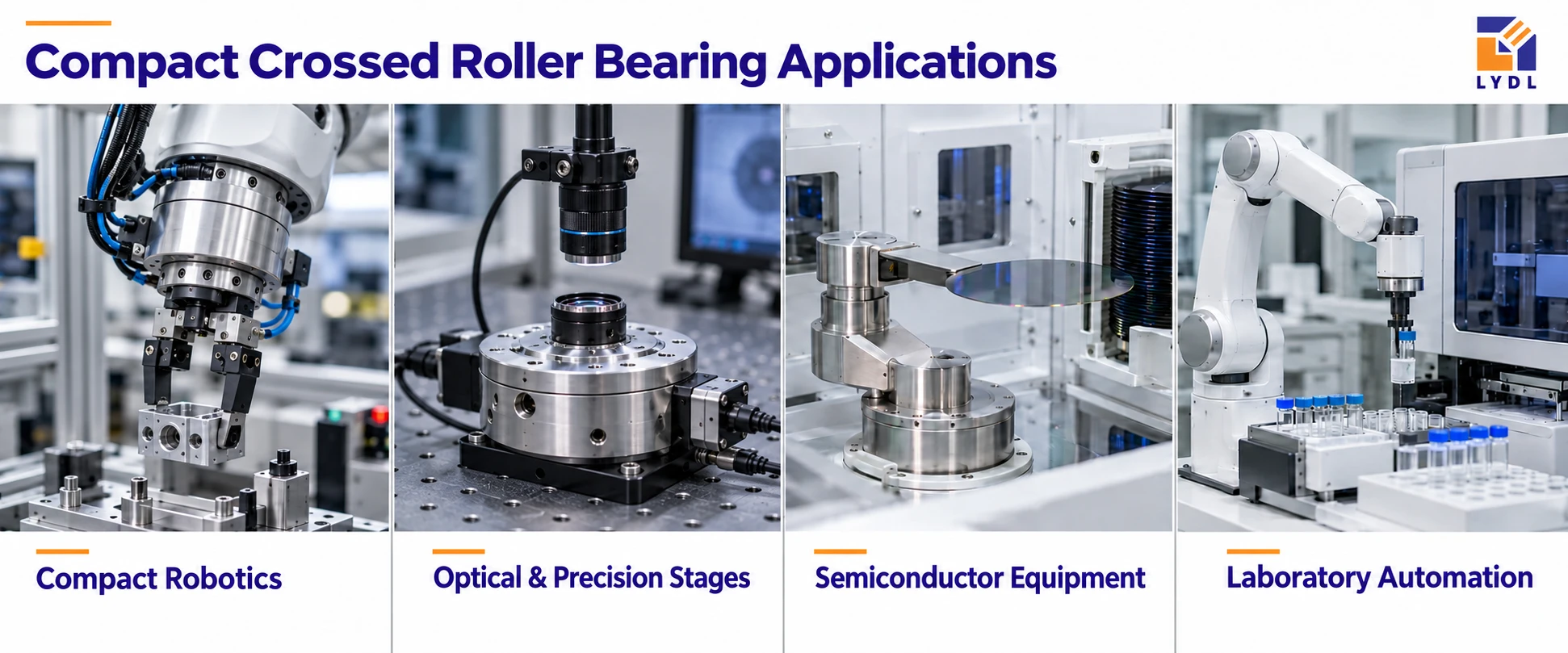
Protect the ring from carton pressure and contamination during export. Labels should distinguish the ordered configuration, while agreed records identify the shipment. Use the montage as an explanation of methods, supported by actual documents when inspection evidence is required.

A platform with samples on one side develops a moment about the bearing even when the total weight is unchanged. Define the most uneven occupancy and transfer-force locations. Those states can be more demanding than a symmetric full load and should appear in the selection review.
No. It is the internal roller pitch circle listed for the THK RAU9008 reference. The station circle belongs to the carousel design and should have its own dimensions. It also affects load offsets, so include it separately in the assembly section. [2]
No. Index position also depends on the drive and encoder chain, backlash, compliance and how the platform is loaded. State the assembled station-position requirement separately from bearing-ring runout, including approach direction and settling time. Keep both checks traceable to the relevant components.
The load distribution and resulting moment change. Supply station positions and sample masses for that configuration, including the transfer event. Do not use a fully loaded symmetric case as the only design case when partial loading is part of normal operation.
Use the agreed LYDL model and full configuration, along with batch or order identification. Seal, clearance and accuracy requirements must remain distinguishable. A basic RAU9008 label is insufficient if the machine uses multiple configurations that look alike but have different acceptance requirements.
Send a carousel plan and section, station positions, sample masses and the indexing sequence. Mark transfer forces and critical positioning surfaces. You can contact LYDL for RAU9008 review with the order quantity and configuration requirements. Confirm the bearing acceptance criteria separately from the machine’s loaded station-position test before purchasing.
Reference review: 10 October 2026. Brand names identify technical sources, not LYDL affiliation. The agreed LYDL drawing and quotation define supply.