A harmonic reducer turns fast motor rotation into slow, precise motion. The output bearing sits on the load side of that gear. It carries the weight, the force, and the tilting load of the machine. If the bearing is wrong, even a perfect gear will lose accuracy.
This guide explains what harmonic reducer output bearings are, which types are used, and how to select and install them.
What Is a Harmonic Reducer Output Bearing?
A harmonic reducer output bearing is the main support bearing of a strain wave gear. It holds the output flange or output shaft in position. It also carries radial, axial, and tilting moment loads from the machine.
You may see other names for it:
- Output support bearing
- Main bearing
- Load bearing
- Crossed roller output bearing
This part is not the wave generator bearing. The wave generator bearing is a thin, flexible ball bearing inside the flexspline. It only helps create the gear motion. It should not be used to support external loads.
How a Harmonic Reducer Works
A harmonic reducer is also called a strain wave gear or harmonic drive. It has three core parts.
- Wave generator: an elliptical cam fitted with a flexible ball bearing. It is connected to the motor shaft.
- Flexspline: a thin, flexible steel cup or ring with external teeth.
- Circular spline: a rigid ring with internal teeth. The flexspline has slightly fewer teeth than this ring.
When the wave generator turns, it bends the flexspline into an oval shape. The teeth mesh at two zones on opposite sides. Each input turn shifts the flexspline by a small tooth difference. This creates a high reduction ratio in a compact size. Common ratios are 50, 80, 100, 120, and 160.
The gear is built to transmit torque. It is not built to carry large outside forces. That job belongs to the output bearing.
Why the Output Bearing Matters
The output bearing affects four things in a harmonic reducer system.
Accuracy. Radial and axial runout determine how steady the output turns. High runout leads to positioning errors.
Rigidity. A stiff bearing resists tilting under load. Low moment rigidity makes the arm or table deflect.
Gear life. A well-supported gear keeps even tooth contact. A poorly supported gear wears faster and loses its low backlash.
Compact design. A bearing that handles all loads in one unit removes the need for extra support parts.
Types of Output Bearings Used With Harmonic Reducers
Cross Roller Bearings
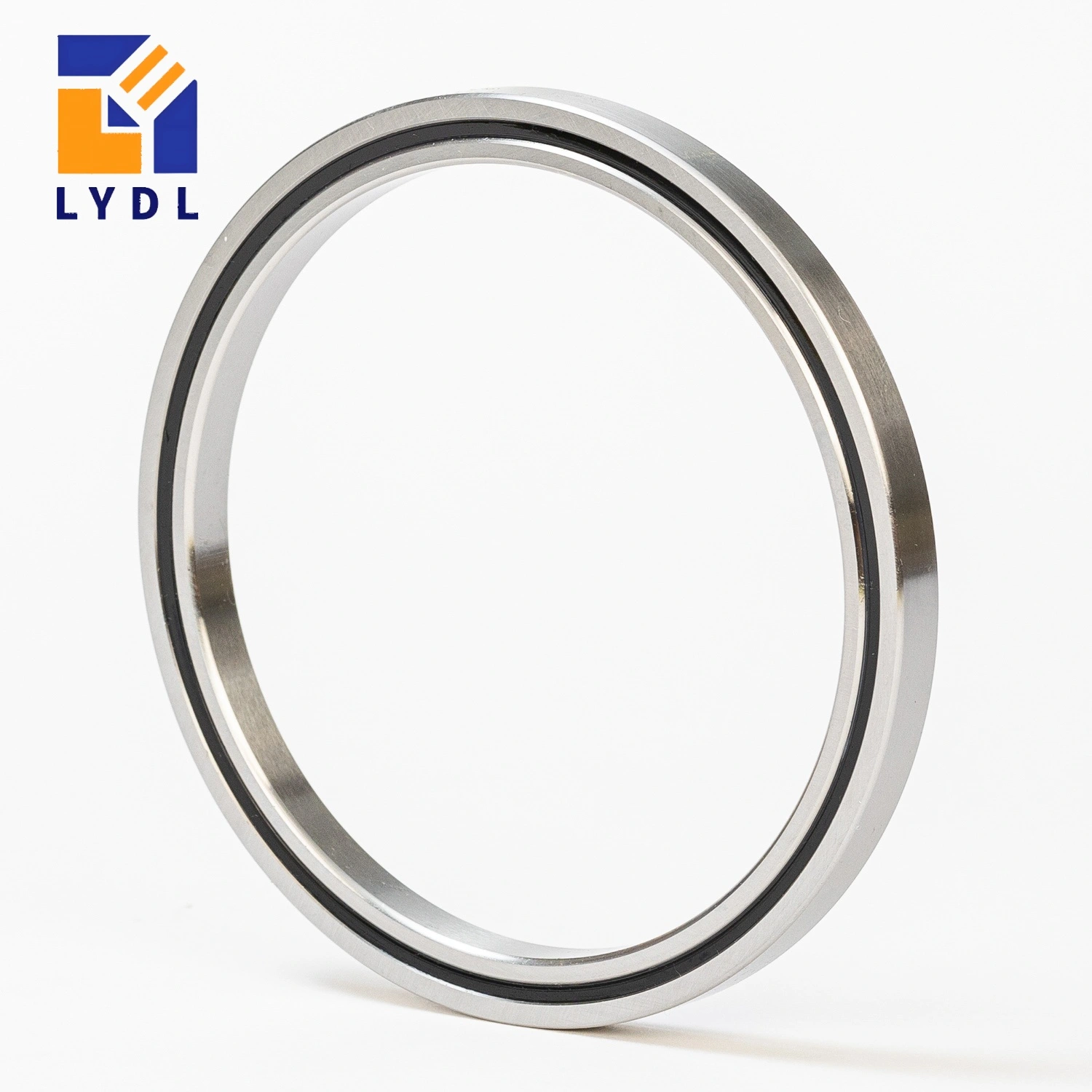
Cross roller bearings are the most common choice. The cylindrical rollers sit at 90 degrees to each other in a V-shaped raceway. One bearing can take radial, axial, and moment loads at once.
Many versions have an integral inner or outer ring with mounting holes. This eliminates the need for extra housing or a flange. The result is a short, stiff, and light assembly.
Four Point Contact Ball Bearings
These bearings have a gothic arch raceway. The balls touch the ring at four points. They handle combined loads and run with low friction. Their moment capacity is lower than cross roller types. They suit small reducers and light joints.
Angular Contact Ball Bearings
Some unit type reducers use a pair or a double row of angular contact bearings. Placing them in an X or back-to-back layout gives good moment stiffness. This design works well when the bearing span is wide enough.
Thin Section Bearings
Thin section bearings keep the same cross section across different bore sizes. They save weight and radial space. They are used in miniature joints and hollow shaft designs.
Quick Comparison
| Bearing Type | Load Handling | Moment Rigidity | Friction | Typical Use |
|---|---|---|---|---|
| Cross roller bearing | Radial, axial, moment | High | Medium | Robot joints, rotary tables |
| Four-point contact ball bearing | Combined loads | Medium | Low | Small joints, light payloads |
| Angular contact pair | Radial, axial, moment | High with wide span | Low to medium | Unit type reducers |
| Thin section ball bearing | Light combined loads | Low to medium | Low | Miniature and hollow shaft designs |
Key Specifications to Check
Before you choose a bearing, review these values in the catalog.
- Basic dynamic load rating: used to estimate bearing life.
- Basic static load rating: used to check for permanent raceway damage under shock or standstill loads.
- Allowable moment load: the tilting load the bearing can take safely.
- Moment rigidity: how much the bearing tilts under a given moment.
- Radial and axial runout: the wobble of the rotating ring.
- Precision class: commonly P5, P4 or P2, depending on accuracy needs.
- Clearance or preload: preloaded bearings give higher stiffness and less play.
- Size and mounting: bore, outer diameter, width and hole pattern.
- Seal and lubrication: grease type, seal design and re-greasing needs.
- Material and hardness: hardened bearing steel for raceways and rollers.
How to Select the Right Output Bearing
Follow these steps in order.
- List the loads. Note the radial load, the axial load, and the distance from the bearing center to the load point. This distance creates the moment.
- Calculate the equivalent load. Use the formula in the bearing catalog. It combines radial load, axial load, and moment divided by the pitch diameter.
- Check the moment limit. Compare your moment with the allowable moment of the bearing. Keep a safety margin for shock loads.
- Estimate life. Use the dynamic load rating and the equivalent load. Roller bearings use a life exponent of 10/3.
- Check accuracy needs. Pick a precision class that matches the runout your machine can tolerate.
- Check the space. Confirm bore size, cable routing, and total height. Hollow shaft reducers often need a large bore.
- Decide on the format. Choose between a built-in bearing unit and a separate bearing with a component set.
Always compare your results with the reducer maker’s own limits. The gear and the bearing must both pass the check.
Integrated Bearing vs Separate Bearing
| Feature | Unit Type Reducer | Component Set With Separate Bearing |
|---|---|---|
| Bearing supply | Built in | Chosen by the designer |
| Assembly effort | Low | Higher |
| Design freedom | Limited | High |
| Axial length | Longer in some designs | Can be very short |
| Best for | Fast integration | Custom joints and tight space |
A unit type reducer saves time. A separate cross roller bearing gives more control over size, stiffness and cost.
Where Harmonic Reducer Output Bearings Are Used
- Collaborative robot and industrial robot joints
- SCARA robot arms
- Semiconductor wafer handling equipment
- Surgical robots and medical imaging devices
- Aerospace antenna and gimbal positioning
- Machine tool rotary tables and indexing heads
- Optical and telescope pointing systems
These machines need low backlash, small size, and steady motion. The output bearing makes that possible under real working loads.
Harmonic Reducer vs RV Reducer Bearings
RV reducers use a cycloidal stage and a larger main bearing set. They suit heavy loads and high tilting moments. Harmonic reducers are lighter and shorter. They fit joints where size and zero backlash matter more than raw load capacity.
The bearing choice follows this difference. Harmonic designs lean on slim cross roller or thin section bearings. RV designs use stronger bearing sets built into the housing.
Installation and Maintenance Tips
Good installation protects both the bearing and the gear.
- Keep mounting surfaces flat and clean. Uneven surfaces distort the rings.
- Follow the housing and shaft tolerances in the catalog.
- Tighten bolts in a cross pattern. Use the stated torque value.
- Never hammer the bearing into place.
- Use the grease type that the maker recommends.
- Protect the bearing from dust, chips, and coolant with proper seals.
- Do not use the wave generator bearing as a support bearing.
- Watch for noise, heat, and rising friction during operation.
- Re-grease at the interval that fits your duty cycle.
Common Problems and Their Causes
| Symptom | Likely Cause | Action |
|---|---|---|
| Rising runout | Wear or distorted mounting surface | Check flatness and replace the bearing if worn |
| Noise or rough turning | Contamination or poor grease | Clean, re-grease and check seals |
| Excess heat | Over preload or too much grease | Review preload and grease quantity |
| Arm deflection | Moment load too high | Use a stiffer bearing or a wider span |
| Fretting marks | Vibration at standstill | Reduce vibration and check bolt torque |
Choosing a Bearing Supplier
Look for a supplier that can share clear data. This includes load ratings, runout values, precision class, and mounting dimensions. Ask for material and heat treatment details as well. Good documentation makes your design check much faster.
LYDL Bearing manufactures cross roller bearings and thin section ball bearings for precision rotary systems, which are the bearing types most often paired with harmonic reducers.
Frequently Asked Questions
Is the output bearing the same as the wave generator bearing?
No. The wave generator bearing is a thin flexible bearing that deforms the flexspline. The output bearing is a separate support bearing that carries the external load.
Why are cross roller bearings so common in harmonic reducers?
They handle radial, axial, and moment loads in one compact bearing. They are also stiff and light. This suits slim robot joints.
Can I use a standard deep groove ball bearing as the output bearing?
It is not a good fit for most designs. A deep groove bearing has low moment capacity. It will tilt under load and reduce gear accuracy.
What precision class should I choose?
It depends on your accuracy target. Many robot joints use P5. Higher accuracy systems may need P4 or P2. Check the runout limits of your design.
Can a harmonic reducer have a hollow shaft?
Yes. Hollow shaft designs let cables, air lines, or optical paths pass through the center. They need a bearing with a large bore and a slim section.
How can I extend output bearing life?
Keep the load below the catalog limits. Use clean, flat mounting surfaces. Apply the right grease and keep the seals in good condition.
Conclusion
The output bearing decides how well a harmonic reducer performs under real loads. It controls moment capacity, rigidity, runout, and service life. Match the bearing to the load, the space, and the accuracy target. Then install it with care.