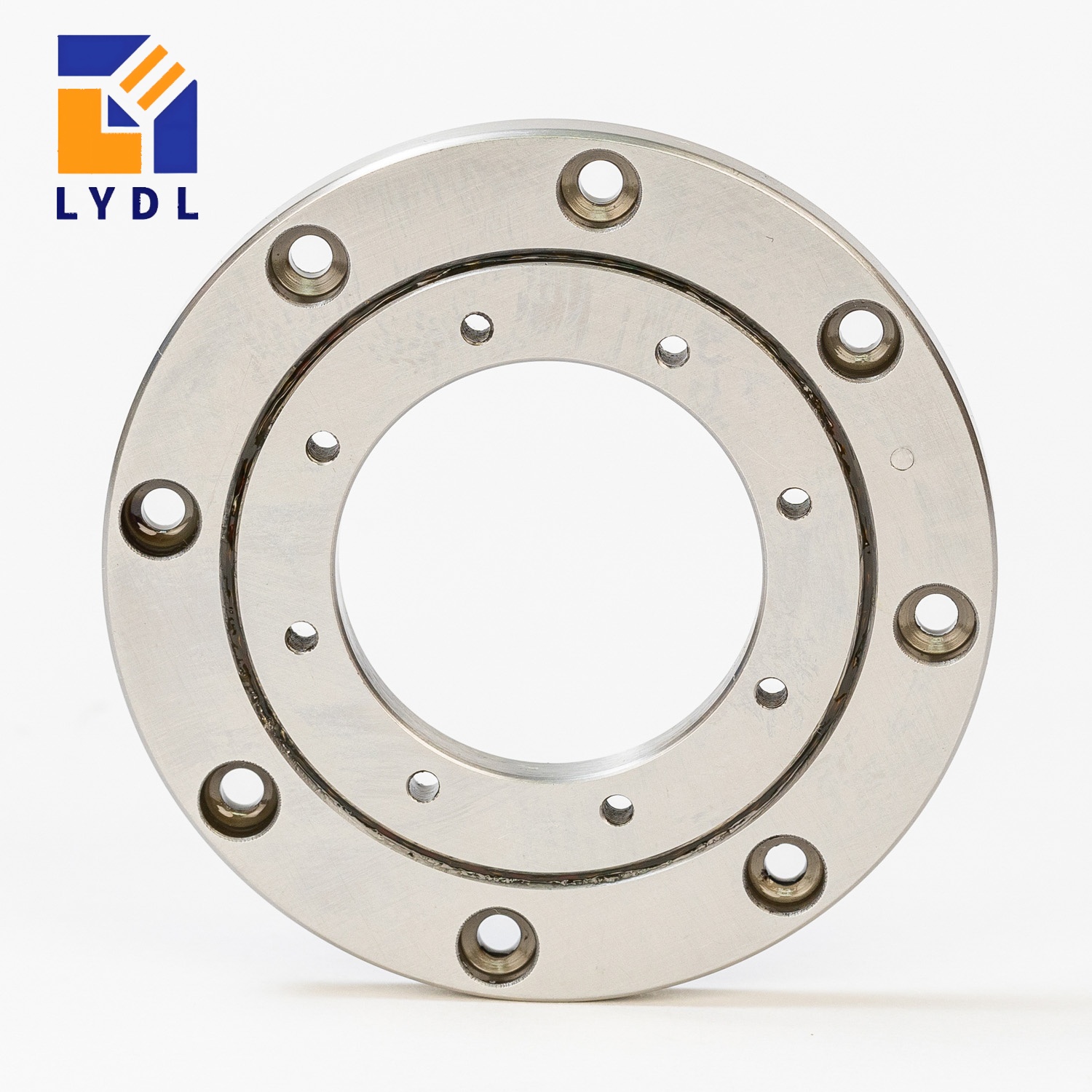
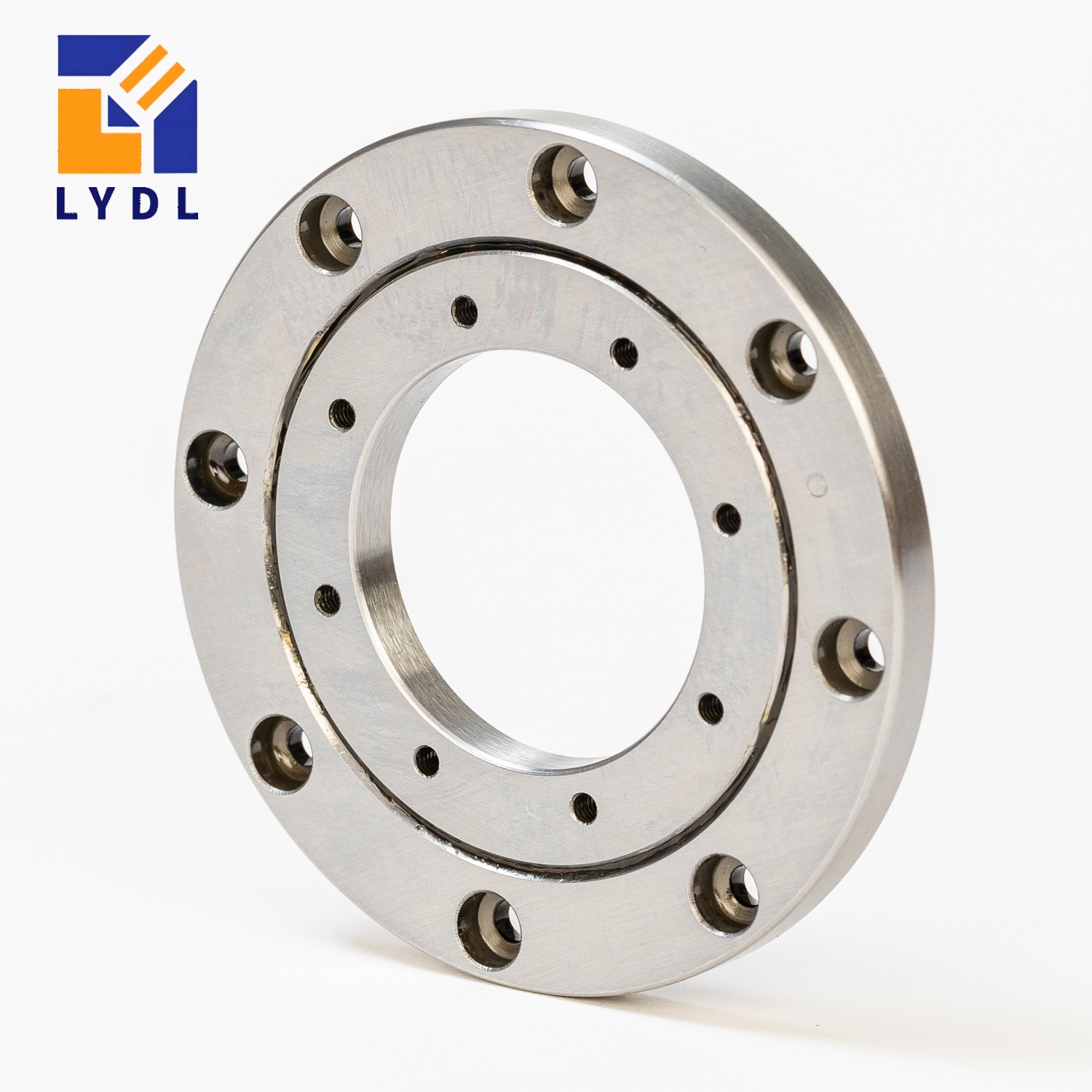
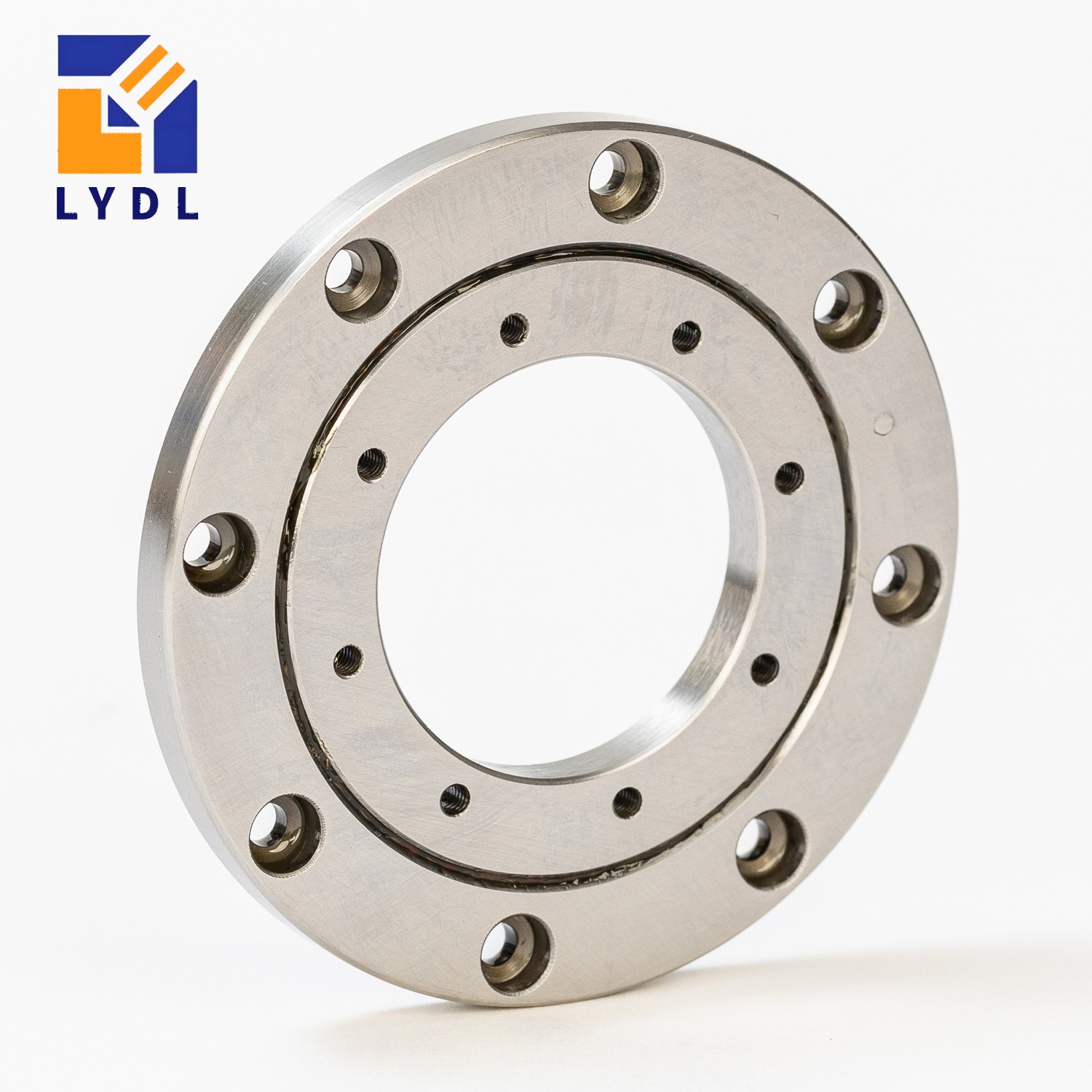
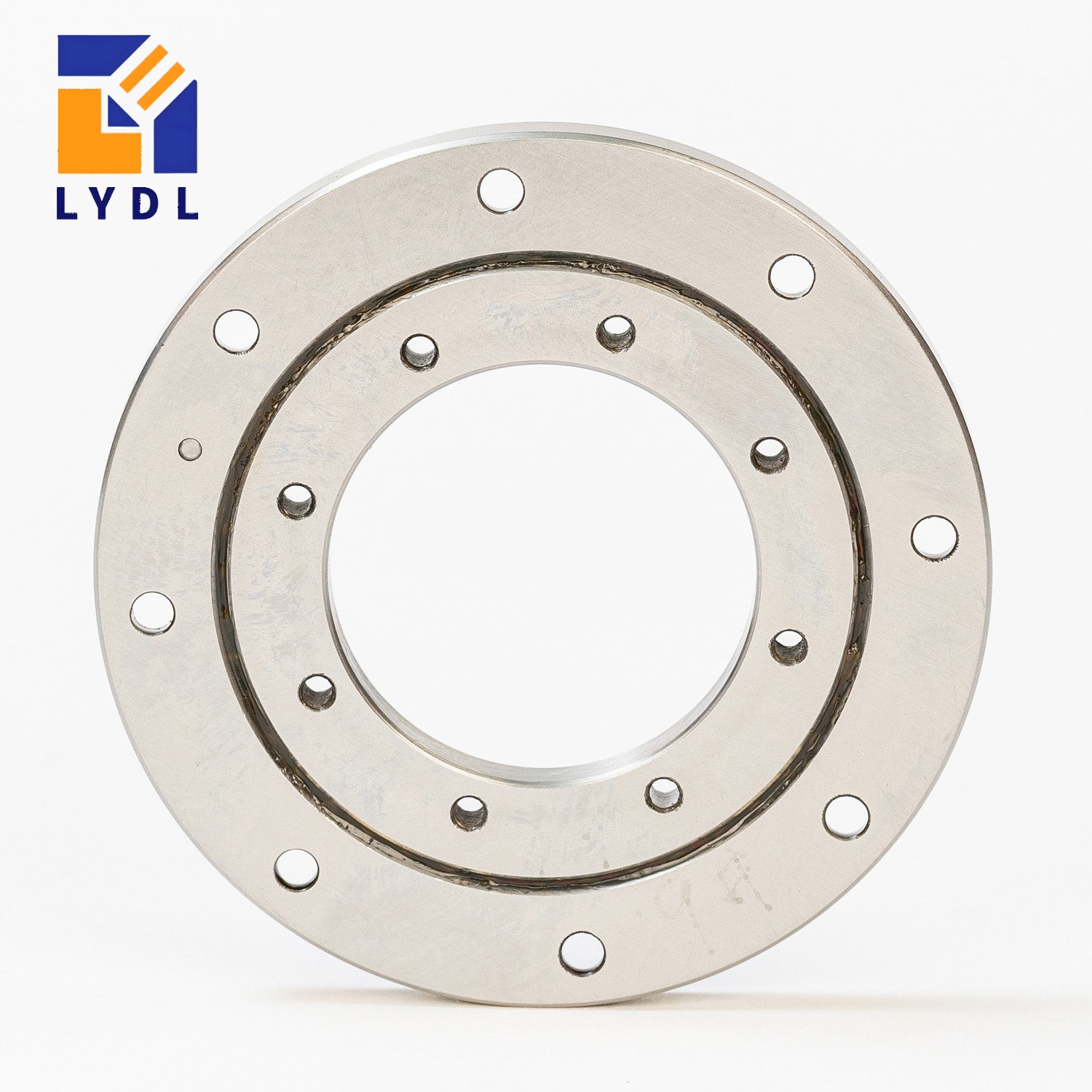
The RU28 cross roller bearing is a miniature mounting-holed precision bearing with a 10 mm bore, 52 mm outside diameter and 8 mm width. Its integrated rings allow direct installation in compact rotary assemblies without a separate bearing housing or clamping flange.
RU28 has a 2.91 kN basic dynamic load rating, a 2.43 kN basic static load rating and an approximate mass of 0.12 kg. It is suitable for miniature robot joints, optical positioning stages, sensor mounts, laboratory automation and small indexing mechanisms.
LYDL supplies open RU28 and sealed RU28UU versions with selectable clearance, preload and P5/P4/P2 accuracy options. Dimensional inspection, rotational accuracy reports, customized marking and export packaging are available for OEM and replacement orders.
The RU28 cross roller bearing is a miniature crossed cylindrical roller bearing with integrated inner and outer rings. Its rollers are arranged alternately at right angles.
This arrangement allows one compact bearing to support radial load, axial load and overturning moment.
RU28 measures 10 × 52 × 8 mm and weighs approximately 0.12 kg. It is designed for small rotary systems where installation width, assembly mass and positioning accuracy are important.
Mounting holes are provided in both rings. The bearing can therefore be installed directly in many mechanisms without a separate housing or retaining flange.
View the complete RU cross roller bearing series or explore our cross roller bearing category for additional structures and sizes.
RU28 Cross Roller Bearing Specifications
Parameter
RU28 specification
Bore diameter, d
10 mm
Outside diameter, D
52 mm
Bearing width, B
8 mm
Roller pitch circle diameter, dp
Approximately 28 mm
Basic dynamic load rating, C
2.91 kN
Basic static load rating, C₀
2.43 kN
Approximate mass
0.12 kg
Reference inner shoulder diameter
24 mm maximum
Reference outer shoulder diameter
29.5 mm minimum
Minimum chamfer radius, r
0.3 mm
Inner-ring bolt-circle diameter
16 mm
Inner-ring mounting holes
4 × M3 threaded through holes
Outer-ring bolt-circle diameter
42 mm
Outer-ring mounting holes
6 × Ø3.4 through holes
Outer-ring counterbores
Ø6.5 mm, 3.3 mm deep
Available structure
Open or sealed
Available accuracy
P5, P4 or P2
Typical clearance options
CC0, C0 or application-specific
The specifications above are reference values for RU28.
Shoulder dimensions may differ between RU28 and CRBF108AT catalogs. The approved LYDL drawing must be checked before machining the surrounding parts.LYDL RU28 miniature cross roller bearing with integrated mounting holes.
Key Advantages of the RU28 Cross Roller Bearing
Only 8 mm Wide
RU28 provides combined-load support within an axial width of only 8 mm.
This makes it suitable for miniature mechanisms where a conventional bearing pair would require too much space.
The narrow width also makes mounting accuracy important. Uneven supporting surfaces can change rotational torque and runout.
Lightweight Integrated Structure
RU28 weighs approximately 0.12 kg. It can help reduce the moving mass of compact robot wrists, optical stages and sensor-positioning units.
The total system inertia must still include the motor, flange, shaft and payload.
Direct Bolt-On Installation
Both rings contain mounting holes. This can reduce the number of housings, retaining plates and adjustment components.
Direct mounting also shortens the dimensional tolerance chain. However, both rings still require rigid and accurately machined supporting surfaces.
Combined-Load Capability
The crossed rollers support radial, axial and moment loads in one bearing position.
Because RU28 is a miniature bearing, offset loads must be evaluated carefully. Payload weight alone does not represent the actual bearing load.
RU28 Mounting-Hole Arrangement
The standard mounting pattern uses:
Four M3 threaded holes on a 16 mm inner-ring PCD
Six Ø3.4 through holes on a 42 mm outer-ring PCD
Ø6.5 outer-ring counterbores with a depth of 3.3 mm
The inner and outer rings use different numbers of fasteners. The original hole pattern should not be altered without an engineering review.
Confirm bolt-entry direction, thread engagement and tool access before completing the assembly drawing.
Open bearing with the standard mounting-hole pattern
RU28UU
Seals installed on both sides
RU28U
One-side seal, available subject to orientation confirmation
RU28UT
Opposite one-side seal orientation, subject to confirmation
RU28CC0
Controlled negative-clearance or preload specification
RU28C0
Normal reference clearance specification
RU28P5
Precision option for general positioning systems
RU28P4
Higher rotational accuracy for inspection or optical axes
RU28P2
Ultra-precision option subject to inspection agreement
Not every suffix combination is a stocked product.
Seal orientation, clearance, preload and accuracy must be written on the quotation and approved drawing.
Are RU28G and RU28X Standard Models?
RU28G and RU28X should not be listed as regular standard variants.
G and X codes are generally applied to larger RU bearings with alternative counterbore or threaded-hole arrangements.
RU28 already has threaded inner-ring holes and counterbored outer-ring holes.
A reversed counterbore or modified thread pattern should be treated as a customized design rather than automatically called RU28G or RU28X.
Is RU28-N a Standard Grease-Nipple Version?
A universal RU28-N configuration should not be assumed.
Published RU grease-nipple guidance commonly starts with larger standard RU models. For RU28, the lubrication port and grease-delivery method should follow the approved production drawing.
RU28 Cross Roller Bearing Applications
The RU28 cross roller bearing can be considered for:
Miniature robot wrists
Compact robotic grippers
Optical positioning stages
Camera and sensor mounts
Small rotary encoders
Laboratory automation
Miniature indexing mechanisms
Semiconductor inspection devices
Medical sample-handling equipment
Compact antenna positioners
Precision calibration fixtures
Small hollow-axis mechanisms
The 10 mm bore can accommodate a small shaft, optical fiber or narrow service line.
The usable opening may be smaller after considering shoulders, connectors and cable bend radius.
RU28 is not intended for large robot bases or heavy workpiece positioners. Its main advantages are compactness, low mass and precise motion control.Typical RU series applications include compact robots, rotary actuators, inspection systems and laboratory automation
Choose RU28 when the 10 mm bore and 8 mm width provide a clear packaging advantage.
Consider RU42 when a 20 mm bore or greater load margin is required. RU52 offers a larger 25 mm central opening without increasing the width beyond 12 mm.
See our cross roller bearing selection guide for additional selection factors.
Need an RU28 Drawing or Quick Quotation?
If the model is known, send the RU28 or RU28UU designation, required accuracy, clearance, quantity and destination.
If selection is not complete, provide the loads, moment arm, speed, duty cycle and available mounting space. Request an RU28 technical review and quotation
RU28 and IKO CRBF108AT Reference
RU28 is commonly compared with IKO CRBF108AT. The corresponding double-sealed reference is CRBF108ATUU.
The commonly referenced specifications include:
10 × 52 × 8 mm boundary dimensions
16 mm inner-ring PCD
Four M3 inner-ring threaded holes
42 mm outer-ring PCD
Six counterbored outer-ring holes
2.91 kN dynamic load rating
2.43 kN static load rating
Approximately 0.12 kg mass
These similarities support dimensional comparison. They do not guarantee full interchangeability.
Some RU28 data tables show a 29.5 mm minimum outer shoulder diameter. CRBF108AT references may show a 31 mm mounting dimension.
Confirm the following items before replacement:
Shoulder and mounting diameters
Bearing tolerances
Hole positions and counterbore depth
Seal structure
Clearance or preload
Radial and axial runout
Starting and running torque
Grease specification
Lubrication-port location
IKO uses AT, ATUU, T1, C1 and C2 designations. These codes should not be automatically converted into LYDL clearance or preload codes.
The current cited THK standard RU table begins with RU42 and does not list RU28. When a customer requests a THK replacement, obtain the original label and drawing before confirming the model.
IKO and THK names belong to their respective owners. They are used only for product identification and technical comparison.
LYDL is an independent manufacturer and does not claim affiliation with or endorsement by these brands.
RU28 Installation Recommendations
Inspect the Mounting Faces
Clean both supporting surfaces before installation.
Remove burrs, contamination and raised material around the mounting holes. Even small surface errors can affect an 8 mm-wide precision bearing.
Both rings should contact continuous and rigid mounting surfaces.
Protect the M3 Threads
RU28 uses four M3 inner-ring threads.
Excessive tightening can damage the threads or distort the small inner ring. Bolt grade and thread engagement should be defined by the assembly designer.
Do not apply a generic torque value without checking the mating material and thread condition.
Use a Progressive Sequence
Install every bolt before applying final torque.
Tighten the outer-ring bolts in a diagonal sequence. Increase torque gradually in several stages.
Use a balanced sequence for the four inner-ring bolts. Check rotation after each tightening stage.
Avoid Forced Alignment
Do not use the bearing bolts to pull misaligned components together.
Shaft and housing features should locate naturally before final tightening. Forced alignment can create internal stress and uneven running torque.
Check the Filler-Plug Position
If the bearing contains a roller-filling plug, avoid placing that area in the highest repetitive load zone whenever possible.
Record its final orientation for repeat production or inspection traceability.
Perform a Low-Speed Run-In
Rotate the assembly slowly after installation.
Check for abnormal torque, noise, vibration and temperature rise. Increase operating speed and load gradually.
For short oscillating movements, confirm that lubricant reaches the active roller-contact area.
RU28 Inspection and Export Packaging
LYDL inspection for an RU28 cross roller bearing may include:
Bore, outside diameter and width measurement
Inner- and outer-ring PCD inspection
M3 thread verification
Counterbore size and depth inspection
Clearance or preload confirmation
Radial and axial runout inspection
Starting and running-torque measurement
Seal and lubrication-port inspection
Appearance and marking verification
Inspection report or product photographs
RU28 is small and lightweight, but its raceways and ring edges still require protection.
After inspection, each bearing is cleaned and protected against corrosion. Individual packaging prevents metal-to-metal contact during batch shipment.
The outer package is selected according to quantity, transport method and destination.dimensional inspection, rotation testing and protective export packaging at LYDL.
Why Source RU28 from LYDL?
Open RU28 and sealed RU28UU versions
P5, P4 and P2 accuracy options
Application-specific clearance or preload
Mounting-hole and M3 thread inspection
Rotational runout and torque reports
Grease and seal customization
OEM marking and batch traceability
Prototype and small-batch support
Protective export packaging
Application-based selection assistance
RU28 Cross Roller Bearing FAQ
Why does RU28 use four inner-ring bolts and six outer-ring bolts?
The inner and outer rings have different available circumferences and mounting functions.
Use the specified 16 mm and 42 mm bolt circles. Do not add or reposition holes without checking ring strength and raceway location.
Can RU28 replace IKO CRBF108AT?
The main dimensions, hole pattern and reference load ratings are similar.
Shoulder dimensions, clearance, accuracy, seals and running torque must still be compared before approving replacement.
When should RU28UU be selected?
RU28UU is suitable when dust or light contamination protection is required.
The seals can increase rotational resistance. Open RU28 may be preferable in clean equipment requiring the lowest practical seal drag.
Is RU28 suitable for a miniature robot wrist?
Yes, if the calculated radial, axial and moment loads are within the required safety margin.
The tool offset, acceleration and emergency stop can create higher loads than the tool weight suggests.
Can services pass through the 10 mm bore?
A small shaft, tube or optical fiber may pass through the center.
Check connector size, bend radius and surrounding shoulder dimensions before finalizing the routing design.
Does RU28 require P2 accuracy?
Not always.
P2 is useful only when the complete axis can benefit from it. Mounting-face accuracy, motor errors, encoder resolution and structural deformation may otherwise limit the final system accuracy.
When should RU42 be selected instead?
Select RU42 when a 20 mm bore or higher load rating is required.
RU28 remains preferable when an 8 mm width and minimum assembly mass are the main design priorities.
THK Cross-Roller Ring Overview — general crossed roller structure and combined-load capability: THK Cross-Roller Ring
ISO 281:2007 — rolling-bearing dynamic load ratings and rating life: ISO 281:2007
ISO 76:2006 — rolling-bearing static load ratings: ISO 76:2006
ISO 492:2023 — radial bearing geometrical specifications and tolerance values: ISO 492:2023
ISO 15:2017 — radial bearing boundary-dimension principles: ISO 15:2017
ISO 15243:2017 — classification of rolling-bearing damage and failure modes: ISO 15243:2017
These references provide general definitions and engineering frameworks.
The approved LYDL drawing, inspection agreement and purchase order remain the controlling documents for the supplied bearing.