WeChat QR
Home WhatsApp Email
WeChat

LYDL · APPLICATION ENGINEERING

Precision Bearing Solutions for Rotary Motion

Connect your application requirements with a bearing family. Explore cross roller, YRT rotary table, thin section ball and slewing bearing options, then check the mounting and operating conditions that matter to your design.

APPLICATION STARTING POINTS

Find the requirements behind your application.

These examples connect common rotary-motion tasks with product families and practical reading. Final suitability requires checking the specific bearing data and installation.

Illustration of an industrial robot wrist joint and gripper

APPLICATION 01

Robotics & automation

Robot joints, wrist axes and indexing units may need combined-load support within a compact installation. The bearing choice also depends on which ring rotates and how the surrounding structure is mounted.

Key design checks
Load and overturning moment; mounting arrangement; rigidity; rotational torque.
Illustration of a five-axis CNC rotary table on a trunnion cradle

APPLICATION 02

CNC rotary tables

Rotary and tilting tables require the bearing, drive and mounting structure to work together. Compare operating speed, table loads and required rotational accuracy before choosing a bearing arrangement.

Key design checks
Axial, radial and moment loads; speed and duty cycle; mounting datums; runout requirements.
Illustration of a rotary positioning stage with a dimensional inspection probe

APPLICATION 03

Compact precision positioning

Positioning stages and handling mechanisms may have limited radial space or a restricted weight budget. Thin section ball bearings are one starting point; the contact type and arrangement must match the loads.

Key design checks
Available envelope; load direction; stiffness; torque; lubrication and operating environment.
Illustration of a tilting industrial welding positioner and rotary faceplate

APPLICATION 04

Industrial rotary platforms

Welding positioners, rotary fixtures and other industrial platforms can combine radial load, axial load and overturning moment. Slewing bearing selection also involves the support structure and, where fitted, the gear drive.

Key design checks
Load cases and moments; support stiffness; mounting bolts; gearing, seals and lubrication.

Application scenes are illustrations of possible equipment contexts; they do not represent customer installations.

FOUR CORE PRODUCT FAMILIES

Choose a starting point, then verify the details.

Design considerations for an initial discussion. Detailed specifications are available through each product family.
Bearing familyTypical design focusVerify before choosing a model
Cross roller bearings →Compact combined-load support and rigidity in rotary mechanisms.Ring structure, rotating ring, preload or clearance, fits and mounting stiffness.
YRT rotary table bearings →Axial-radial support for rotary tables and indexing mechanisms.Load cases, speed, mounting datums, rotational accuracy and drive requirements.
Thin section ball bearings →Restricted installation space and compact, lightweight assemblies.Contact type, load direction, stiffness, torque, fits and lubrication.
Slewing bearings →Rotary platforms with combined loads and overturning moments.Load combinations, support structure, bolting, gear arrangement and sealing.

Bearings with similar outside dimensions are not automatically interchangeable. Compare structure, ratings, fits, clearance or preload, and the installation before substitution.

ENGINEERING READING

Work through the selection and installation details.

Use the Knowledge guides for a closer look at mounting arrangements, inspection and practical troubleshooting.

RB or RU: start with the mounting arrangement

Review ring structure and mounting considerations before comparing model numbers.

Read the mounting guide →

Define the YRT runout inspection

Review a practical measurement guide when discussing rotational accuracy and acceptance checks.

Read the inspection guide →
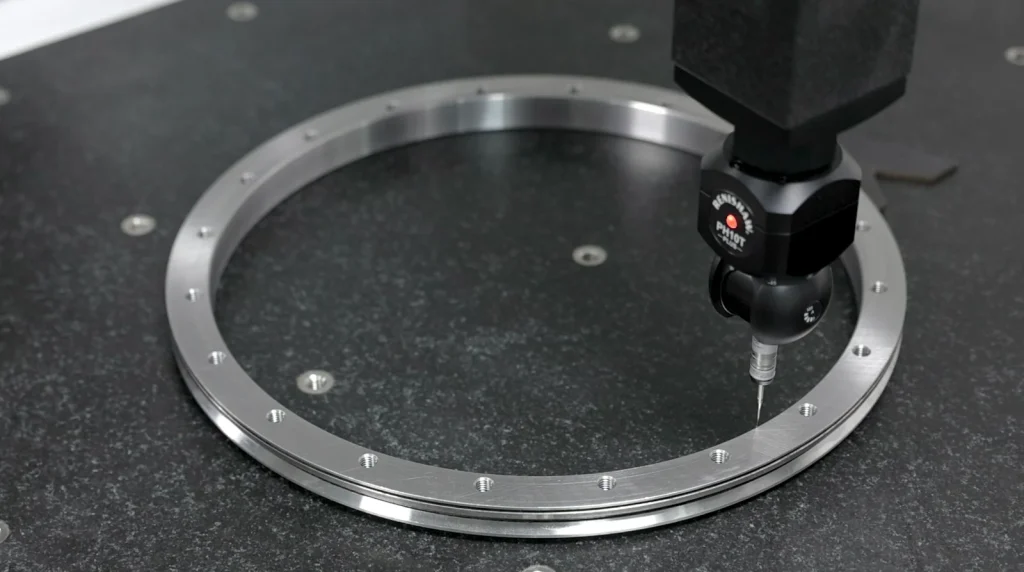
Coordinate measuring probe checking a bearing ring on a granite measuring table
Coordinate measuring probe checking a bearing ring. Photograph supplied by LYDL.

FROM REQUIREMENT TO INSPECTION

Make the inspection requirement part of the discussion.

Dimensions, profiles and roundness are different checks. Review the available equipment and agree the inspection items, acceptance criteria and any required reports for the order.

See our quality control equipment →

Before you request a bearing recommendation

Is the application name enough to choose a bearing?

No. It helps identify an initial product family, but the loads, moments, mounting arrangement, speed, accuracy and environment must be reviewed together. A drawing and operating conditions make the discussion more specific.

Can a bearing with the same dimensions replace my current model?

Matching dimensions are only one check. Compare the ring structure, load ratings, clearance or preload, mounting interfaces, seals and lubrication requirements before treating a model as an alternative.

What should an inspection request include?

Provide the drawing revision, critical dimensions or geometric requirements, measurement datums and acceptance criteria. If specific reports or measurement methods are required, agree them before ordering.

Bring us the drawing and the operating conditions.

Discuss a standard or drawing-based bearing requirement with Luoyang Deeplink Technology Co., Ltd. Use the checklist to describe your application.

Discuss your bearing requirement
  • Bearing model, drawing or available installation space
  • Radial and axial loads, overturning moment and duty cycle
  • Speed, rotating ring and mounting arrangement
  • Accuracy, stiffness, torque and environmental requirements
  • Quantity, inspection needs and required delivery timing