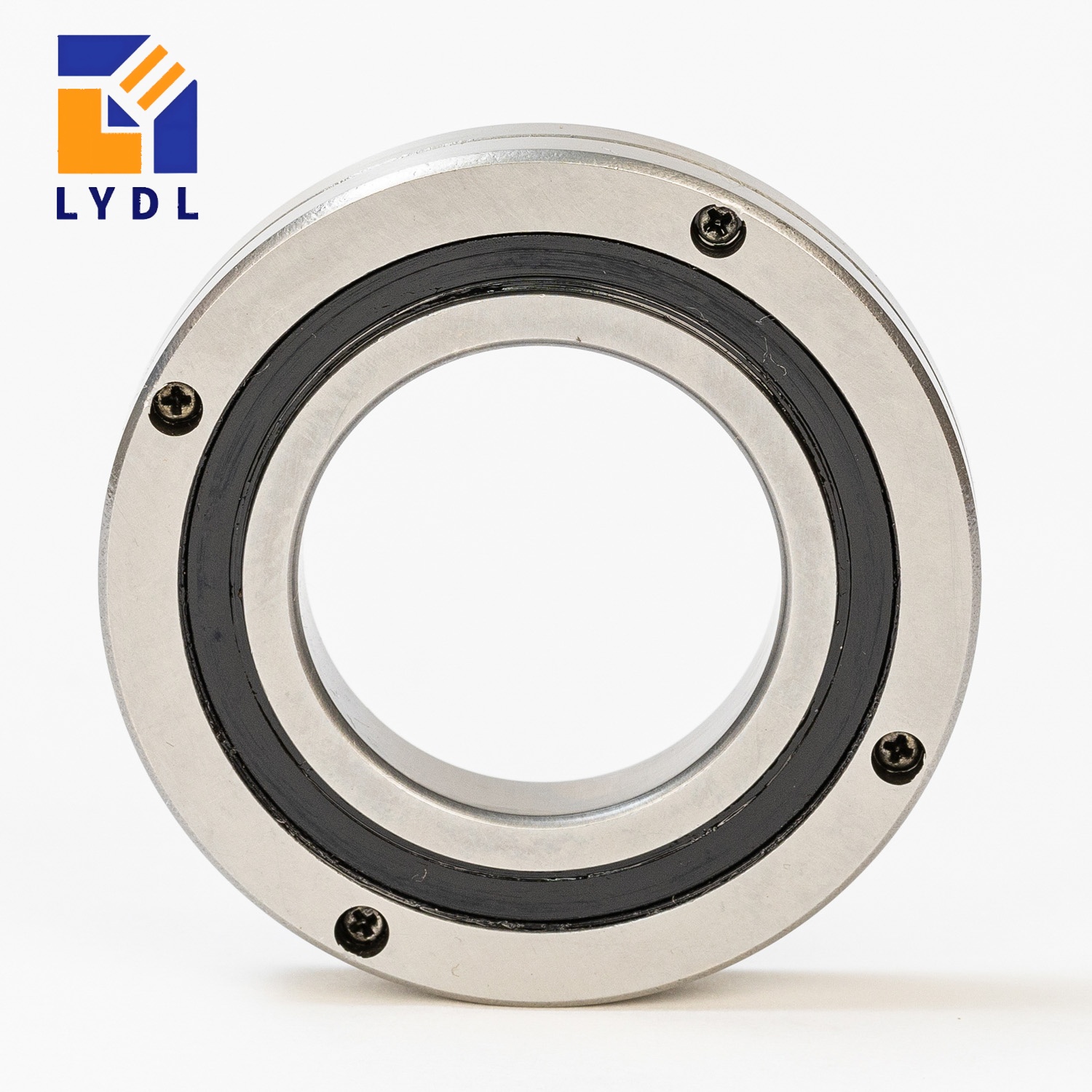
1. RB cross roller bearing is Inner and Outer Ring Integrity, outer ring with plug. 2. Sizes:Inner Diameter: 20mm Outer Diameter: 36mm Width: 8mm 3.Performance Advantages:High radial, axial and moment load capacity in a single bearing; low friction coefficient for smooth rotation; excellent runout accuracy. 4.Material: Gcr15, Gcr15SiMn. 5. Application: Joints or rotating parts of industrial robots, rotary tables of machining centers, rotating parts of manipulators, precision rotary tables, medical machines, measuring instruments, IC manufacturing devices, etc. 6. Accurcy: P6, P0, P5, P4, P2.
RB2008 Cross Roller Bearing Overview
The RB2008 cross roller bearing is a compact precision bearing with a 20 mm bore, 36 mm outside diameter and 8 mm width. It combines radial, bidirectional axial and overturning-moment load support in one bearing position.
RB2008 uses an integrated inner ring and a circumferentially split outer ring. Cylindrical rollers are arranged alternately at 90 degrees, allowing the bearing to provide high rigidity while maintaining a small installation envelope.
With a mass of approximately 0.04 kg, the RB2008 cross roller bearing is suitable for miniature robot joints, optical positioning stages, measuring instruments and other mechanisms where space, weight and rotational accuracy are important.
The bearing is normally selected for precision inner-ring rotation. The split outer ring must be correctly supported and clamped during installation. Explore the complete LYDL RB Series Cross Roller Bearings or visit the Cross Roller Bearing product category for additional sizes and structures.
RB2008 Technical Specifications
Parameter
RB2008 specification
Bearing type
RB Series crossed roller bearing
Bore diameter, d
20 mm
Outside diameter, D
36 mm
Width, B
8 mm
Roller pitch-circle diameter, dp
27 mm
Minimum corner radius, r min.
0.5 mm
Shaft shoulder diameter, ds max.
23.5 mm
Housing shoulder diameter, Dh min.
30.5 mm
Lubrication-hole reference, a × b
2 × 0.8 mm
Basic dynamic radial load rating, Cr
3.23 kN
Basic static radial load rating, C0r
3.10 kN
Approximate mass
0.04 kg
Preferred precision rotation
Inner ring
Standard structure
Integrated inner ring, split outer ring
Mounting holes
None
Available accuracy options
P5, P4, P2 and custom
Available configurations
Open, sealed, clearance-controlled or preloaded
The listed Cr and C0r values are basic radial load ratings. They must not be treated as direct allowable axial or moment-load limits.
For combined-load applications, LYDL recommends calculating bearing life and checking raceway contact stress, overturning moment, rigidity, rotational torque and mounting deformation.
Why Choose the RB2008 Cross Roller Bearing?
The RB2008 is one of the more compact sizes in the RB product family. Its 8 mm width helps reduce the axial length of miniature rotary mechanisms.
Its approximately 0.04 kg mass also helps reduce moving inertia in small robot joints, inspection equipment and fast-response positioning systems.
Alternately crossed rollers allow one RB2008 cross roller bearing to support radial force, axial force from both directions and overturning moment. This can simplify an assembly that would otherwise require multiple conventional bearings.
The RB2008 does not contain integral mounting holes. Shaft, housing, shoulder and clamping components must therefore be manufactured with sufficient accuracy to support the bearing correctly.
Typical RB2008 Applications
The RB2008 cross roller bearing is commonly considered for:
Miniature robot wrists and end effectors
Compact rotary and tilting stages
Optical gimbals and lens-positioning mechanisms
Semiconductor alignment and inspection equipment
Coordinate-measuring and metrology heads
Medical and laboratory positioning devices
Small indexing mechanisms
Precision camera and sensor platforms
For a robot joint, the designer should evaluate the arm length and overturning moment instead of selecting the bearing only by radial load.
For an optical or measuring stage, rotational torque variation and installation runout may be more important than maximum load capacity.
For oscillating applications, the lubrication method and oscillation angle should be specified because short-stroke motion may not redistribute grease in the same way as continuous rotation.
Planning a new mechanism or replacing an existing bearing? Contact LYDL for an RB2008 drawing and quotation. Please include quantity, radial and axial loads, moment load, speed, rotating ring, accuracy class, preload, lubricant, temperature and the original bearing designation.
Choose the RB2008 Cross Roller Bearing when minimum size and weight are primary requirements.
Choose the RB2508 Cross Roller Bearing when a 25 mm shaft is required without increasing the nominal bearing width.
Choose the RB3010 Cross Roller Bearing when the assembly allows a larger envelope and requires higher radial ratings or greater rigidity.
The ratings in this table are reference values for model comparison. Final selection must consider combined loads, speed, duty cycle, lubrication, desired life and mounting rigidity.
Lubrication and contamination control are provided by the machine
RB2008U
Single-seal configuration
Confirm the required seal side before ordering
RB2008UU
Seals on both sides
Suitable when improved grease retention is required
RB2008UUC0
Sealed, specified clearance class
Confirm the numerical clearance requirement
RB2008UUCC0
Sealed, controlled negative clearance or preload
Confirm preload range and allowable starting torque
RB2008UUP5
Sealed precision version
Suitable for general precision positioning
RB2008UUCC0P4
Sealed, preloaded P4 version
Intended for higher rigidity and running accuracy
RB2008UUCC0P2
Sealed, preloaded P2 version
Requires confirmed inspection criteria and mounting conditions
Suffix definitions can vary among manufacturers. A suffix should not replace numerical agreement on clearance, preload, runout, seal arrangement and rotational torque.
Increasing preload can improve rigidity and suppress clearance, but it also increases starting torque, friction and sensitivity to mounting errors.
The RB2008 bearing price depends on accuracy class, clearance or preload, seal configuration, lubricant, inspection documentation, quantity and packaging requirements. Send the complete operating conditions for an accurate quotation.
Cross-Brand Identification and Replacement Guidance
Brand or product family
Possible reference designation
Replacement guidance
LYDL
RB2008, RB2008UU, RB2008UUCC0P4/P2
Final suffix and inspection requirements are defined by the approved order
THK
RB2008, RB2008UU
Closely related designation; confirm accuracy, clearance, seal and torque requirements
IKO
CRBH208 A or related CRBH208 versions
Similar boundary dimensions may be available, but ring construction and suffix systems differ
Other manufacturers
RB2008 or CRB2008 variants
Do not assume identical internal design or preload from the model number alone
An identical 20 × 36 × 8 mm boundary dimension does not guarantee direct interchangeability.
Before replacing another brand, compare:
Bore, outside diameter and width
Inner- and outer-ring construction
Shoulder and fillet dimensions
Raceway and mounting-hole geometry
Radial and axial runout requirements
Clearance or preload values
Seal contact and rotational torque
Lubricant type and fill quantity
Operating temperature
Rotating ring and load direction
LYDL can evaluate an existing model number or customer drawing and propose an equivalent or customized RB2008 configuration. Final interchangeability should be approved from drawings and inspection requirements, not from a cross-reference table alone.
Installation and Housing Guidance
The performance of an RB2008 cross roller bearing depends strongly on the accuracy and rigidity of the surrounding components.
Use a shaft shoulder diameter no greater than the specified ds reference and a housing shoulder diameter no smaller than the specified Dh reference. Confirm the final chamfer and shoulder geometry against the approved drawing.
The shaft and housing seats should have adequate roundness, cylindricity and surface finish. Thin or uneven housings can deform the raceways and increase rotational torque.
Support the split outer ring uniformly around its circumference. Uneven clamping can create localized raceway distortion.
Tighten fasteners gradually in a diagonal or cross pattern. Rotate the assembly during staged tightening and monitor torque or runout when practical.
Do not strike the bearing directly or transmit installation force through the rollers. The small cross-section of the RB2008 makes it particularly sensitive to mounting damage.
The small retaining screws or separators supplied with some split-ring bearings are intended to keep the ring components together during handling. They should not be treated as structural mounting fasteners.
After installation, verify:
Smooth rotation through a complete revolution
Starting and running torque
Radial and axial runout
Abnormal noise or local tight spots
Seal interference
Fastener tightness
Axial clamping and shoulder contact
Clearance, Preload and Lubrication
A clearance-controlled RB2008 is generally more tolerant of minor mounting variation and temperature changes.
A preloaded RB2008 cross roller bearing can provide higher rigidity and reduced displacement under moment load, but the surrounding parts must be more accurately manufactured.
For precision orders, specify an acceptable numerical clearance or preload range instead of relying only on C0 or CC0 suffixes.
Standard bearing grease may be used for many industrial applications. The required viscosity, base oil, thickener, fill quantity and relubrication interval depend on speed, load, oscillation angle and temperature.
Vacuum, cleanroom, low-particle, food-processing, low-temperature and high-temperature applications require separately confirmed lubricant and seal specifications.
Do not mix incompatible greases. Excess grease can increase running torque and temperature, especially in a compact bearing such as the RB2008.
LYDL Manufacturing and Quality Control
LYDL manufactures RB Series cross roller bearings in Luoyang, China, with P5, P4, P2 and customized precision options available subject to the approved technical specification.
The RB2008 production and inspection process can include:
Bearing-steel verification and forging inspection
Soft turning of ring datum surfaces and raceway blanks
Controlled heat treatment and optional cryogenic stabilization
V-groove raceway grinding and superfinishing
CMM inspection and dimensional micro-sorting
Roller diameter and geometry sorting
Cleaning, demagnetization and controlled assembly
Clearance, preload, runout and rotational-torque inspection
Marking, anti-rust protection and export packaging
Depending on the order, available inspection documentation can include dimensional reports, running-accuracy results, clearance or preload records, rotational-torque records, material certificates, hardness reports and batch traceability.
Custom services can include special clearance, controlled preload, P4 or P2 accuracy, selected grease, special seals, matched inspection criteria, private labeling and OEM packaging.
Frequently Asked Questions About RB2008
Why is the 8 mm width of RB2008 important?
The 8 mm width allows designers to shorten the axial length of a rotary mechanism. It is particularly useful in miniature joints, optical stages and instruments where installation space is limited.
Which ring should rotate in an RB2008 bearing?
The RB structure is generally preferred for inner-ring rotation because the inner ring is integrated and the outer ring is split. Other arrangements require confirmation of load direction, support rigidity and clamping method.
What is the difference between RB2008 and RB2508?
Both bearings are 8 mm wide, but RB2508 has a 25 mm bore and 41 mm outside diameter. RB2508 also has slightly higher basic radial load ratings, while RB2008 provides the smaller and lighter installation envelope.
Can RB2008 support an overturning moment?
Yes. The crossed-roller arrangement can support overturning moment together with radial and bidirectional axial loads. The allowable moment must still be calculated from the complete load case, mounting span, rigidity and life requirement.
What does RB2008UUCC0P4 mean?
It usually describes an RB2008 with seals on both sides, a controlled preload or negative-clearance condition and P4 accuracy. Because suffix definitions are manufacturer-specific, the numerical preload, runout and torque limits must be confirmed before ordering.
Is RB2008 suitable for high-speed continuous rotation?
It can operate in appropriate rotary applications, but there is no universal safe-speed value for every RB2008 configuration. Speed capability depends on cage design, preload, seals, lubricant, heat dissipation, load and installation accuracy.
Why does RB2008 torque increase after installation?
Common causes include an out-of-round housing, uneven outer-ring clamping, excessive preload, shoulder interference, seal compression, excessive grease or misalignment. Compare free-bearing torque with installed torque during staged assembly.
Can LYDL RB2008 replace THK or IKO bearings directly?
LYDL can manufacture an RB2008 with matching boundary dimensions and agreed performance requirements. Direct replacement should only be confirmed after comparing drawings, accuracy, preload, seals, lubricant and rotational torque.
Request an RB2008 Quotation
For an accurate RB2008 bearing price and delivery estimate, please provide:
Competitor names and model numbers are used only for technical identification and comparison. LYDL is not affiliated with the referenced manufacturers.
Published dimensions and load ratings are reference data. The approved LYDL drawing, inspection agreement and sales confirmation govern the final supplied product.