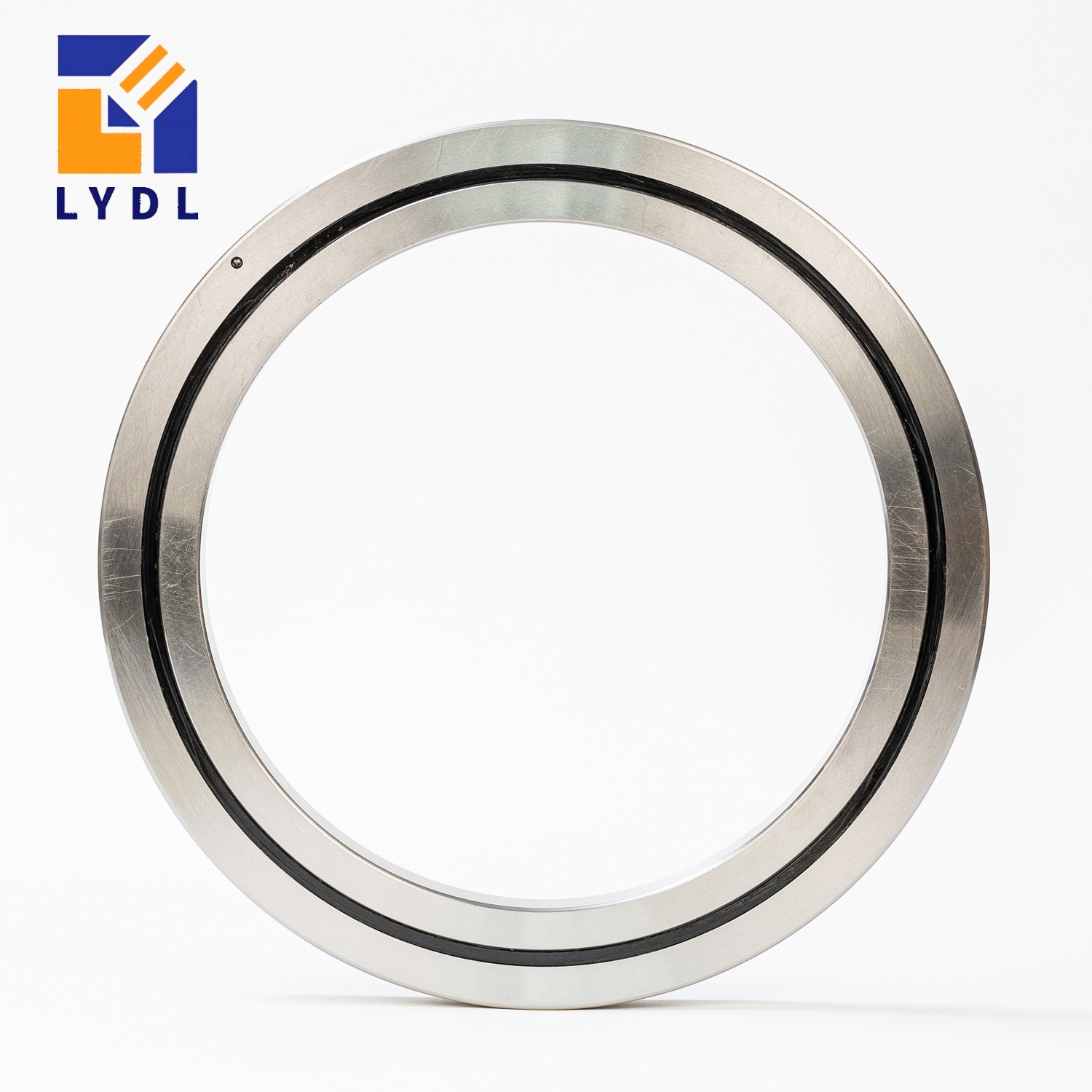
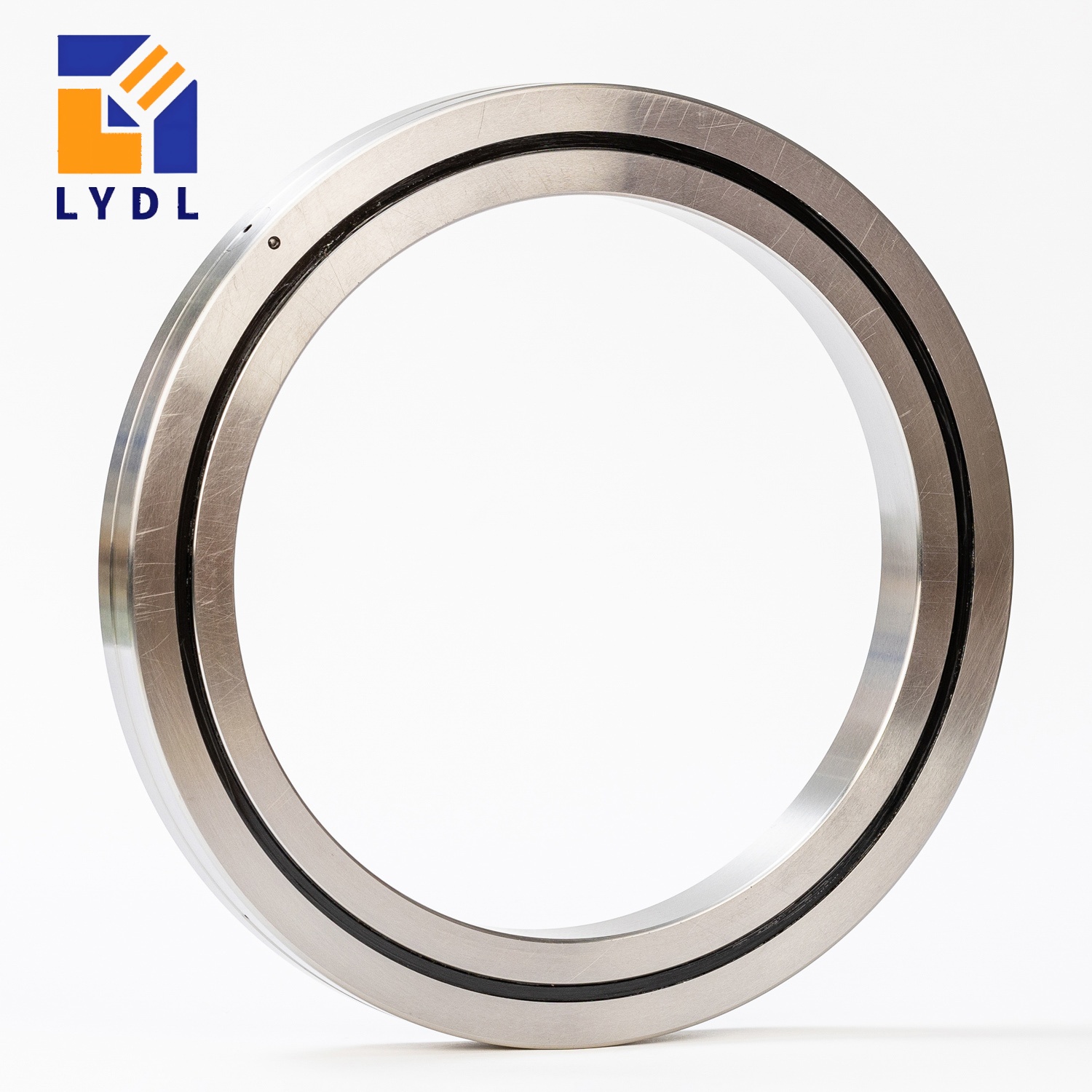
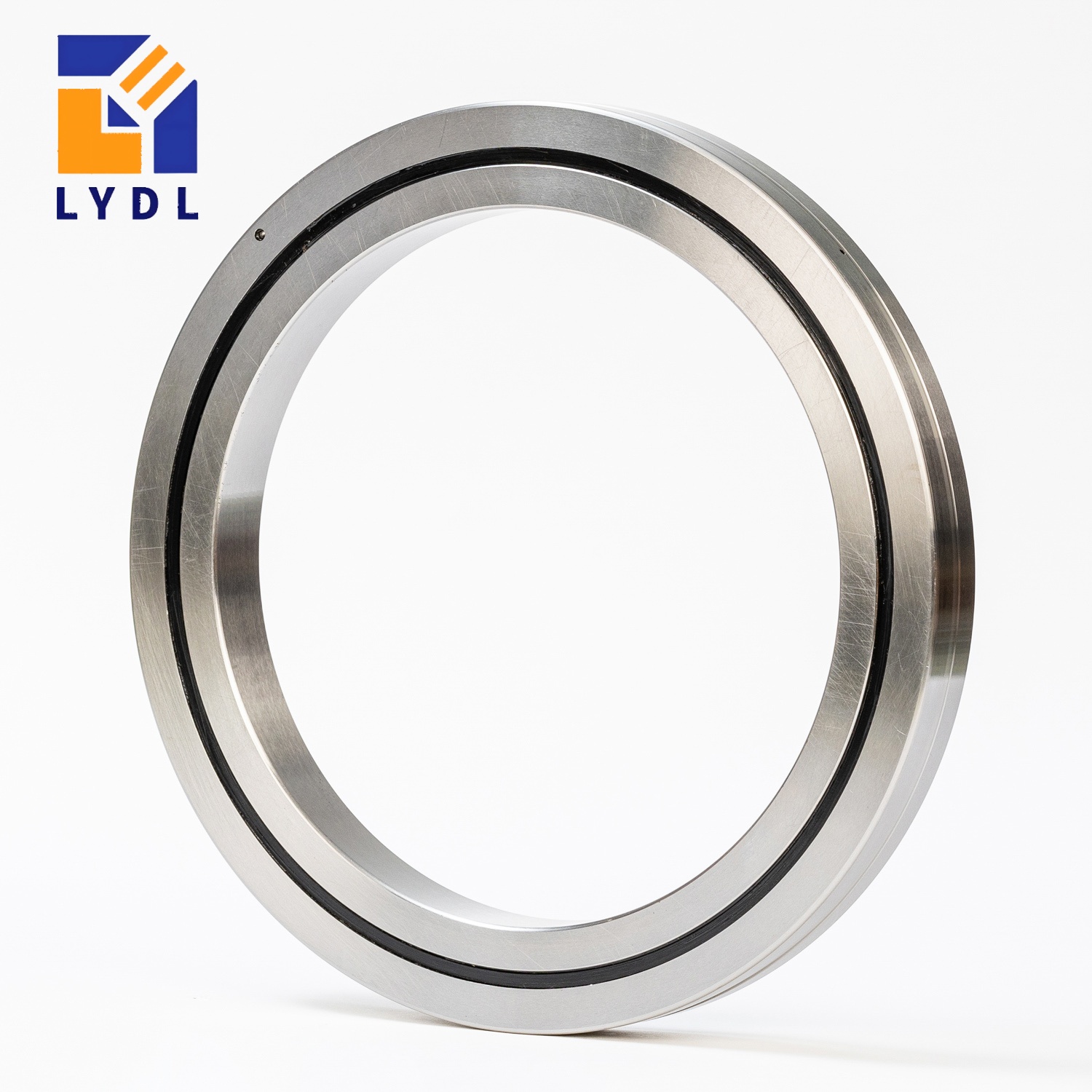
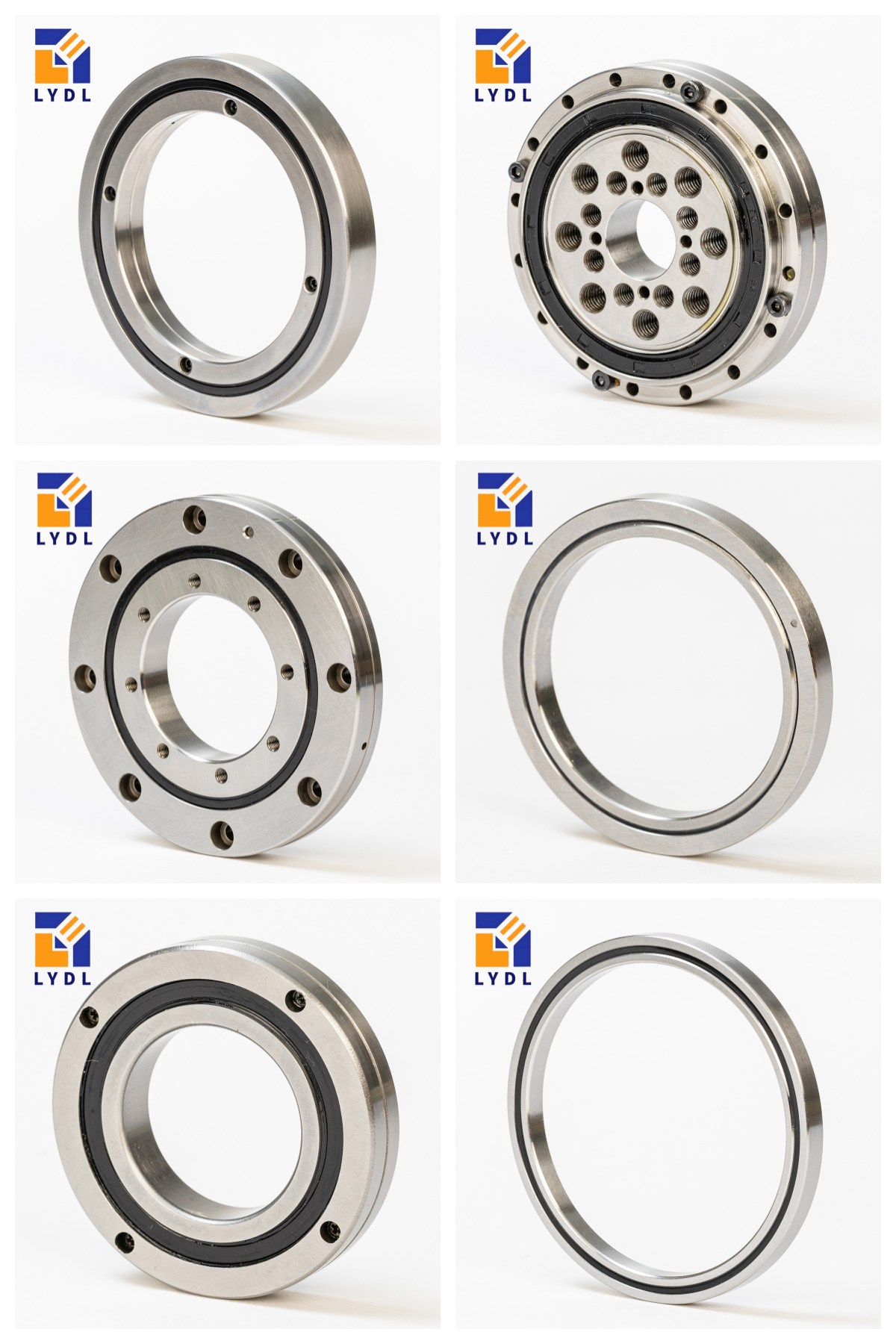
The RA12008 cross roller bearing is an ultra-thin precision bearing with a 120 mm bore, 136 mm outside diameter and only 8 mm width. Its large through-bore provides valuable routing space for cables, optical components, air lines or a hollow drive shaft.
Cylindrical rollers arranged alternately at 90 degrees allow one bearing position to support radial, bidirectional axial and overturning moment loads. The one-piece inner ring is normally selected as the rotating ring, while the separable outer ring requires uniform housing support.
LYDL supplies the RA12008 cross roller bearing in open, sealed, C0 and CC0 configurations. Special grease, higher accuracy, clearance control and inspection reports can be provided after technical review.
Send your quantity, load, moment, speed, accuracy, sealing and lubrication requirements for an LYDL drawing review and quotation.
RA12008 Cross Roller Bearing Overview
The RA12008 cross roller bearing is designed for precision rotary systems that require a 120 mm through-bore within a 136 mm outside diameter.
Its width is only 8 mm. This combination provides a large usable opening without adding a heavy or bulky bearing section.
Cylindrical rollers are arranged alternately at 90 degrees between the raceways. One bearing position can therefore support radial load, axial load in both directions and overturning moment.
Spacer retainers separate adjacent rollers. They reduce roller-to-roller friction and help maintain smooth, stable rotational torque.
RA12008 uses a one-piece inner ring and a separable outer ring. The inner ring is normally selected as the rotating ring when running accuracy is important.
RA12008 Cross Roller Bearing Specifications
The following RA12008 cross roller bearing specifications are based on recognized RA-series catalogue dimensions.
Parameter
RA12008 specification
Bore diameter, d
120 mm
Outside diameter, D
136 mm
Width, B
8 mm
Roller pitch circle, dp
127 mm
Lubrication-hole reference, a × b
2 × 0.8 mm
Minimum corner radius, r min
0.5 mm
Maximum shaft shoulder, ds
123.5 mm
Minimum housing shoulder, Dh
130.5 mm
Basic dynamic radial load rating, C
7.84 kN
Basic static radial load rating, C0
16.5 kN
Approximate mass
0.17 kg
Ring structure
One-piece inner ring and separable outer ring
Standard lubrication
Grease lubrication
Standard-grease temperature range
−15°C to +80°C
The listed load ratings are basic radial catalogue ratings. They are not direct allowable limits for combined radial, axial and moment loading.
Service life depends on the real load spectrum, speed, lubrication, duty cycle, contamination and required reliability.
The 123.5 mm and 130.5 mm shoulder values are catalogue references. Confirm the approved LYDL drawing before machining mating components.
What Makes RA12008 Different?
Large 120 mm Central Opening
The RA12008 cross roller bearing offers a 120 mm bore while keeping the outside diameter to 136 mm.
The opening can accommodate cables, air lines, optical paths or a hollow transmission shaft. This is valuable in robot elbows, inspection systems and compact rotary modules.
Constant 8 mm Width
RA12008 maintains the same 8 mm width as smaller RA8008 and RA10008 models.
Designers can increase the central opening without increasing the axial space required by the bearing. However, the larger and thinner rings demand a rigid surrounding structure.
Improved Capacity over Smaller RA Models
The 7.84 kN dynamic rating and 16.5 kN static rating are higher than the corresponding RA10008 catalogue values.
This does not make RA12008 a heavy-duty bearing. Its main design advantage remains the combination of a large opening and an extremely thin section.
Combined-Load Support
The crossed rollers allow the bearing to react to radial, bidirectional axial and moment loads.
This can simplify a rotary mechanism that would otherwise require separate radial and thrust-bearing positions.
Typical RA12008 Applications
The RA12008 cross roller bearing is suitable for applications such as:
Hollow-shaft robot joints
Robot elbows and wrist assemblies
Semiconductor wafer-handling modules
Optical inspection and scanning stages
Compact direct-drive rotary axes
Medical positioning equipment
Precision measuring instruments
Cable-routing rotary mechanisms
The 120 mm bore is particularly useful when multiple cables or optical components must pass through the rotation center.
RA12008 should be selected from the available installation space, load, moment arm, accuracy and required rotational torque.
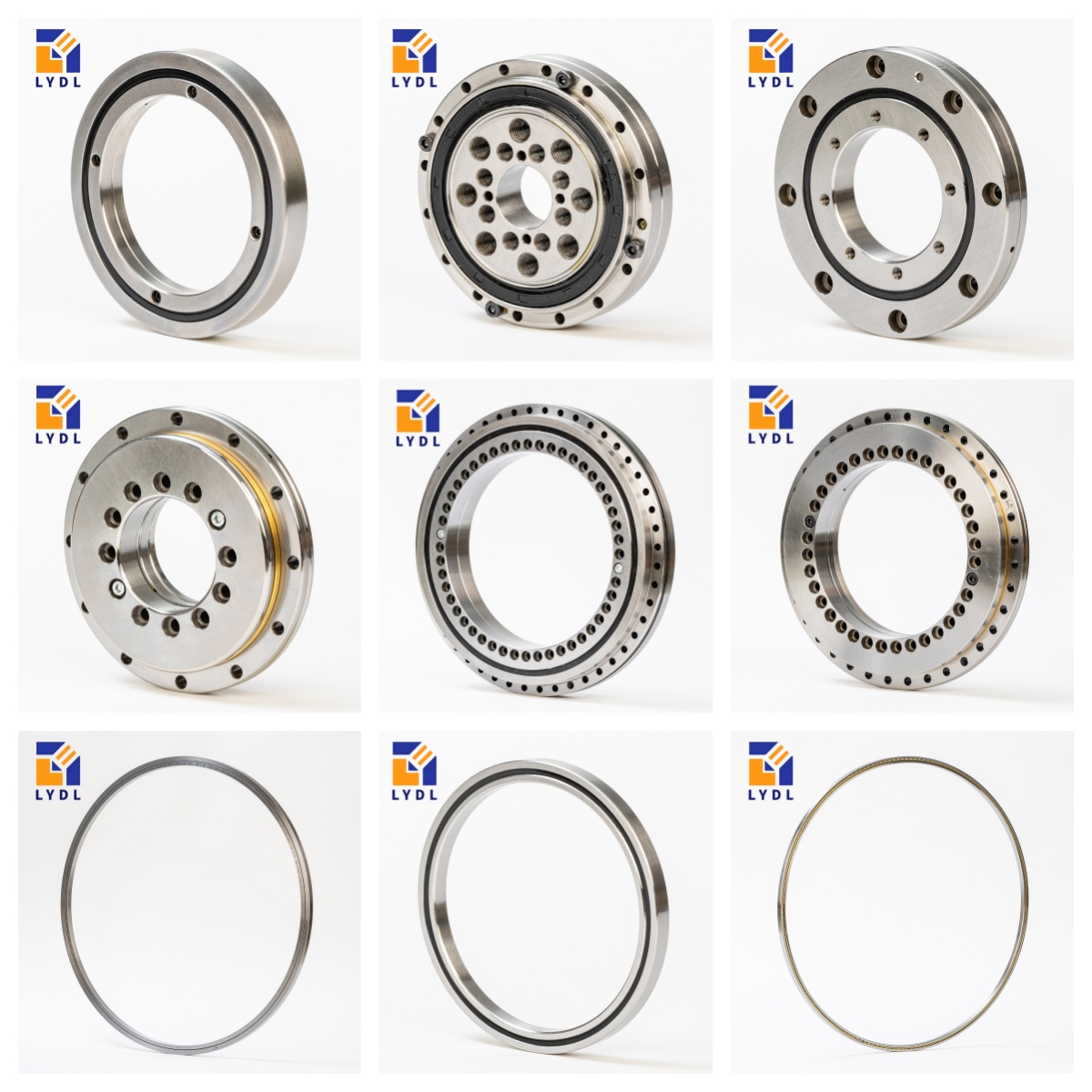
For broader selection guidance, visit LYDL’s Cross Roller Bearing Guide and Cross Roller Bearing Product Range.LYDL RA10008 cross roller bearing inspection and export packaging
Need an RA12008 technical review? Send LYDL your quantity, radial load, axial load, moment load, speed and duty cycle.
Please include the rotating ring, accuracy, clearance or preload, temperature, lubricant, sealing environment and replacement brand.
We will review the RA12008 cross roller bearing configuration and provide a quotation with the controlled drawing.
RA12008 Variants and Suffixes
Suffix meanings can differ between bearing manufacturers. Confirm the complete designation and technical drawing before ordering.
Improves grease retention and contamination protection
RA12008C
Single-split alternative
Structure and availability require drawing confirmation
RA12008CUU
Single-split type with two seals
Confirm sealing drag and required torque
C0
Standard or positive radial clearance
Generally favors lower rotational resistance
CC0
Controlled negative clearance or preload
Improves rigidity but increases mounting sensitivity
P6T / P5T
Specified rotational-accuracy options
Confirm the measured ring and inspection method
P4 / P2 custom
LYDL high-precision option
Requires an approved accuracy and inspection agreement
UU seals can protect the raceways in moderately contaminated environments. Seal contact may increase starting torque.
CC0 preload can improve rigidity and reduce internal movement. Excessive preload can increase torque, temperature and installation sensitivity.
An LYDL RA12008 cross roller bearing should therefore be specified from the actual application rather than from a suffix alone.
Choose the RA10008 Cross Roller Bearing when a 100 mm passage is sufficient, and the machine requires a smaller outside diameter.
Select the RA5008 Cross Roller Bearing when the design requires a 50 * 66 * 8 mm central opening.
All three models have an 8 mm width. Increasing the bore does not eliminate the need to calculate combined load, deflection, and housing rigidity.
Installation and Housing Requirements
The thin rings of the RA12008 cross roller bearing closely follow the shape of the shaft and housing.
Housing roundness, coaxiality, shoulder flatness and cover-plate rigidity can directly affect clearance and rotational torque.
Use 123.5 mm as the maximum shaft-shoulder reference. Use 130.5 mm as the minimum housing-shoulder reference.
Confirm both values against the final LYDL drawing.
Remove burrs and clean all mating surfaces before installation. Do not force the bearing into a distorted or misaligned housing.
Tighten the outer-ring retaining cover gradually in a diagonal sequence. Uniform tightening helps prevent local deformation of the separable outer ring.
After assembly, rotate the inner ring slowly. Check starting torque, running smoothness, noise and runout before connecting the drive.
Higher installed torque can result from:
Uneven outer-ring clamping
Insufficient cover-plate rigidity
Housing roundness error
Misalignment between shaft and housing
Excessive interference
Excessive preload
Contamination or unsuitable grease
These installation factors should be checked before determining that the bearing is defective.
Lubrication and Operating Conditions
Standard RA12008 configurations normally use grease lubrication. Grease selection must match speed, load, temperature and operating environment.
The published −15°C to +80°C range relates to a standard grease configuration. It does not automatically apply to customized grease, seals or materials.
Vacuum, cleanroom, low-temperature and high-temperature applications require separate lubricant and material confirmation.
Open bearings need a clean surrounding enclosure. Sealed versions reduce contamination entry but are not maintenance-free under every operating condition.
LYDL Manufacturing and Quality Control
LYDL controls ring material, heat treatment, raceway grinding, roller sorting, clearance and final inspection according to the approved specification.
Inspection for an RA12008 cross roller bearing can include:
Bore, outside diameter and width
Raceway and surface condition
Radial clearance or preload
Inner-ring rotational runout
Starting and running torque
Noise and rotational smoothness
Seal condition and grease quantity
Product marking and packaging
Material certificates, dimensional reports and running-accuracy records can be supplied when agreed before production.
Because RA12008 weighs only about 0.17 kg, its thin rings must be protected from impact and concentrated packaging pressure.
LYDL uses anti-rust protection and shock-resistant export packaging. The bearing is immobilized to reduce the risk of deformation during transportation.
Interchange and Cross-Reference Guidance
RA12008 and IKO CRBS1208 share nominal boundary dimensions of 120 × 136 × 8 mm.
Their published load ratings are not identical. Internal roller design, clearance, accuracy, seals and lubrication details may also differ.
Matching dimensions alone do not guarantee complete interchangeability.
Before replacement, provide:
Existing manufacturer and complete model number
All suffixes and accuracy requirements
Shaft and housing drawing
Rotating ring
Applied loads and moment
Speed and duty cycle
Lubrication and environmental conditions
LYDL will compare the existing product with the RA12008 cross roller bearing and issue a controlled drawing for approval.
RA12008 Cross Roller Bearing FAQ
1. Does the 120 mm bore make RA12008 suitable for heavy loads?
Not automatically. RA12008 has higher catalogue ratings than RA10008, but it remains an 8 mm-wide thin-section bearing.
Selection must consider combined load, moment arm, housing rigidity and target service life.
2. How much usable clearance remains through the center?
The bearing bore is 120 mm, but the usable machine opening depends on the shaft shoulder, fasteners, cable guides and surrounding structure.
Check the complete assembly drawing rather than assuming the full bore remains unobstructed.
3. Why is housing flatness especially important for RA12008?
The rings are large in diameter but only 8 mm wide. They can follow errors in the mounting surface more easily than a heavier bearing section.
A distorted housing can produce uneven preload, periodic torque and increased runout.
4. Can the outer ring rotate?
RA12008 is normally applied with inner-ring rotation because its outer ring is separable and housing-clamped.
If outer-ring rotation is necessary, compare an integrated-ring RAU design or another suitable structure before final selection.
5. Why is installed torque higher than free-bearing torque?
The most common causes include uneven clamping, housing distortion, excessive interference, incorrect preload and seal friction.
Measure torque after the retaining cover has been tightened to the specified sequence and value.
6. Should I order RA12008UU for a cleanroom mechanism?
UU seals improve grease retention but may generate additional drag and particles from seal contact.
For critical cleanroom equipment, confirm grease, seal material, torque and contamination requirements instead of choosing UU automatically.
7. Can RA12008 replace IKO CRBS1208 directly?
The nominal 120 × 136 × 8 mm dimensions match, but published load ratings and internal configurations differ.
Compare the controlled drawings, clearance, accuracy, seals, lubrication and torque before approving substitution.
8. What information is needed for an accurate quotation?
Provide quantity, load, moment, speed, duty cycle, rotating ring, accuracy, clearance, sealing, lubricant and temperature.
An existing bearing drawing or equipment model will help LYDL complete the technical review more efficiently.
Request an RA12008 Quotation
Send your application data or existing bearing drawing to receive an RA12008 cross roller bearing quotation.
LYDL can review open, sealed, clearance-controlled and customized precision configurations.
Complete technical information allows us to recommend the correct configuration and prepare a traceable drawing without unnecessary revisions.
ISO 492:2023 — geometrical product specifications and radial-bearing tolerances.
Engineering note: Catalogue data support preliminary selection only. Final life, fit, clearance, accuracy and interchangeability require complete application data and an approved LYDL drawing.