


The CRBH6013A cross roller bearing / CRBHV6013A envelope is 60 × 90 × 13 mm. It is a useful comparison when a 50 mm bore no longer provides enough room but the machine has a 13 mm axial bearing allowance. The nominal outside diameter grows with the bore, so the change still requires a larger radial seat.
The IKO reference row lists 18.8 kN dynamic radial rating, 24.3 kN static radial rating and 0.33 kg mass. Treat these as the selected size’s reference data. A design move from 5013A should be checked for fit, life, torque and the surrounding structure rather than approved by the rating increase alone.
The series dimension chart compares the 13 mm profiles; the CRBH / CRBHV category page provides the product-family overview.
Ordering the CRBH6013A / CRBHV6013A cross roller bearing? Send the drawing, the complete replacement reference or the required quantity. LYDL confirms the matched configuration, inspection scope and export terms in the quotation.
| Parameter | Value | Unit |
|---|---|---|
| Bore diameter d | 60 | mm |
| Outside diameter D | 90 | mm |
| Bearing width B | 13 | mm |
| Minimum chamfer rmin | 0.6 | mm |
| Inner-ring shoulder reference da | 66 | mm |
| Outer-ring shoulder reference Da | 84 | mm |
| Basic dynamic radial rating Cr | 18.8 | kN |
| Basic static radial rating C0r | 24.3 | kN |
| Reference bearing mass | 0.33 | kg |
Keeping the 13 mm width does not preserve the 5013A shoulder geometry or reference ratings. The 60 mm bore changes the interfaces around the shaft. Match these dimensions to the LYDL drawing and assess the actual combined load case before choosing the larger profile.
The reference design uses integrated inner and outer rings. For the V option, IKO identifies separators made from POM in the CRBHV family description. A CRBHV6013A requirement should therefore remain visible as a configuration choice, not be hidden behind a generic crossed roller bearing description.
The 60 × 90 × 13 mm dimensions do not settle seal type, clearance or running accuracy. Select these features for the proposed operating conditions, or carry the existing requirements across for an interchangeable replacement. The quotation should identify what is being supplied before the purchase order is released.
Describe temperature and grease compatibility if the bearing is close to a motor or process enclosure. An open configuration and a double-sealed configuration can require different lubrication planning. The same outside diameter does not imply the same torque or maintenance access.
Reference construction: catalogue [1] and product guide [2].
Relative to 5013A, 6013A adds 10 mm to both the bore and outside diameter while keeping 13 mm width. The calculated radial section remains 15 mm. This can preserve the nominal axial bearing slot, but the retainers and the load path need a separate review.
Check the shaft step and housing bore against the new ring diameters. The 66 mm and 84 mm shoulder references replace the 56 mm and 74 mm references of 5013A. Reusing the former retaining flange without assessing contact and clearance can undermine an otherwise straightforward size change.
A larger bore may make internal wiring easier, but calculate the space left after shafts, sleeves and connectors are fitted. Reserve bend clearance for cables if the joint oscillates. An enlarged nominal opening is not automatically an enlarged working passage throughout the complete mechanism.
Compare both the moving parts and the supporting structure after the redesign. A new flange, coupling or shaft can add more inertia than the bearing itself. Evaluate the revised acceleration and duty with those components included rather than considering only the 0.04 kg reference mass increase between the two bearings.
5013A, 6013A and 7013A form a useful dimensional group: each is 13 mm wide with a 15 mm calculated radial section. Their bores are 50, 60 and 70 mm respectively. This grouping helps an engineer organise possible housing changes; it does not make the three references interchangeable with each other.
If fastening the rings directly is more important than preserving the thin slot, compare a mounting-holed RU design. That construction brings its own fixing pattern and larger surrounding envelope. Select the retention strategy before deciding whether the existing housing should be enlarged or redesigned.
| Size reference | Bore d (mm) | OD D (mm) | Width B (mm) |
|---|---|---|---|
| CRBH5013A / CRBHV5013A | 50 | 80 | 13 |
| CRBH7013A / CRBHV7013A | 70 | 100 | 13 |
The RB outer-ring retention concept merits review if adapting a split-ring housing. RU85, 55 × 120 × 15 mm offers fixing holes but loses 5 mm of bore and increases outside diameter, so retaining the 6013A envelope needs a different layout.
Robot joints with a hollow centre: the 60 mm bore can be reviewed where a connector or cable sleeve is becoming difficult to package. Include the complete service route in the assembly section.
Small CNC positioning axes: retain the 13 mm nominal bearing width while assessing the changed radial seat. Add process-force positions to the calculation rather than relying on centred weight.
Electronic assembly modules: identify the required positioning smoothness and lubricant compatibility. A dimensional upgrade may leave the operating environment unchanged but still alter the torque requirement.
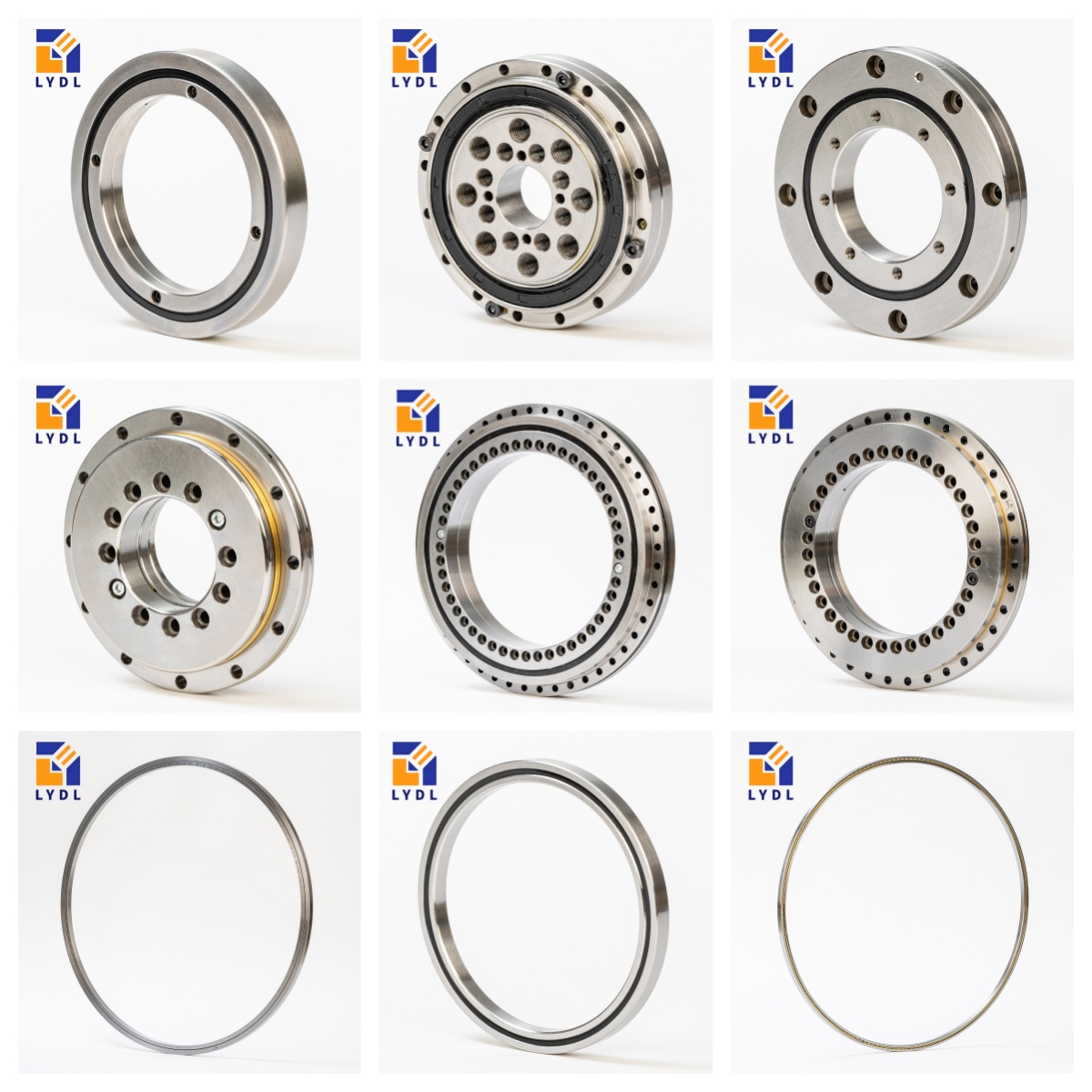
Laboratory rotary carriers: give the sample layout and the repeat motion. The four-scene illustration supports the application discussion without representing a specific supplied device.
Application-family background: reference [3].

For a migrated design, inspection should verify the revised mating components as well as the bearing identity. Record the actual seat, shoulder and retention dimensions on the assembly drawing. This separates a bearing acceptance issue from an interface left over from the previous model.
Define the 60 mm bore, 90 mm outside diameter and 13 mm width as dimensional checks. Where replacement repeatability is important, state the running-accuracy and torque conditions that the original machine requires. Avoid substituting a different test simply because its result is easier to report.
Keep open and sealed units separately identified in protective cartons. Cushion the rings without pressing on vulnerable interfaces and preserve the anti-corrosion protection until assembly. Confirm any outer-crate requirement from the order quantity and route; the 0.33 kg reference mass excludes packaging.

Both nominal widths are 13 mm, but the bore, outside diameter and shoulder arrangement differ. The bearing slot may retain its depth while the shaft, housing and retainers require redesign. Check the complete interface before approving the change.
The reference da and Da dimensions change from 56 and 74 mm to 66 and 84 mm for 6013A. Review the adjoining retaining faces and corner relief against the new drawing rather than carrying over the original flange unquestioned.
No. Sleeves, shafts, connectors and bending motion can use the added space. Verify the passage throughout the assembly and across its travel range. The 60 mm bearing bore describes one opening, not the whole service route.
Yes. Changes to couplings, flanges and shafts alter the moving mass and inertia. Their influence can exceed the difference in bearing mass, so review the complete redesigned axis rather than adjusting the parts list by the bearing change alone.
The comparison clarifies future bore and housing allowances within the same 13 mm width family. It does not mean 7013A should be fitted to a 60 mm seat. Select the reference that matches the intended shaft and available radial space.
Send LYDL the existing 5013A or 6013A assembly section, the reason for changing bore size and the complete replacement specification. Include quantity, target motion, load offsets and receiving-inspection requirements. The quotation can then address the revised size, matched internal configuration, drawing scope and transport packing. Commercial availability and shipment timing are checked for the specific order.
IKO is its owner’s trademark. LYDL supplies its own branded equivalent, matched to the complete reference configuration; the technical comparison does not imply IKO manufacture or endorsement.