

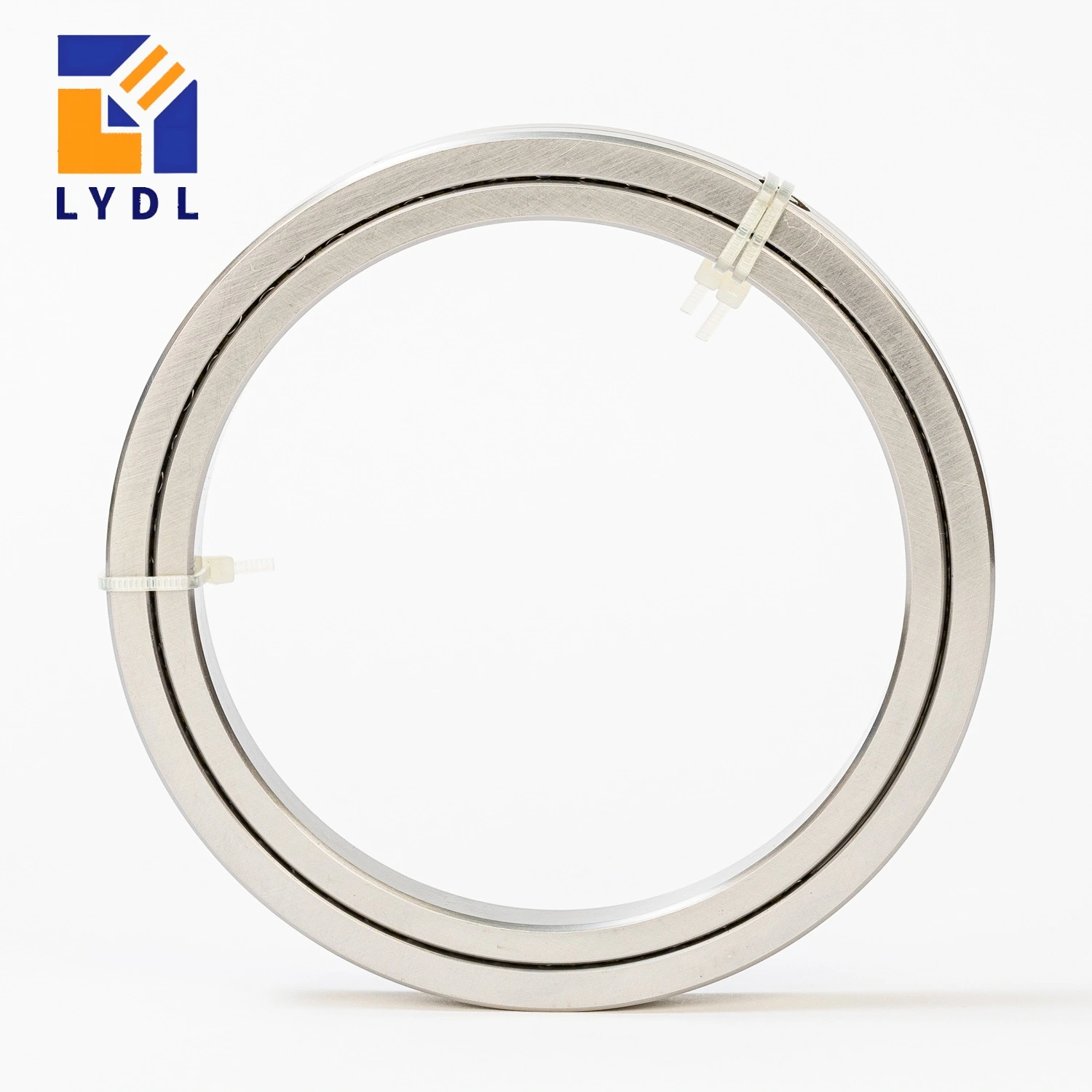

CRBH10020A cross roller bearing and CRBHV10020A use a 100 mm bore, 150 mm outside diameter and 20 mm width. This size is worth reviewing when a positioning axis has outgrown the smaller 13 mm and 16 mm profiles but still needs a compact axial package.
The radial section is 25 mm, calculated from half the difference between the outside diameter and bore. That dimension describes the installation envelope; it does not measure raceway thickness or predict stiffness. The 100 mm central opening can accommodate a shaft, coupling or service passage after allowances for the surrounding hardware have been made.
Compare the full family in the size-selection guide or browse the CRBH / CRBHV category.
Ordering the CRBH10020A / CRBHV10020A cross roller bearing? Send the drawing, the complete replacement reference or the required quantity. LYDL confirms the matched configuration, inspection scope and export terms in the quotation.
| Parameter | Value | Unit |
|---|---|---|
| Bore diameter d | 100 | mm |
| Outside diameter D | 150 | mm |
| Bearing width B | 20 | mm |
| Minimum chamfer rmin | 0.6 | mm |
| Inner-ring shoulder reference da | 110 | mm |
| Outer-ring shoulder reference Da | 140 | mm |
| Basic dynamic radial rating Cr | 50.9 | kN |
| Basic static radial rating C0r | 72.2 | kN |
| Reference bearing mass | 1.45 | kg |
The 50.9 kN and 72.2 kN values belong to separate basic radial rating definitions. Evaluate the platform duty, life requirement and stationary safety case rather than converting either number directly into payload capacity. Use the matched drawing for the supplied interfaces.
The IKO CRBHV10020A catalogue entry provides the reference dimensions and ratings on this page. Its V family employs separators to keep adjacent crossed rollers apart; IKO identifies POM for that family. If the existing machine calls for a CRBH10020A configuration, carry its internal specification into the order instead of changing the reference simply because both sizes fit.
Choose an open arrangement when the assembly provides the intended lubrication and external protection. A double-sealed reference should be discussed where contamination or grease retention makes internal seals useful. Seal drag, lubricant behaviour and preload can influence the motor requirement even though none changes the nominal 100 × 150 × 20 mm boundary dimensions.
For a new machine, state which ring carries the rotating platform and which ring is stationary. Include the permitted radial and axial runout at the actual measurement diameter. This gives the quotation a clear acceptance target and avoids assuming that a precision code alone describes the complete installed axis.
Reference construction: catalogue [1] and product guide [2].
A rotary platform can subject its bearing to several loads at once: component weight, process force, cable pull and overturning moment. Give the load positions as well as their magnitudes. A modest payload far from the centre may create a more demanding moment than a heavier, centrally supported part.
The basic dynamic radial rating is 50.9 kN and the basic static radial rating is 72.2 kN. These are inputs to the appropriate bearing assessment, not simultaneous permissible operating loads. A satisfactory selection also needs the motion cycle, required service life, static safety and mounting stiffness.
The 20 mm bearing width leaves little room for a poorly supported clamping arrangement. Design broad, flat retaining surfaces and check that assembly bolts do not distort the rings. A bearing can meet its dimensional inspection limits while the completed table still develops runout from a flexible plate or uneven tightening.
During drive selection, separate bearing resistance from gearbox loss, seal resistance and cable reaction. Record starting torque and running torque under agreed conditions where they matter to the project. This is particularly useful for direct-drive tables that must make small corrections around their final position.
Compare 8016A if an 80 mm bore is sufficient and a 16 mm width better suits the housing. Compare 12025A when the mechanism requires a 120 mm opening and can accommodate 25 mm width. Neither change is a housing-only substitution: the shoulder arrangement, reference ratings and moving mass also change.
For a different mounting strategy, the RU family provides model-specific fixing holes. Its dimensions should be assessed as a fresh assembly choice rather than borrowed as a direct replacement for 10020A. A dimensioned section through the platform makes this comparison easier than a photograph of the installed bearing.
| Size reference | Bore d (mm) | OD D (mm) | Width B (mm) |
|---|---|---|---|
| CRBH8016A / CRBHV8016A | 80 | 120 | 16 |
| CRBH12025A / CRBHV12025A | 120 | 180 | 25 |
For a platform designed around bearing fixing holes, examine RU124: 80 × 165 × 22 mm. It trades a smaller bore for a different fastening interface. The RU mounting-hole family helps compare that construction before redesigning the table.
Indexing tables: use the 100 mm bore when the rotating fixture needs a central shaft or pneumatic route. Describe locking, dwell time and the forces applied while the table is stationary.
Robot positioners: include the acceleration of the fixture and the changing orientation of its payload. A bearing selected for one pose should be checked across the working sequence.
Semiconductor positioning: specify torque smoothness and cleanliness at the system level. The catalogue size does not by itself establish vacuum service or a particle classification.
Laboratory automation: define the sample carrier, cleaning environment and required repeatability. The application illustration shows typical uses; it is not evidence of a particular customer installation.
Application-family background: reference [3].

For receiving inspection, identify the surfaces used as datums and distinguish bearing-level runout from assembled-platform accuracy. A measurement taken on the customer fixture includes the fixture, shaft and clamping errors as well as the bearing contribution.
Request dimensional results for the 100 mm bore, 150 mm outside diameter and 20 mm width. Add rotation or torque checks only with defined conditions and acceptance limits. A clear inspection plan is more useful than asking for an unspecified precision certificate.
Packing should isolate the machined faces from moisture and movement. A protected individual carton is suitable for identification and handling; larger orders may need a secured outer crate. Count cartons, bearing references and packing weights separately when arranging transport.

The bearing itself is 20 mm wide. The complete installation also needs retaining components, clearances and any external seals. Do not set the housing depth from the bearing width alone; review the full section through the assembled table.
It provides a larger 100 mm bore and a 150 mm outside diameter, with 20 mm rather than 16 mm width. It is a size-selection candidate when more central space is needed, but the load assessment and mounting design must be updated.
Location determines the moment produced around the bearing. The same weight can impose different requirements when placed close to the centre or at the edge of a fixture. Include the working position and any process force in the load description.
A larger motor may overcome resistance, but it does not correct an unsuitable bearing specification or thermal condition. Choose clearance or preload for the required axis behaviour and verify friction before finalising the drive.
Use CRBH10020A or CRBHV10020A together with the required seal, clearance and accuracy information. LYDL’s interchangeable-reference offer is based on a matched specification; keeping those details on the order prevents an unintended configuration change.
For a 10020A quotation, send the platform drawing, complete IKO replacement reference or requested LYDL configuration, quantity and delivery destination. Add the load positions, motion sequence, torque target and inspection conditions. LYDL can review the matched specification and return the agreed product identification, drawing requirements, packing scope and commercial terms. Lead time and stock are confirmed for the actual order.
IKO is its owner’s trademark. LYDL supplies its own branded equivalent, matched to the complete reference configuration; the technical comparison does not imply IKO manufacture or endorsement.