

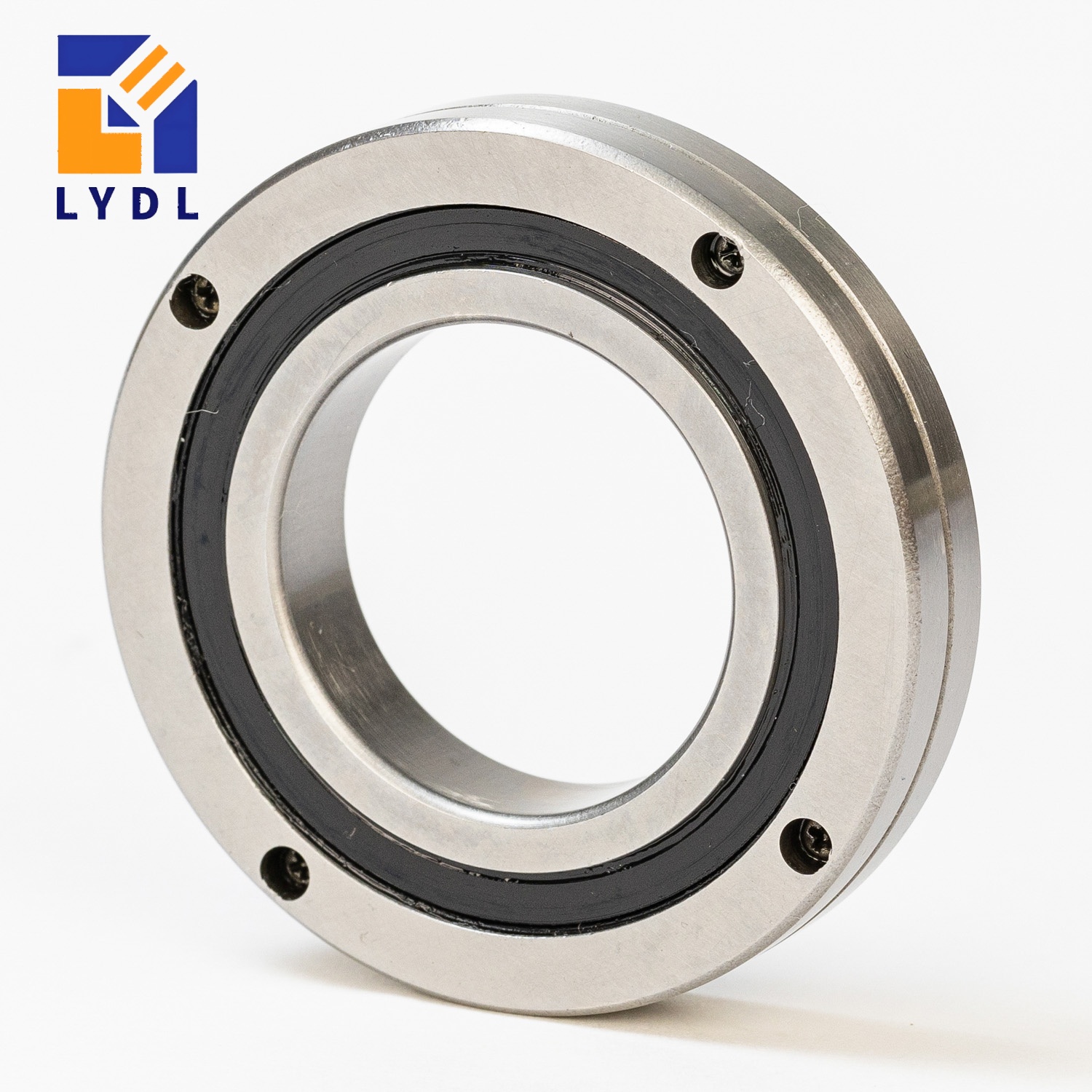
Crossed roller bearing L10 life is calculated from the basic dynamic load rating and the dynamic equivalent radial load using the roller exponent 10/3. For a teaching example using THK RB10016 catalogue data, C = 31.7 kN and an assumed equivalent load of 10 kN give approximately 46.8 million revolutions, or 13,000 operating hours at 60 rpm. This is a statistical rolling-fatigue estimate under stated conditions, not a guaranteed service interval or a complete bearing selection.
The important engineering decision comes before entering the numbers: have you converted the actual radial, axial and moment loads correctly, and have you checked the maximum static load separately? This guide shows the arithmetic, its limitations and the information needed to turn a first estimate into an application review.
What does L10 life actually mean?
L10 is the basic rating life associated with 90% reliability against rolling-contact fatigue for a population of nominally identical bearings operating under the same conditions. It does not mean that each bearing will run for exactly the calculated duration. It also does not describe every failure mechanism: contamination, inadequate lubrication, fretting, corrosion, seal damage and installation errors can end useful service before the calculated fatigue life.
The general rolling-bearing rating-life framework is addressed by ISO 281. For the crossed roller ring discussed here, THK’s nominal-life guidance defines C on a one-million-revolution basis and uses a dynamic equivalent radial load. Do not mix this rotational rating basis with linear crossed roller guide ratings expressed in kilometres.
Use the roller formula, then convert revolutions to hours
L10 [revolutions] = (C / P)10/3 × 106
L10h [hours] = L10 / (60 × n)
| Symbol | Meaning | Input rule |
|---|---|---|
| C | Basic dynamic radial load rating | Use the applicable manufacturer’s value for the actual bearing configuration. |
| P | Dynamic equivalent radial load | Use the manufacturer’s combined-load method, not payload weight alone. |
| n | Rotational speed in rpm | The simple hours conversion assumes continuous rotary motion at this speed. |
| 10/3 | Roller-bearing life exponent | The corresponding basic formula for ball bearings uses 3 instead. |
C and P must use the same force unit. A ratio formed with C in kN and P in N is wrong by a factor of 1,000 before the exponent is applied. If L10 is recorded as a number of million revolutions, multiply that number by one million before converting to hours.
Worked RB10016 example: about 13,000 hours
The THK RB dimensional table, page A18-24, lists RB10016 with dimensions 100 × 140 × 16 mm, C = 31.7 kN and C0 = 48.6 kN. These are THK catalogue reference values for this calculation. They are not a LYDL test result or a transferable rating guarantee for every bearing carrying the RB10016 designation.
Assume that a separate load assessment has already established P = 10 kN, and assume n = 60 rpm. The example uses the unmodified basic rating-life equation; it does not incorporate preload, temperature or application load factors. The assumed speed is not an approval for continuous operation of a particular supplied configuration.
- Calculate the rating-to-load ratio: 31.7 / 10 = 3.17.
- Apply the roller exponent: 3.1710/3 = 46.7948.
- Convert to revolutions: L10 = 46.7948 × 10⁶ revolutions.
- Convert to hours: 46,794,794 / (60 × 60) = 12,998.6 hours.
The rounded result is 46.8 million revolutions and 13,000 operating hours. Expressing this as calendar years requires a defined operating schedule. Even then, it remains a fatigue-life estimate rather than a maintenance or warranty promise.
Why halving equivalent load changes life by about ten times
If P falls from 10 kN to 5 kN while C and the other assumptions remain unchanged, the calculated life multiplier is 210/3 = 10.0794. This sensitivity can justify investigating load paths before ordering a higher precision grade.
| Dynamic equivalent load P | L10, million revolutions | L10h, operating hours | Relative basic life |
|---|---|---|---|
| 10 kN | 46.795 | 12,999 | 1.00 |
| 5 kN | 471.662 | 131,017 | 10.08 |
This does not mean that halving the payload necessarily halves P. An overhung tool, acceleration torque, axial load and the bearing’s roller pitch circle can change the equivalent load differently. Check whether moving a load closer to the support reduces the governing moment. Compare the resulting P values before comparing life. A higher accuracy grade alone does not establish a higher dynamic load rating or longer fatigue life.
Check static safety separately: P0 is not automatically P
fs = C0 / P0, where P0 is the static equivalent radial load for the maximum relevant load case, including peak forces and moments. Use the corresponding manufacturer’s static-load conversion. Dynamic and static equivalent-load coefficients can differ.
THK’s crossed roller ring guidance gives minimum reference factors of 2 without vibration or impact and 5 with vibration or impact. Its accompanying note recommends 7 or above when considering dynamic performance such as service life. These are manufacturer-specific selection guidelines, not a universal acceptance rule for all crossed roller bearings.
For illustration only, if a separate static calculation gives P0 = 10 kN, the THK reference C0 gives fs = 48.6 / 10 = 4.86. That exceeds the reference minimum of 2, but is below 5 and below the additional recommendation of 7. A satisfactory basic L10 number therefore cannot, by itself, approve the bearing for an impact-loaded machine. Do not assume P0 = 10 kN merely because the dynamic example used P = 10 kN.
Four checks that a basic L10 number cannot complete
| Check | What to establish | Decision affected |
|---|---|---|
| Combined loads and duty spectrum | Radial force, axial force, overturning moment, load direction, speed and duration for each operating stage; separate peak cases | Applicable dynamic equivalent load and static safety calculation |
| Preload and torque | Supplied preload or clearance, assembly effects, starting and running torque requirements | Internal loading and thermal suitability; external-load arithmetic alone is insufficient |
| Mounting and load path | Shaft and housing fits, shoulder geometry, flange and bolt support, mounting-face accuracy | Whether the installed bearing can achieve the assumed loading conditions |
| Lubrication and environment | Grease or oil, temperature, sealing, contamination and motion pattern | Whether fatigue is likely to govern useful service at all |
For varying loads, do not use a simple arithmetic average and insert it into the nonlinear life equation. Establish a duty spectrum and use an applicable manufacturer-approved equivalent-load or damage-accumulation method. Keep emergency stops and other peak cases visible for the static check.
Compare RB and RU mounting arrangements to define the load path. Still choosing a family? Review rotary table bearing types and use the selected design’s rating method.
Can the same rpm formula be used for oscillating bearings?
Not directly. A joint swinging through an angle and returning is not making one full revolution per cycle. An oscillatory-life calculation needs the angle convention, cycles per minute and load over the motion. Even a correct travel conversion does not resolve lubrication problems at small oscillation angles.
THK’s rotary and oscillatory guidance warns that small-angle motion can hinder oil-film formation and cause fretting, and directs users to consult it for reciprocating or low-speed service. Treat a small-angle indexing or robot-joint application as a separate engineering review, not as continuous rotation with an invented rpm.
How to apply this calculation to a LYDL enquiry
Use the crossed roller bearing range to identify the candidate series, then confirm the rating basis and supplied configuration. The LYDL RB10016 product page lists selection reference data; the applicable load ratings and operating conditions for the quoted supply should be confirmed in the technical agreement. This article’s worked calculation remains explicitly based on the cited THK values.
For structure and series context, see the cross roller bearing guide. If RB10016 is under consideration, use the RB10016 preload ordering checklist to define clearance, preload and inspection requirements rather than assuming that a suffix settles every operating condition.
Frequently asked questions
Does 13,000 hours mean the bearing must be replaced at that time?
No. It is the basic rating-life result for the stated example, not an inspection interval. Maintenance decisions also depend on lubrication, contamination, condition monitoring, machine criticality and the supplier’s operating instructions.
Can I substitute a ball-bearing exponent of 3?
No. The basic crossed roller ring calculation here uses 10/3. Keeping the same C and P but changing the exponent produces a different model and an incorrect result for this example.
Can I use the same rating for any RB10016 bearing?
No. A model designation and matching envelope do not establish identical internal geometry, rating basis, preload or operating suitability across suppliers. Confirm the applicable rating and configuration with the supplier.
Send the load spectrum, not just a target lifetime
Contact LYDL for an application review with the following information. Include units and identify whether each value is measured, calculated or assumed.
| Input | What to send |
|---|---|
| Candidate bearing | Series, size, drawing revision, rotating ring, clearance or preload, seals |
| Load spectrum | Radial and axial forces, overturning moments, directions, lever arms and duration for each stage |
| Motion | Rotary rpm or oscillation angle and cycle rate, acceleration, dwell and emergency-stop cases |
| Installation and environment | Shaft, housing and flange drawings; temperature, lubrication and contamination conditions |
| Acceptance target | Required operating hours and reliability basis, static safety requirement, allowable torque and accuracy |
With these inputs, the review can distinguish a load-path problem, a peak-load limitation and a lubrication constraint before selecting a different size or accuracy grade.


