

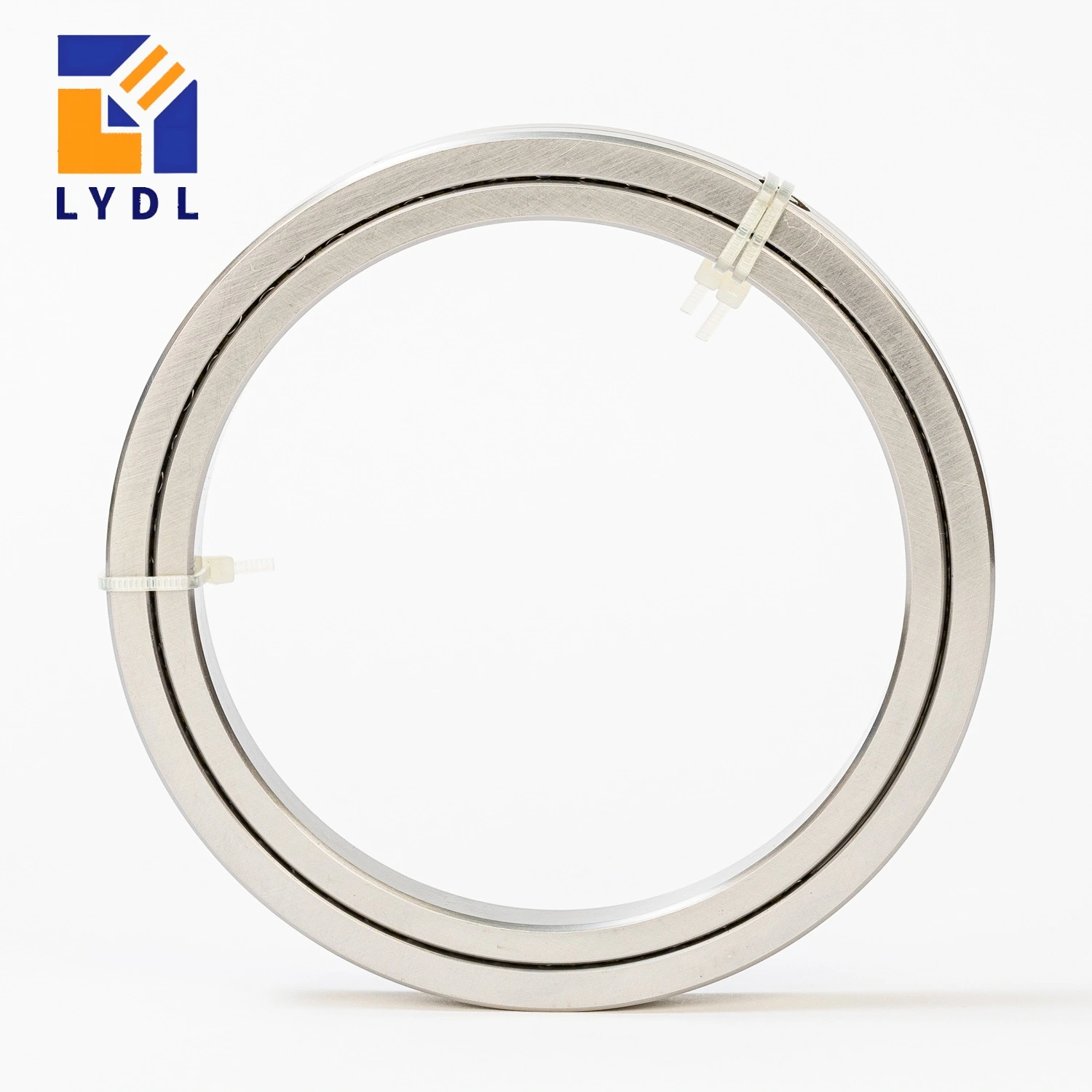
Keeping an existing housing when changing between CRBH and RU requires a complete drawing comparison. Both reference families can have integral inner and outer rings, so ring integrity alone does not establish a compatible mounting. Compare the locating seats, support contacts, retention, fixing holes, screw access and complete operating requirements before treating the change as a replacement.
This guide addresses an existing machine whose shaft, housing or output interface may need to remain unchanged. It focuses on deciding whether the proposal is a direct replacement, an adaptation or a redesign; it does not rank the two families by an unsupported universal performance claim.
Understand the reference construction without merging model families
LYDL's CRBH/CRBHV selection table describes integral-ring reference constructions. The RU range uses integral rings with fixing holes for direct attachment.
The practical question is how each supplied ring connects to the machine. An integral ring can still need surrounding locating and retaining components. It is not a synonym for a particular bolt pattern or a guarantee that a separate housing can be removed.
IKO's current crossed roller range lists CRBHV and mounting-hole designs such as CRBFV separately. Keep the full reference on the drawing rather than combining features from different product entries. Technical reference: IKO crossed roller range
If the general architecture is still open, the RB versus RU guide explains the split-ring/direct-fixing comparison. A CRBH-to-RU review adds a different issue: similar ring-integrity descriptions can conceal substantially different machine interfaces.
Classify what the replacement is allowed to change
Before comparing catalogue values, define the design boundary.
| Change class | What is intended | Evidence needed |
|---|---|---|
| Direct replacement | Existing mating parts and acceptance requirements remain | Complete dimensional, configuration and performance match |
| Adapted installation | Some sleeves, retainers, plates or fasteners may change | Revised drawing and assessment of the affected load path |
| Redesigned bearing position | Support architecture or axis package changes | Complete layout, operating and acceptance review |
An adaptation can be a valid engineering solution. It should simply be identified and assessed as an adaptation rather than described as a drop-in replacement.
Ask which interfaces are fixed: the bearing seat, output flange, drive coupling, base attachment or service route. If every surrounding part must remain, the candidate has to meet that constraint; a convenient catalogue description does not remove it.
Check all three boundary dimensions
For an example of why the full envelope matters, compare these published LYDL entries:
| Reference | Bore | Outside diameter | Width |
|---|---|---|---|
| CRBH10020A / CRBHV10020A entry | 100 mm | 150 mm | 20 mm |
| RU124 | 80 mm | 165 mm | 22 mm |
Sources: CRBH10020A/CRBHV10020A entry and RU124 entry.
These are not presented as equivalent-capacity alternatives. They demonstrate that a seemingly compact integrated-ring proposal can fail several existing interfaces at once. The RU124 envelope cannot simply be inserted into a fixed 100 × 150 × 20 mm bearing position.
Do not generalise that example into a claim that no other suitable size exists. Identify another actual candidate if necessary and repeat the drawing comparison.
Map location, support and retention separately
Mark each function on the original assembly section.
Location: identify the shaft and housing surfaces that position the rings. Include shoulders, corner radii, chamfers and the relevant fit requirements.
Support: identify the intended contact faces and the structure that receives the bearing reactions. Check whether the proposed ring is supported where its drawing requires support.
Retention: identify which parts keep the rings secured axially and how the joint is assembled. A locating diameter does not automatically provide adequate retention, and a fixing screw does not automatically establish accurate location.
For each function, mark whether the proposed bearing can use the existing feature or needs a revised part. This produces a concrete machining and inspection list instead of a vague statement that the housing should fit.
Review the screw path when direct fixing is proposed
A directly fixed RU arrangement introduces specific fixing circles, hole details and tool-access requirements. Review both rings and the complete fastener path.
Check:
- Which component contains the working thread.
- Screw entry direction and head seating.
- Usable thread engagement and clearance behind the screw end.
- Access after adjacent parts are installed.
- Clearance to the ring or part that must rotate.
- The approved tightening method for the joint.
For RU124, confirm the applicable standard, G or X mounting arrangement against the supplied drawing. Do not assume a screw selected for a through-hole arrangement is appropriate for a threaded-ring version.
Direct fixing changes the surrounding component design; it does not eliminate the need for suitable support, location and a verified joint.

Keep CRBH and CRBHV configuration details explicit
A combined size table can make catalogue comparison easier while leaving internal configuration unresolved. LYDL's CRBH/CRBHV page specifically calls for the separator configuration to be confirmed on the quotation and drawing.
Carry the complete replacement reference into the enquiry. Do not infer that every suffix has one universal material meaning across suppliers, or that one entry's performance values automatically apply to another configuration with the same envelope.
In particular, distinguish:
| Configuration item | Question to settle |
|---|---|
| Complete reference | Which exact existing and proposed bearing is being compared? |
| Separator/internal construction | What does the matching documentation specify? |
| Seals and lubricant | What is supplied and what operating condition is required? |
| Clearance/preload | What definition and reference condition apply? |
| Accuracy | Which ring and features are controlled? |
| Ratings | Which data belong to the actual proposed supply? |
Public comparison codes help identify references. They are not a declaration of original-brand supply, affiliation or automatic interchangeability.
Recheck performance after the interface review
An envelope match is necessary for a direct replacement, but it is not sufficient. Review the actual combined loads, load positions, motion cycle, permitted displacement and rotational resistance.
Changing the support or retaining arrangement can change installed behaviour even when the bearing itself has an appropriate specification. Compare the completed proposals with the same functional requirements.
Keep running accuracy, loaded displacement and drive torque separate. A higher accuracy grade does not establish the resistance of the mounted axis or compensate for an unsuitable supporting plate.
Also identify the reason for replacement. A bearing change intended to address unusual resistance should include a mounting investigation; otherwise, the original installation issue may remain. A change intended to improve availability still needs the interface and operating checks, even when the machine performed acceptably before.
Plan the first-article inspection
For an adapted or redesigned installation, agree on the checks that connect the component to the completed axis.
| Inspection stage | Record |
|---|---|
| Before assembly | Bearing identity, drawing, mating-part features and intended configuration |
| After mounting | Supported condition, fixing record, defined runout and resistance |
| With drive/accessories | Connected components and completed-axis behaviour |
| Under required duty | Relevant load, motion and thermal conditions |
Use agreed limits for the features and states being inspected. A photograph or video can document a setup, while the method, conditions and results should remain in readable records.
This is a proposed inspection structure, not a claim that the comparison has already been tested on an LYDL customer machine.
Common replacement questions
Can integral rings be used as proof that CRBH and RU mount the same way?
No. Ring construction and the fixing interface describe different aspects of the bearing. Compare the complete drawings and the surrounding support arrangement.
Can I keep the housing by adding a sleeve or adapter?
An adaptation may be possible, but the revised geometry, support, fixation, load path and acceptance requirements need engineering review. It should not be described as direct interchangeability.
Is a matching catalogue envelope enough to order a substitute?
Include the internal configuration, seals, lubricant, clearance/preload, accuracy and applicable operating data. Those requirements can differ even where boundary dimensions match.
Send LYDL the existing and proposed interfaces
Provide the original bearing reference, assembly section, fixed interfaces and reason for the change. Add the loads, motion cycle and the requirements that must remain satisfied.
Review the CRBH/CRBHV range and RU range, then contact LYDL about the mounting conversion. A marked interface comparison helps define whether the next step is a matched replacement drawing, an adaptation or a new bearing-position design.


